Scarica Grammatica Inglese: Tempi Verbali e Strutture e più Schemi e mappe concettuali in PDF di Lingua Inglese solo su Docsity!
ARGOMENTI DA RIPASSARE PER LA GRAMMATICA B
TEMPI VERBALI:
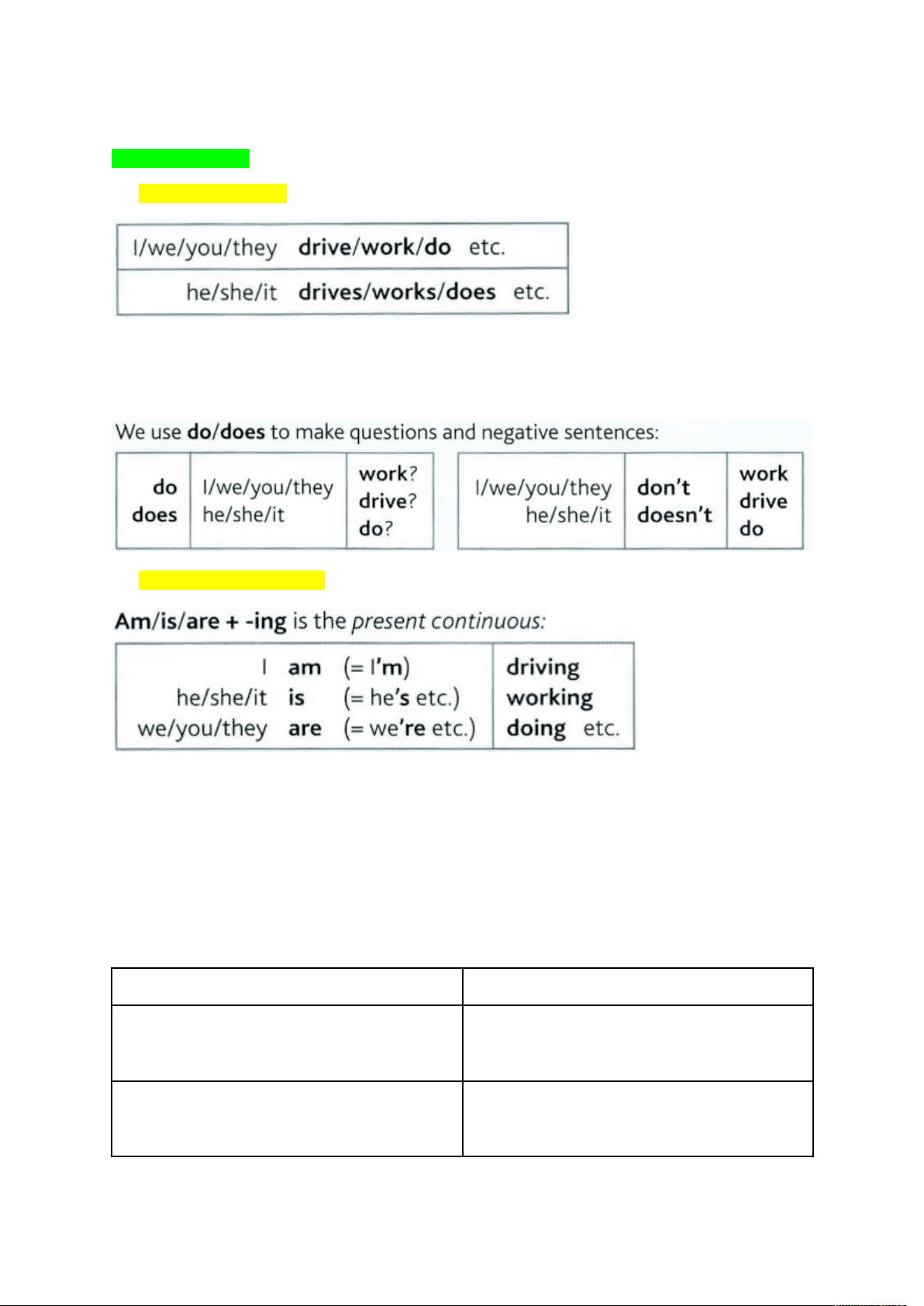
- present simple We use the present simple to talk about things in general. We use it to say that something happens all the time or repeatedly/ or that something is true in general. We use the present simple to say how often we do things
- present continuous I am doing something = I'm in the middle of doing it; I've started doing it and I haven't finished. You can use the present continuous with today I this week I this year et c. Sometimes the action is not happening at the time of speaking. Some more examples: Kate wants to work in Italy, so she's Learning Italian. (but perhaps she isn't learning Italian at the time of speaking) Present continuous (I am doing) Present simple (I do) We use the continuous for things happening at or around the time of speaking. The action is not complete. We use the simple for things in general or things that happen repeatedly. We use the continuous for temporary situations: I'm Living with some friends until I find a place of my own. We use the simple for permanent situations: My parents Live in London. They have lived there all their lives. We use continuous forms for actions and happenings that have started but not finished (they are eating I it is raining etc.). Some verbs (for example, know and Like) are not normally used
in this way. We don't say 'I am knowing' or 'they are liking'; we say 'I know', 'they Like'.
- past simple
- past continuous stavo facendo qualcosa e nel mentre è successo qualcos’altro.
- present perfect The present perfect simple is have/has+ past participle. The past participle often ends in -ed (finished/decided etc.), but many important verbs are irregular (Lost/done/written etc.). When we say that 'something has happened', this is usually new information. When we use the present perfect, there is a connection with now. The action in the past has a result now: 'Where's your key?' 'I don't know. I've Lost it.' (=I don't have it now) You can use the present perfect with just, already and yet. just = a short time ago: We use already to say that something happened sooner than expected Yet = until now. Yet shows that the speaker is expecting something to happen. Use yet only in
Il present perfect continuous si riferisce a un periodo non definito del passato compreso tra 'prima di adesso' e 'adesso'. La persona che parla sta pensando a qualcosa che è stato iniziato, ma che forse non è ancora terminato, in quel determinato periodo di tempo. La persona è interessata sia al processo che al risultato; il processo dell'azione potrebbe essere ancora in corso o potrebbe essersi appena completato. We use the present perfect continuous for an activity that has recently stopped or just stopped. There is a connection with now. Azioni iniziate nel passato e che continuano nel presente I've been working on this report since eight o'clock this morning (= e non l'ho ancora terminato). They have been travelling since last October (= e non sono ancora tornati a casa). Azioni appena completate, ma quello che interessa è il risultato She has been cooking since last night (= e il cibo sulla tavola ha un aspetto delizioso). Someone's been eating my chips (= e ne è sparita la metà). present perfect continuous / present perfect simple We use the continuous to say how long (for something that is still happening) We use the simple to say how much, how many or how many times.
FOR e SINCE
- past perfect continuous Sogg + had + forma base in ing Funzioni del past perfect continuous You can say that something had been happening for a period of time before something else happened. Il past perfect continuous si riferisce ad un’azione in svolgimento e terminata prima di un’altra azione/evento nel passato. Ad esempio: I’d been looking for a job for several months when I found this position
- would+infinitive per parlare di abitudine al passato "Would" può essere usato per parlare di cose che accadevano regolarmente nel passato. Questo uso è piuttosto formale e letterario, quindi non è molto comune nel linguaggio colloquiale.
- When I was a child, my grandmother would take us to the park every Sunday ➡Quando
- present simple e present continuous con valore futuro Il present simple viene scelto per parlare di eventi nel futuro la cui programmazione non dipende da te. Questa costruzione è accompagnata da espressioni di tempo che specificano il giorno, il momento o l’orario in cui tale evento è previsto. We use the present simple when we talk about timetables, programmes etc. (for public transport, cinemas etc.). You can use the present simple to talk about people if their plans are fixed like a timetable. Per esempio:
- The film starts at 9:00 pm. (Il film segue una programmazione che non hai deciso tu)
- The train leaves at 6:30 am. (Il treno parte con o senza di te!) Il present simple assume valore di futuro in inglese anche nelle frasi con when , while, before, until e così via. Ad esempio: When you meet Susan, tell her I still play tennis. I'm doing something (tomorrow) = I have already decided and arranged to do it You can also use the present continuous for an action just before you begin to do it. This happens especially with verbs of movement (go/come/Leave etc.): ~ I'm tired. I'm going to bed now. Good night. (not I go to bed now)
- going to… We use I am doing (present continuous) when we say what we have arranged to do- for example, arranged to meet somebody, arranged to go somewhere. I am going to do something= I've decided to do it (but perhaps not arranged to do it). You can also say that ~something is going to happen' in the future. I was going to do something= I intended to do it, but didn't do it
- future continuous = I will be in the middle of doing it: Compare will be-ing with other continuous forms:
- At 10 o'clock yesterday, Sally was in her office. She was working. (past)
- it's 10 o'clock now. She is in her office. She is working. (present)
- At 10 o'clock tomorrow, she will be in her office. She will be working.
We also use will be-ing to talk about complete actions in the future. Funzioni del future continuous Il future continuous si riferisce a un'azione o a un evento che sarà in corso di svolgimento nel futuro. Il future continuous viene utilizzato per esprimere diversi concetti. Il future continuous per proiettarsi nel futuro. Esempi:
- This time next week I will be sun-bathing in Bali.
- By Christmas I will be skiing like a pro.
- Just think, next Monday you will be working in your new job. Il future continuous per fare supposizioni su ciò che accadrà nel futuro. Esempi: - He'll be coming _to the meeting, I expect.
- I guess_ you'll be feeling thirsty after working in the sun. - You'll be missing the sunshine once you're back in England. Nelle frasi interrogative, il future continuous per chiedere, in modo molto educato, un'informazione sul futuro. Esempi: - Will you be bringing your friend to the pub tonight? - Will Jim be coming with us? - Will she be going to the party tonight? - Will I be sleeping in this room? Il future continuous per parlare di eventi continuativi che si prevede si verificheranno nel futuro. Esempi: _- I'll be seeing Jim at the conference next week.
- When he is in Australia_ he will be staying with friends.
- I'll be eating with Jane this evening so I can tell her.
- future perfect simple e progressive subject + will + have + verb
CONDIZIONALE : di tipo 0, 1, 2 e 3 (possibilità irrealizzabile)
- 0° CONDIZIONALE (Zero Conditional) Usato per esprimere fatti generali, verità universali o situazioni sempre vere quando una condizione è soddisfatta. Struttura: If + present simple, present simple Esempio: If you heat water, it boils. (Se riscaldi l'acqua, bolle.) - 1° CONDIZIONALE (First Conditional) Usato per parlare di situazioni reali o possibili nel futuro, legate a una condizione. Struttura: If + present simple, will + base verb Esempio: If it rains, we will stay at home. (Se piove, staremo a casa.) - 2° CONDIZIONALE (Second Conditional) Usato per situazioni ipotetiche o improbabili nel presente o nel futuro. Struttura: If + past simple, would + base verb Esempio: If I were rich, I would travel the world. (Se fossi ricco, viaggerei per il mondo.) - 3° CONDIZIONALE (Third Conditional) Usato per parlare di situazioni ipotetiche o impossibili nel passato, spesso con rimpianto. Struttura: If + past perfect, would have + past participle Esempio: If I had studied harder, I would have passed the exam. (Se avessi studiato di più, avrei passato l'esame.) PROPOSIZIONI RELATIVE + relative incisive + pronomi relativi: Le proposizioni relative in inglese servono a fornire informazioni aggiuntive su un sostantivo (persona, oggetto, luogo, ecc.) nella frase. Queste proposizioni sono introdotte dai pronomi relativi, che collegano la proposizione relativa al resto della frase. I pronomi relativi:
1. Who: si usa per persone (soggetto). The girl who is singing is my sister. (La ragazza che sta cantando è mia sorella.) 2. Whom: si usa per persone (complemento oggetto), soprattutto in contesti formali. The man whom I saw was very kind. (L'uomo che ho visto era molto gentile.) 3. Whose: indica possesso (persone o cose). The boy whose dog is barking lives next door. (Il ragazzo il cui cane sta abbaiando vive accanto.) 4. Which: si usa per cose o animali (soggetto o complemento). The book which I read was fascinating. (Il libro che ho letto era affascinante.) 5. That: si usa per persone, cose o animali in proposizioni determinative (vedi sotto). The car that he bought is very expensive. (L'auto che ha comprato è molto costosa.) **Altri pronomi e avverbi relativi
- Where:** si usa per luoghi. The house where I was born in Italy. (La casa dove sono nato è in Italia.) 2. When: si usa per momenti o periodi di tempo. The day when we met was unforgettable. (Il giorno in cui ci siamo incontrati è stato indimenticabile.) 3. Why: si usa per motivi o ragioni. The reason why he left is unclear. (La ragione per cui è partito non è chiara.) PHRASAL VERBS: I phrasal verbs sono combinazioni di un verbo base con una preposizione o un avverbio (o entrambi) che formano un’espressione con un significato spesso diverso da quello letterale del verbo principale. Sono molto comuni in inglese e spesso possono creare confusione per chi sta imparando la lingua. **Tipi di phrasal verbs:
- Phrasal Verbs con significato letterale:** Quando il significato è chiaro e corrisponde al significato delle singole parole. Stand up (alzarsi). Sit down (sedersi). 2. Phrasal Verbs con significato idiomatico: Quando il significato non è letterale, ma figurato o idiomatico. Break down (guastarsi, crollare emotivamente); Give up (arrendersi) We often use verbs with the following words: in, on, up, away, by, about, over, round, or, around, I, out, off, down, back, through, along, forward.
VERBI + GERUNDIO(azione abituale) o INFINITO(azione occasionale): In inglese, alcuni verbi richiedono un gerundio (forma in -ing) dopo di loro, mentre altri richiedono un infinito (to + base verbale).
1. Verbi seguiti dal gerundio (-ing) Questi verbi si usano con il gerundio quando il verbo successivo agisce come un sostantivo (azione generale o abitudine). Esempi di verbi seguiti da gerundio: - Enjoy (godere) → I enjoy reading books. - Avoid (evitare) → She avoids talking to strangers. - Finish (finire) → We finished eating dinner. - Keep (continuare) → He keeps making the same mistake. - Consider (considerare) → They are considering moving abroad. Regola pratica : il gerundio è spesso usato dopo verbi che indicano piacere, abitudine o evitamento. 2. Verbi seguiti dall'infinito (to + base verbale) L'infinito è usato per esprimere intenzioni, decisioni o qualcosa che deve accadere in futuro. Esempi di verbi seguiti dall'infinito: - Decide (decidere) → She decided to go home. - Want (volere) → I want to learn Spanish. - Promise (promettere) → He promised to help me. - Try (provare) → We’ll try to fix it. - Need (avere bisogno) → I need to call my parents. Regola pratica: l’infinito segue verbi che indicano intenzioni, desideri o scelte. DISCORSI INDIRETTI: Si usa il reported speech (noto anche come discorso indiretto, indirect speech) per dire a qualcuno cosa ha detto un'altra persona senza usare le sue esatte parole. She said she was coming to class. (Ha detto che sarebbe venuta a lezione.) Quali sono le regole? Negli esempi che seguono si notano due cambiamenti:
- Discorso diretto: “ I am happy to drive you to the airport.” (" Sono felice di accompagnarla all'aeroporto”)
- Discorso riferito o indiretto: “She said she was happy to drive me to the airport.” ("Ha detto che era felice di accompagnarmi all'aeroporto”) In primo luogo, cambiano i pronomi personali, in relazione alla persona che sta parlando. Cambia anche il tempo del verbo, rispetto al momento attuale. Questo di solito comporta il
cambiamento del tempo verbale, ad esempio dal present simple al past simple, come nell'esempio precedente. Come cambiano i tempi verbali da diretto ad indiretto? alcuni esempi:
- present simple (diretto)- past simple (indiretto)
- present continuous(diretto)- past continuous (indiretto)
- present perfect (diretto)- past perfect (indiretto)
- will (diretto) - would (indiretto) FRASI CON L’IMPERSONALE: L'uso dell'impersonale in inglese serve a esprimere un'idea o un concetto generale, senza riferirsi a una persona specifica. Ecco come funziona: 1. Uso del soggetto generico "you": In inglese, si usa spesso "you" per riferirsi in modo generico a chiunque, senza indicare una persona specifica. È simile al "si" impersonale italiano. Esempio: Italiano: "In Italia si mangia bene." Inglese: "In Italy, you eat well." (Non si sta parlando di una persona specifica, ma di un concetto generale.) 2. Uso di "one": Il pronome "one" è più formale e significa "chiunque" o "si" in italiano. Si usa in contesti accademici o formali. Esempio: Italiano: "Quando si viaggia, si imparano molte cose." Inglese: "When one travels, one learns a lot." 3. Frasi passive: La forma passiva viene spesso usata per creare una costruzione impersonale, specialmente quando non si vuole o non si può specificare chi compie l'azione. Esempio: Italiano: "Si dice che lui sia molto ricco." Inglese: "It is said that he is very rich." 4. Uso di "it": Il pronome "it" viene utilizzato per espressioni impersonali, spesso legate a tempo, distanza o situazioni. Esempio: Italiano: "È importante studiare." Inglese: "It is important to study." 5. Costruzioni con "people" o "they" : A volte si usano "people" o "they" per riferirsi a gruppi indefiniti. Esempio: Italiano: "Dicono che il tempo cambierà." Inglese: "They say the weather will change." ORDINE SINTATTICO: in particolare gli aggettivi descrittivi seguono questo ordine
- dimensioni
ADJECTIVE
We use adjectives after be / get / become / seem : Be careful! Many adverbs are formed from an adjective+ -Ly Good is an adjective. The adverb is well : Your English is good. but You speak English well We use SO + adjective/adverb: so stupid / so quick We use SUCH + noun: such a story / such people We also use such +adjective +noun: such a stupid story / such nice people ENOUGH goes after adjectives and adverbs: Enough normally goes before nouns Quite / pretty / rather / fairly = less than 'very' but more than 'a little' AS Some more examples of not AS ... (as): jack isn't as old as he looks. (= he looks older than he is) LESS ... than is similar to not as ... as: I spent Less money than you. We say the SAME AS (not the same like): Laura's salary is the same as mine. As= at the same time as You can use as when two things happen at the same time. Or you can say that something happened as you were doing something else. just as (=exactly at that moment) such as (=for example) As also means I because' Compare as and when:
- We use as only if two things happen at the same time.
- Use when (not as) if one thing happens after another. COMPARATIVE AND SUPERLATIVE comparative →-er per le parole piccole o more per quelle più grandi (+ than) good/well →better bad/badly →worse far →further (or farther) We repeat comparatives ( better and bette r etc.) to say that something changes continuously: Your English is improving. lt's getting better and better. You can say the (sooner/bigger/more etc.) the better: what time shall we leave?' The sooner the better.' (=as soon as possible) You can use ELDER (or older) when you talk about people in a family.
superlative →-est for short words and most ... for longer words. A few adjectives are irregular: good →best bad →worst far →furthest/farthest AT / ON / IN We use: AT for the time of day at five o'clock at 11.45 at midnight at lunchtime at sunset etc. ON for days and dates on Friday, on 16 May 2009 on Christmas Day on my birthday IN for longer periods (for example: months/years/seasons) in October in 1998 We use BY in many expressions to say how we do something. send something by post contact somebody by phone/by email We also say that something happens by mistake / by accident / by chance You cannot use by if you say my car / the train / a taxi etc. We say: by car but in my car (not by my car)