Scarica Inglese per la comunicazione - Appunti e slide e più Appunti in PDF di Comunicazione Internazionale solo su Docsity!
INGLESE PER LA COMUNICAZIONE
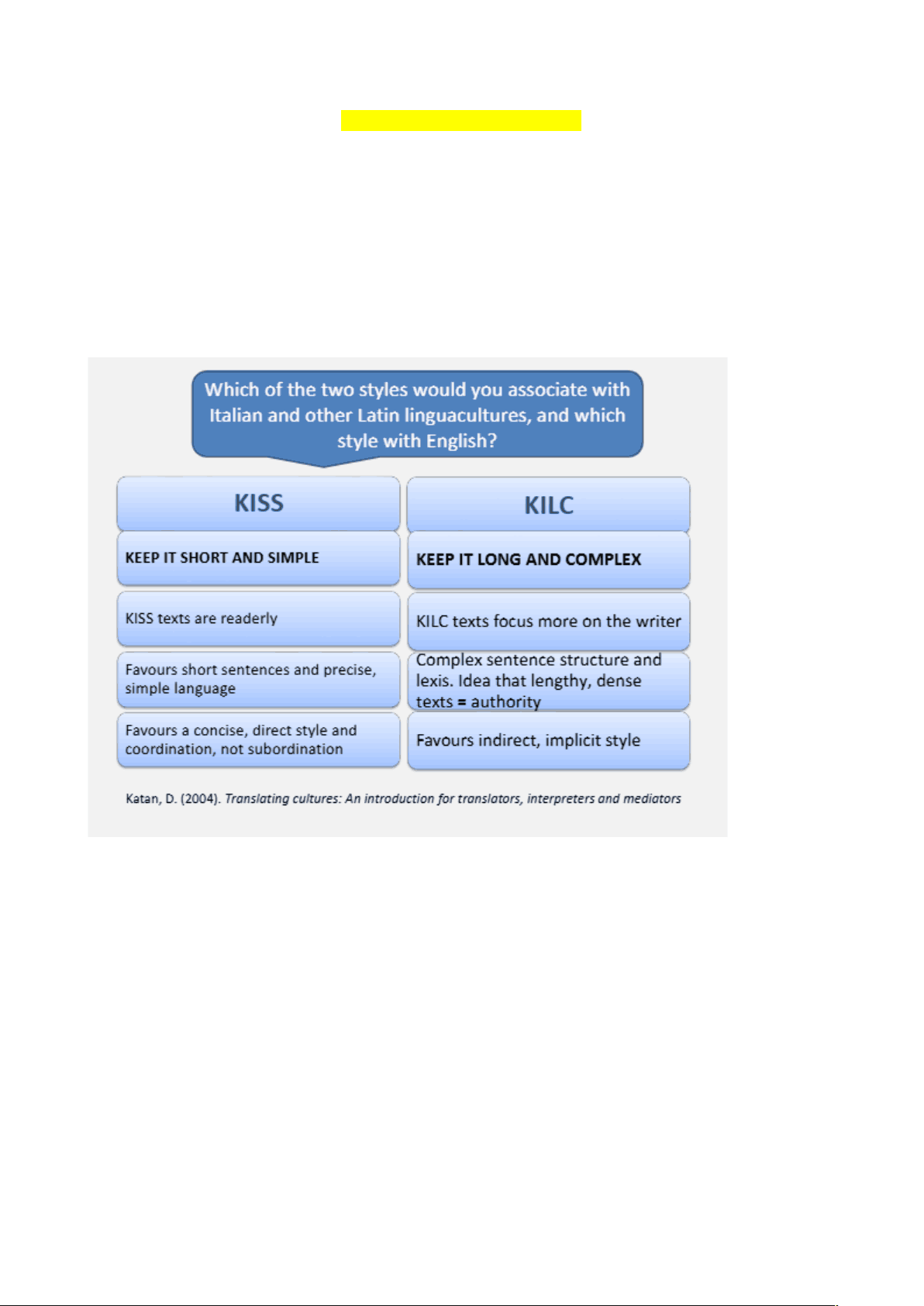
WEEK 1 Thomas Hirschhorn, a swiss artist, thinks that in every moment of our lives we are bombarded with lots of information over saturation; this could lead to becoming immune, and sometimes we tend to live automatically and not think of a reason why we’re acting in a certain way. How does the communication process work? To answer this question, we refer to media consumption patterns. English is a lingua franca : this means that it’s used to communicate in countries where you’re unfamiliar with the local language, we can refer to it as a “contact language”, but also in different contexts online and offline. The way we sometimes are asked to write in English varies in comparison with how we’re asked to write in Italian. English’s writing style is KISS: Keep It Short and Simple. It’s important to pay attention if the message is delivered clearly and coherently. In KISS it’s essential to cut out information that is not crucial. I need to consider the level of knowledge my audience already has, and that is going to determine whether the information I’m about to deliver is going to be comprehended by them or not KISS favours short sentences, but that does not automatically mean that all the sentences must be of the same length. When we talk about precision, that could mean that the introduction to a certain topic will be highly descriptive when making descriptions, the writer needs to stay focused on not repeating the same words multiple times. Another writing style, which is associated with the Italian language, is KILC: Keep it Long and Complex. In Italian culture, a text produced in this writing style is more widely appreciated: Italian academic essays are often complicated and many people can’t get past the introduction. It is often required to read it more than once to truly understand the meaning of the text. English is more direct, the publications need to be concise: that assures clarity, unambiguity and directness. For English speakers, this style of writing conveys sincerity.
What can we say about the role of English in Italian advertising? There’s a lot going of behind mere words layout, subject, positioning of the words in the foreground, colours, visuals… The man in the Boggi adv is elegant, but with a more modern hairstyle. In fashion campaigns monotone colours are preferred, not the ones which are bright and saturated: in this case, the choice black and white suggests there is a link between the modern gentleman and the traditional past. The Diesel adv stupid has a negative connotation; the sentence is played juxtaposing “there is” to “there could be”. Could opens up a sea of possibilities. Diesel is a brand known for provocative advs the brand is telling us to be stupid.
Semiology wants to identify the factors that contribute to the way in which meaning is made in the act of mediation – how the content of media messages mean what they do. The sign is the basic unit of communication systems. It consists of two indivisible aspects, signifier and signified: Signifier refers to the physical properties or aspects of a sign that lead them to be perceived in some way (words, images, etc.) Signified refers to the conceptual aspect of the sign – the idea(s) conjured up by our perception of the signifier. Important: there’s no arbitrariness of language within systems of signification; it’s only apparent and operates thanks to socio-cultural conventions. Example: are you more of a cat person or a dog person? This question is a sign. When we look for example at a cat not only the immediate meaning matters (biologic features of the animal), there’s also an additional social meaning. If a person tells us they prefer one over the other, it might give us some insight on their personality. DENOTATION AND CONNOTATION (Roland Barthes’ Terminology) Denotation : it’s the literal primary meaning that the sign represents Connotation : the abstract meaning which triggers further associations Different interpretations of the same text are possible thanks to the encoding and decoding procedures that people do (Stuart Hall, Umberto Eco). Media texts offer many opportunities for polysemia (= “many readings”). Advertising is often played on different connotations. Example: picture of a letter N, we have been socialized to associate this particular letter in this style with the famous streaming platform Netflix (Net: abbreviated form from Internet + flix: slang for movie) Umberto Eco is the one who coined this term: codes, he says that the text producer chooses a code to communicate with by encoding the message preferred meaning to the text, the aim is to control as much as possible to contain the possibility of other meaning surfacing. The risk is that the decoder decodes the message in a different way from the one the encoder had intended media producers want to avoid this. MEDIA SIGNS Signs are subjected to processes of selection and combination to create meaning. The choices are influenced by the up goal= what we want to communicate and how we want to communicate it. The organization of signs in texts:
- combination impacts on the connotations of a text and can have a range of effects on the interpretation of signs
- the combination of signs can challenge the associations we make
- Valentin Volosinov: meanings are subjected to challenge + they are not fixed. They can change based on the reader’s culture etc… ! REMEMBER : in looking at modern mass media, we could extend the semiological approach in order to identify the signs in, and signifying practices of computer games, TV programmes , podcasts, magazine articles, adverts and pieces of music or films.
CASE STUDY: THE ECONOMIST
1. What recommendations does this part of the guide make? This guide recommends the journalist to use the language of everyday speech to make the article easier to read, to avoid euphemisms and circumlocutions promoted by intergroups. A journalist should also pay attention to phrase sentences in a way which is not offensive to women, but without being excessively complicated (and also, get rid of “ugly expressions” such as chairpersons, humankind…). Also, it is preferable for the journalist to avoid being too didactic. 2. How should a journalist treat readers? The journalist should encourage them to continue reading their article, without acting arrogant or showing a superiority complex. Readers should be persuaded with reasoning, demonstrations, the journalist has the
duty to accompany them throughout the reading, preferably by using a friendly tone. Overall, readers are to be treated with respect.
3. Based on what you have read, how would you describe The Economist’s style overall? The style of The Economist prioritises the point of view of the readers. It’s accessible, enriched by expressions which come from everyday speech, but also straightforward House Style – a definition The expression house style refers to the specific usage and editing conventions followed by writers and editors to ensure stylistic consistency in a particular publication or series of publications (newspapers, magazines, journals, websites, books). House-style guides (also known as style sheets or stylebooks) typically provide rules on such matters as abbreviations, capital letters, numbers, date formats, citations, spelling and terms of address. WHAT IS A CASE STUDY? A case study is a close-up examination of a subject of study and its related contextual conditions. It Illustrates a theory or principle and includes references. Case studies are usually used in research in the social sciences and by business, marketing, communications and brand strategy professionals. Structure : begins with background and context; explains examples and different points of view; finally, sums up main ideas and discusses implications MEDIA REPRESENTATION (Re- : to do something again) Re-present: my point of view has shifted, I describe, depict something again, but in a different way. It often suggests the representation of a certain side in a story. It also means to symbolise, to be a specimen of or to substitute for + to present again. Therefore, any form of representation can’t provide a full, complete picture of what is being represented: all representations are ‘ selective abstractions’ of a messy reality and are worthy of investigation due to their distinct link to social contexts. Ex : Media producers, reporters: each of them represents a different media broadcaster. All of them share a desire to represent the truth, but each of them recognises in their own way that it’s not possible to represent all the sides of a story. Ex : BBC News video. The video features comments from actual journalists – feeling of not having the big picture. Without historical context (ex Russia v Ukraine) the events are simply violence and horror, that’s why context helps to anchor meaning. Keep in mind: seeking to bear witness to events. Be accurate. Be fair. No propaganda, no nonsense, no fake news. STEREOTYPE AND ARCHETYPE They are all a part of TYPIFICATION. Typification is a form of shorthand in which individuals are defined by what they represent (in terms of appearance, status, behaviours, beliefs, etc) rather than for their unique qualities as individuals. ARCHETYPE : an archetype is a ‘perfect’ or idealised person or thing that exhibits certain core values and identities that offer a model or pattern for the way in which cultures are viewed. In a way, it is something that we take for granted. Ex. The Royal family could be viewed as the perfect family model. They are represented as happy, joyful, playful + they are staying outdoors, conveying an idea of activity and energy. It’s a positive image for people that have grown up in a similar situation, and actually these people who align don’t even question the meaning of these pictures. STEREOTYPE : a stereotype is, instead, a form of cultural shorthand, reducing the complexity of an individual, group or situation to a familiar and quickly understood and defining set of attributes. Stereotypes are widely used in media to communicate: we’re not emphasizing the uniqueness of the individual, but some characteristics which can be quickly recognized and understood by the public (because they reflect shared cultural ideas of the majority). It is more limiting than archetyping but is not necessarily negative. It is important to remember that stereotypes (like archetypes) are constructed and not natural. They are successful because they are usually based on a ‘ grain of truth ’ ( Tessa Perkins), even when
CELEBRITIES, PERSONALITIES AND THE CONSTRUCTION OF THE IMAGE
- Stars, Personalities, Celebrities : it is often said that we live in a “ celebrity culture ”. Media stars must be understood primarily as commodities ‘produced’ by media companies for consumption by audiences that will lead to profit. ‘ Actors become stars when their off-screen lifestyles and personalities equal or surpass acting ability in importance ’ (Gledhill, 1991) It now seems that one no longer has to be famous for something at all – one can just ‘be’ a celebrity. In short, all we know of the star is their image. We must analyse stars not as real people but as signs and texts: this means that they represent ideas, values, or social meanings beyond just who they are. People who appear in media—like actors, singers, characters, celebrities—carry meaning with them. That meaning is both denotative and connotative These meanings are used (deployed) in media texts (films, ads, shows, etc.). At the same time, people perform roles in these media (as actors, celebrities, etc.) and take on different meanings depending on the context. CONSTRUCTION OF THE IMAGE A star’s image is made out of a range of primary and secondary elements:
- Primary elements in the construction of any image – the primary texts – are the films, videos, songs, TV programmes and so on of a star’s portfolio
- Secondary materials (e.g., posters, badges, T-shirts, web pages) consist of those generated by the process of promotion and the deliberate textual construction of record companies, film studios, PR departments or fan clubs. In addition, there is also ‘publicity’, i.e. material that is not – or doesn’t seem to be – the result of deliberate manipulation or occasionally intention. On the one hand a star must be ‘ typical’ in some way. On the other hand, if the star is too ordinary , they are no longer special enough to be a star. What does “Stardom” represent? The elevation of stars and celebrities tells us a great deal about society and how media are regarded and understood. In media (whether in front of the camera—like actors or presenters—or behind the scenes—like directors, editors, producers), the language and storytelling often hide the fact that it’s a team effort. Instead, the media tends to focus on and glorify certain individuals, such as a famous actor, a well-known director, or a star journalist. This gives the illusion that these individuals are the most important, while ignoring the many people who also contribute. This “hierarchy” is reinforced by many structures, both inside media institutions (like production companies, studios, newsrooms) and outside (like marketing, awards, or celebrity culture). When talking about the validation of the individual in society in general, of all the pop stars, news reporters, actors, voice-over artists, and indeed ‘celebrities’, who are available to the media, some are deemed to be more valuable than others.
CASE STUDY: GRAZIA MAGAZINE COVER
How does the use of Gowribalan’s picture on the magazine’s cover work rhetorically? She is an ordinary woman in her late 20s, early 30s. Stereotypically, based on how she’s dressed people could associate her with being a nurse rather than a doctor. It’s written in the cover, she’s an intensive care doctor: it’s a hard job. The title “From the Frontline” contains an alliteration and a metaphor (“frontline” associated with war). “We’re putting ourselves in danger…” they’re not using the present simple, which could convey an idea of neutrality, but the present continuous which emphasizes the circumstances. The “We” is collective, inclusive. Usually, when we see danger we try to avoid it + “please help us help you” there’s a repetition and they’re using the first-person plural pronoun, it’s nothing abstract. The editors are prioritizing openness and directness. In addition, the “please” is important: without it the cover wouldn’t have been as effective, people don’t like to be told what to do. They’re asking nicely.
What other topics are reported on the cover? How are they linked and combined within the overall focus of the magazine? Also on the cover: the potential reader scans the columns to look for topics that interest him. Here, on the right we have celebrities, such as Megan and Harry and Kim Kardashian. On the left there are the ordinary topics instead. What is the meaning of Gowribalan’s body language? She looks relaxed, confident. The way she’s looking at the camera’s lens, it’s like she’s staring at every one of us. Plus, she doesn’t look tired. Her arms are gently crossed, in a professional and friendly manner. Which colors are used and why? The blue she’s wearing is linked to an idea of calmness and friendliness. In contrast then we have black, yellow and white alternated in the different stories in the straplines. They are rather serious colours, reflecting or mediating the tone of the topic Stereotypically, Asians are considered to be academically strong.
TYPES OF NEWSPAPERS
- the TABLOID (or “popular”): the language is playful but also biased. They condense stories into a simplified, easily absorbed format. The topics are the ones which are trending (crime stories, celebrity gossip, television, astrology...). In 1901,"tabloid journalism" originally meant a paper that condensed stories into a simplified, easily absorbed format. Characteristics : Emphasis on human interest stories (scandals, gossip, celebrities) Easier to read Traditionally A3 size Vocabulary more limited Simple sentence structure Short paragraphs Large headlines Lots of images Less text Tend to be politically very biased
- the BROADSHEET (or “quality”): it’s called like this because they used to be broad. They have a more intellectual approach and tend to use their greater size to publish stories in which they explore the topics more in depth. It’s broad because it contains a lot of topics which interest a bigger portion of the public. Characteristics : Emphasis on serious, in-depth reporting on a wide range of issues Gives impression of objective and accurate reporting More difficult to read Traditionally A2 size More complex language Less obvious headlines Less images More text Tend to avoid ‘crude’ bias The differences are not only in the structure and content, but also in the readership. The readership of the TABLOID tends to be the traditionally working class, consisting of less well-educated people who are looking for a condensed analysis of the issue. Therefore, the tabloid has a higher circulation and a lower cost. On the other hand the BROADSHEET is read by the traditionally middle and upper classes, consisting of educated people who are looking for an in-depth analysis of an issue. It has a lower circulation but higher cost. ! REMEMBER : Although these traditional distinctions between the economic and social classes of readers have become increasingly blurred, advertisers still target different markets when they ‘buy space’ in a
France’s most popular news program on the TF1 channel for six weeks, filling in for Patrick Poivre d’Arvor. Why did his new role attract attention? He attracted attention because he was one of the few Black presenters with an important role on French television. His presence made people aware of issues of racial representation in the French media, to the point that Roselmack was featured on newspapers like Le Parisien. Even international media like The New York Times discussed how Black people in France were not represented adequately both socially and politically. According to the case study, did French media workers in 2006 reflect the make-up (composition) of French society? Why/why not? No, French media workers did not reflect the composition of French society. The black population was estimated at five million people, but only a few were featured in visible and important contexts such as politics or media channels. Do you think the ethnicity, gender, and sexuality of media workers could ‘bias’ media content? I personally agree with this affirmation because I feel like personal experiences influence the way a person talks and reports. A lack of diversity in media can lead to biased coverage, underrepresentation, or stereotypical descriptions of certain groups. It’s imperative to include the different points of view of people who have had particular life experiences based on their ethnicity and heritage. HEADLINES They are not written by journalists but by sub-editors. Behind a headline there’s a range of strategies that fit with the publication’s market and objectives. A tabloid headline will often induce anger, fear or concern A broadsheet headline may use cultural references or puns to capture the reader’s attention without relying on ‘affect’ to do so. Typical features:
- Omission of words : we don’t want to have an entire sentence as a headline, it’s better to omit words which aren’t necessary. Function words (articles, pronouns, auxiliaries, titles etc) are removed in place of content words (nouns, lexical verbs, adjectives). As a result, the Headline is stronger and more eye-catching
- Use of short, sensational and economical “loaded” words in order to convey meaning and draw the reader in. It’s helpful to create connotations.
- Noun phrases in subject position, as they are incisive, effective and economical. Structure: modifier + modifier + head word; basically, one modifier adds more information to the head word and the other has an adjectival function, but they’re all nouns.
- Nominalisation. It permits a noun to be used instead of a verb a noun phrase is more abstract – a concept with connotations, while a verb phrase is simply an action/act that is not complete of itself. Nominalized forms can be used as nouns which can be placed in different positions in the sentence
- Verbs forms : the preferred form is usually the present simple (instead of the past simple or present perfect). It gives a sense of immediacy, of something that is happening right now. For the passive voice it’s common to use the past participle (with the auxiliary omitted or in present tense), and the future is expressed using the infinitive to + verb.
- Gimmicks and Rhetorical devices ( PAGE 3)* EXAMPLES: “Off! Off! Off!” (sports analogy) “Kate’s stout and about” (=Kate’s out and about) “Horror snorey” (= horror story) Word plays “Bear the brunt” “positive phone call” “skies safe” Alliteration “Mutiny at BBC over Lineker red card” Euphemism “PM” Metonymy What to look for when you’re analysing a headline?
- Lexical verb choices and verb tenses
- Lexical word choices (nouns, adjectives)
- Use of pronouns
- Use of adverbs
- Data or figures
- Alliteration and assonance
- Metaphoric imagery
- Metonymy
- Any other rhetorical device NEWS MEDIA – DIGITAL: MAIN FEATURES A NEW MODEL OF NEWS PRODUCTION AND DISSEMINATION
- More news sources (academics, freelance journalists, local witnesses, ‘interested others’, etc.)
- A more active reader/participant (interactive)
- Writing, sound, image and video integrated in single textual space ( multimodality )
- Bite-size chunks of information in unbounded quantity PRINT VS DIGITAL
- In print media, the headline consists of communication in just a few words, but interpretation may require knowledge of cultural references and/or of the broader political context Headlines may include alliteration, word plays, rhyme or cultural references. The story follows the ‘Inverted Pyramid’ format
- In digital media, the headline functions in a similar way but may be more precise - it should be ‘clickable’ More so than in print, web headlines must be short as people tend to read less online and may be reading on a hand-held device with just a few moments to spare. Web headlines must contain key topic words in order to be ‘searchable’ (SEO). !! In digital media, people’s style of reading is called SCANNING. It's when people look over a website or text for things that interest them. Overall, web headlines are:
- Very concise
- Front-loaded , meaning the most important keywords are placed at the beginning
- Less likely to use idioms and word play and more likely to use a straightforward summary of the article in (on average) just FIVE words
- Designed with search engines in mind. People scan a list of results quickly. The web headline generally makes the content very predictable ‘ SEO’ About news on digital platforms in general:
- There is no limit to the amount of content that can be provided online
- Content is organized and presented in a hierarchical order based on its newsworthiness (e.g. recency and immediacy)
- Interactive (user-producer-opinion-comment-surveys)
- Audio and audio-visual material support or replace written news items
- Easy to up-date 24/
- Data tracking Writing online:
- A special form of ‘print-English’
- Writing for a small screen (mobile, tablet, computer)
- Supported by visual material (images, video)
- Concise (short sentences, short paragraphs, short texts, links to more stories on same topic)
- Language not figurative but ‘searchable’
- Personal (first-hand account, pov, easy to read)
- Follows the inverted pyramid writing style
- 24/7 reporting (constantly updating) BIAS & MEDIA REPRESENTATION What is bias? Bias is both a noun and a verb (adjective = biased). It means giving more (or less) representation to one
- Negative – it has negative implications
- Novel – it is unexpected, novel, or bizarre
- Celebrated – celebrities and VIPs
- Geographic proximity – close to home
- Cultural proximity – event/people share common cultural values making it more meaningful despite distance
- Attributable – it can be attributed to a ‘respectable’ or ‘authoritative’ source
- Factual – higher the level of facticity (names, places, statistics, numbers, etc)
- Numerical – greater the number of the affected, the bigger the news ('reach’)
- Personal – the more personalized the event
- Relevant – it connects the readers’ lives Reach = the number of persons taking part in an event or being affected by an event:
- Zero reach : no persons are directly affected
- Low reach : single persons or small groups are affected
- Medium reach : social categories such as employers or interest groups are affected, for example, bankers, managers, students, citizens of cities or regions, workers and foreigners
- High reach : all citizens of a country or other nations, society or the state are affected News Sources
- Direct coverage by journalists who monitor ‘proven sources of the news’ (political institutions, police & other emergency services, law courts, royalty, annual events, etc)
- Witnesses describe event to journalists who report it
- Investigation of event by journalist/team
- News agencies (Reuters, Press Association)
- Press releases (large companies, organisations, political institutions, emergency services, individuals)
- Press conferences (Q’n’As / Announcement to press)
- Collaborative Journalism
INVERTED PYRAMID STRUCTURE
It sets out how a newspaper report is a) written, and b) read (usually). The Pyramid represents the newspaper’s readership for a particular article,
100% look at headline 80% look at first sentence of article (lede/lead) 5% actually read the article. LEAD : gives all of the important points of the story (the 5Ws). WHY? Because not all readers might read to the end. Sub-editors may delete some text to make article fit into a given space. After the lead and body, each subsequent paragraph of text is a stand-alone item or satellite (a self-contained unit) that can be ‘easily’ deleted without changing or affecting the meaning of the article as the paragraphs are not chronological or otherwise dependent on each other for their meaning. Rather they are each directly connected to the nucleus (ie the headline and lede). What are the advantages?
- Improves comprehension : Readers can quickly form a mental model and a general understanding of the article, making it easier to understand the details that follow
- Encourages scrolling : This structure can encourage scrolling by engaging the audience with the main point, and drawing them into the details that follow
- Supports readers who skim : Readers can stop reading at any point on the page and still come away with the main point What are the challenges?
- To be competitive you need to be fast but comprehensive
- With unlimited space, a challenge to know what to include (writer => editor)
- Need to be able to ’tie together’ different angles of the story, pictures, graphics, video and audio content
- Must update a developing story in few words and in real time (competing with speed of social media) SO, HOW TO WRITE ONLINE?
- Keep it short and simple
- Use lots of breaks in your text (1 idea 1 paragraph)
- Keep sentences (syntax) clear and simple
- Avoid unnecessary repetition
- Use language easily understood by everyone
- Use bullet points to summary detailed facts or figures
- Highlight key information visually (e.g.: using bold)
- Rather than write one long story, break it into sub-stories with clear links
- Check spelling and punctuation before you publish (affects your credibility!) ! The new tools of the “writable web” enable social media and interactivity online, but there’s also an underlying human desire to share, participate and make things together CONNECTIVITY , Audiences are PROD USERS (Alex Bruns, producer + user, distinctions have faded together). Newspapers are mainly concerned with people and tend to report abstract issues through the people involved. PRESS RELEASE written by the company/media team/PR people – written by those who have a vested interest in the story’s positive evaluation in the press. Can ultimately assist funding and further research etc.
LANGUAGE OF ADVERTISING
KEY TERMS :
MARKETING : the process of identifying consumer needs, market opportunities and producing products and services in order to generate a profit PUBLIC RELATIONS : the management of communication between organisations and the public ADVERTISING : a form of communication designed to generate awareness of products, services and organizations. Its purpose is to persuade people to purchase, subscribe to or consume a particular brand, product, service or organization What is advertising? ‘an instrument, an economic tool used in marketing’ ‘a socio-cultural institution, one that in a market-based society takes on the tasks of “persuading” but also
therefore is a sign of affluence, a function of enjoyment and modern leisure, something related to individualism, a form of liberation, a way for fulfilling needs, etc. To consume is to belong, to confirm one’s place in the wider social system, a mode of conformity.
- What is a brand? The term ‘brand’ itself originated many centuries ago in the Old English word brandr , meaning ‘to burn’. A brand is an identifying symbol, mark, logo, name, word, and/or sentence that companies use to distinguish their product from others (a combination of one or more of those elements can be utilized to create a brand identity) a brand is a benchmark of quality that may reflect the trustworthiness of the brand as a guarantor of quality. Brands are much more than product identifiers: they permeate and influence our identity and make-up. Advertisers and marketers are the storytellers, the dream makers […] the mythmakers. In semiotic terms, they naturalise the relationship between signifiers and signifieds for given strategic goals. Legal protection given to a brand name is called a trademark. The purposes of advertising : to persuade, amuse, inform, misinform, worry, warn. ! While advertisements are not necessarily about selling a product – some are asking people to donate money, vote for a political party or take medical tests, they are all united in wanting to ‘ influence’ the behaviour of consumers. The language of advertising:
- Informal, colloquial language, personal pronouns
- Short sentences or phrases (easy to repeat/recall, SVO)
- Simple syntax
- Imperative form =>‘Think Different’, or direct address: ‘Because You’re Worth It’. dynamic action verbs, modal. They suggest inward and outward progress.
- Unusual or stylish or experimental word choices
- ‘Shape’ words and ‘Tactile’ words: poetic devices (sounds/images/words) make not only for more meaningful texts but more entertaining texts. The emphasis is often on pleasure.
- Adjectives can apply to any number of features: size, colour, shape, formula, etc (“trigger words”) adjectival compound phrases, onomatopoeic imagery.
- Neologisms – newly coined for an advert, they may not enter into the general English language or indeed have any value in Standard English at all.
- alliteration, assonance, onomatopoeia, rhyme
- puns
- punctuation for emphasis
- paradoxes and oppositions !!! SLOGANS & TAGLINES Often made up of very few words: these words have an intrinsic value (meaning of the words themselves) => Look at the verbs/nouns/pronouns They are often intertextual , that is, referring to other, pre-existing texts – written or visual - or aspects of culture. Their life can be extended by social network sites!