Scarica Schemi tempi verbali e più Schemi e mappe concettuali in PDF di Lingua Inglese solo su Docsity!
Past
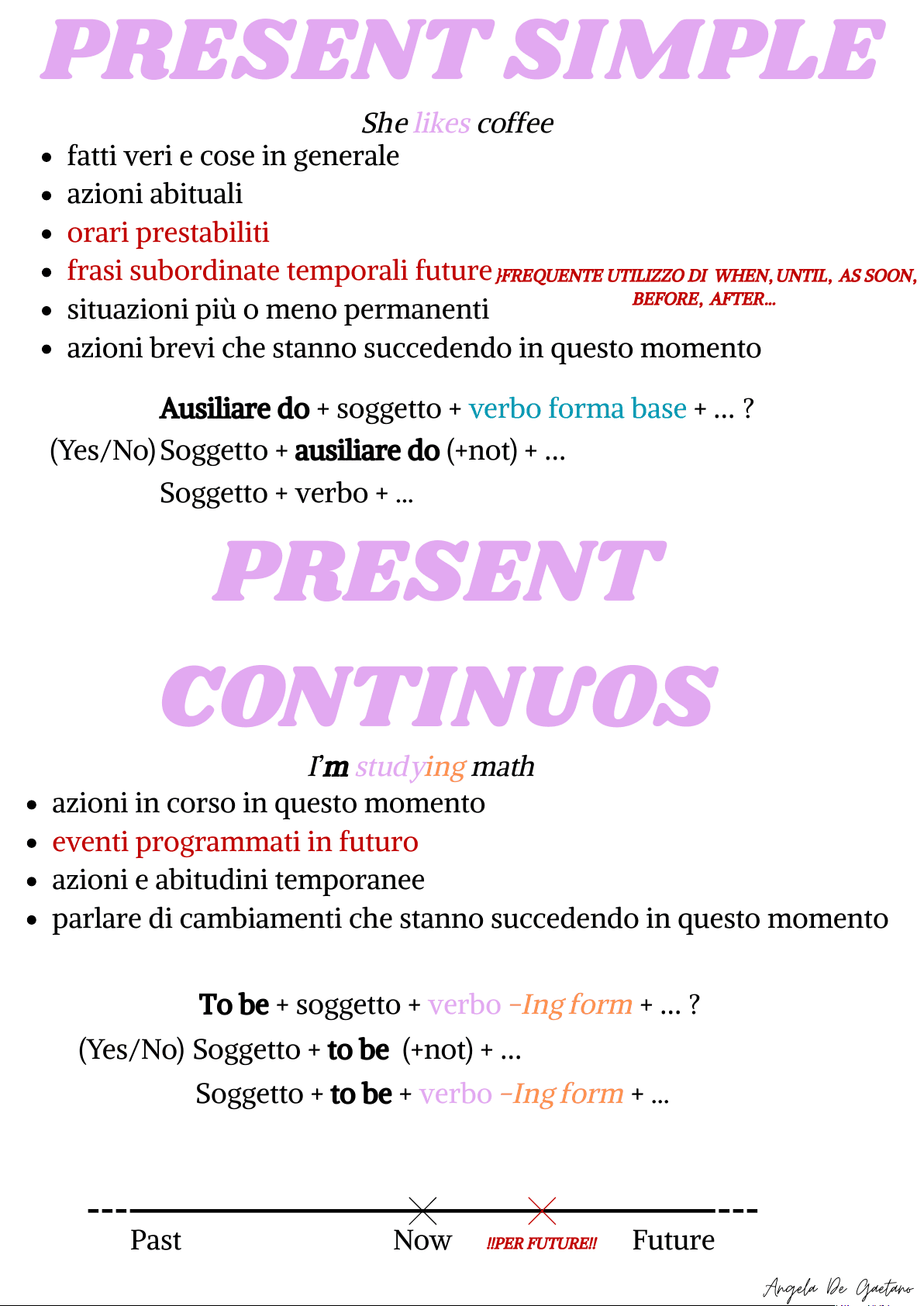
PRESENT SIMPLE
She likes coffee
fatti veri e cose in generale
azioni abituali
orari prestabiliti
frasi subordinate temporali future
situazioni più o meno permanenti
azioni brevi che stanno succedendo in questo momento
Ausiliare do + soggetto + verbo forma base + …?
Soggetto + ausiliare do (+not) + …
Soggetto + verbo + ...
PRESENT
CONTINUOS
I’m studying math
(Yes/No)
azioni in corso in questo momento
eventi programmati in futuro
azioni e abitudini temporanee
parlare di cambiamenti che stanno succedendo in questo momento
To be + soggetto + verbo - Ing form + …?
(Yes/No) Soggetto + to be (+not) + …
Soggetto + to be + verbo -Ing form + ...
Now !!PER FUTURE!! Future
}FREQUENTE UTILIZZO DI WHEN, UNTIL, AS SOON,
BEFORE, AFTER...
Past
PAST SIMPLE
I visited Maria last night
azioni iniziate e finite nel passato
fatti storici
Ausiliare passato + soggetto + verbo forma base + …?
Soggetto + ausiliare passato (+ not) + …
Soggetto + verbo - Ed form + ...
PAST
CONTINUOUS
I was watching the TV when + ...
(Yes/No)
azioni in corso di svolgimento nel passato interrotte da azioni brevi
(past simple)
To be al passato + soggetto + verbo -Ing form + …?
(Yes/No) Soggetto + to be al passato (+not) + …
Soggetto + to be al passato + verbo -Ing form + ...
Future
Now
Future
Past
Now
!!SEGUITO SPESSO DA AVVERBI DI FREQUENZA!!
Earlier in the past
PRESENT PERFECT
Where have you been?
eventi iniziati nel passato che hanno ripercussioni e legami nel
presente
azioni non definite nel tempo
To have + soggetto + verbo past participle + …?
Soggetto + to have (+ not) + …
Soggetto + to have + verbo past participle + ...
PAST PERFECT
They had left when it started to rain
(Yes/No)
eventi successi in un passato precedente
per porre anteriorità ad un'azione rispetto a un altra
To have al passato + soggetto + verbo past participle + …?
(Yes/No) Soggetto + to have al passato (+not) + …
Soggetto + to have al passato + verbo past participle + ...
Now
Past
Past Future
Now
(Yes/No)
MUST
I must study
nelle frasi affermative, must, indica un obbligo urgente sentito dal
parlante
nelle frasi negative, mustn't, indica un divieto
!!NON ESISTE LA FORMA INTERROGATIVA!!
Soggetto + must (+not) + …
HAVE TO
I have to go to school tomorrow
nelle frasi affermative, have to, indica un obbligo meno urgente
imposto dall'esterno
nelle frasi negative, don't have to, significa "non è necessario"
Ausiliare do + soggetto + have to + v. forma base + …?
(Yes/No) Soggetto + ausiliare do (+not) + …
Soggetto + have to + v. forma base + ...
SECOND
CONDITIONAL
If I won the lottery, I would buy a house
si usa per parlare di situazioni immaginarie improbabili
(If) + sogg. + v. al pesent simple (+ ... ) + sogg. + would + v. f. base +…
THIRD
CONDITIONAL
!!L'ORDINE PUÒ VARIARE!!
If you had told him, he would have come
Would + soggetto + v. forma base + if + sogg. + p. simple + …?
Soggetto + would (+not) + …
(Yes/No)
si usa per parlare di un passato non reale
(If) + sogg. + p. perfect + sogg. + would + p. perfect +…
Would + soggetto + p. perfect + if + sogg. + p. perfect + …?
(Yes/No) Soggetto + would (+not) + …
IF SOMETHING HAPPENED THE RESULT
WOULD BE TRUE
IF SOMETHING HAD HAPPENED THE
RESULT WOULD HAVE BEEN TRUE
RELATIVES
I think that you're beautiful
Si usano per identificare ciò di cui si sta parlando
(che, il quale, la quale ecc.)
Who (e that) si usa per le persone; that/which per le cose ; where per i
luoghi
WH-
- When - How long - How - Which - When - Who - How come
!!IN UNA FRASE SI
POSSONO OMETTERE
THAT/WHICH/WHO SE
QUESTI PRECEDONO
UN NOME O UN
PRONOME!!
SO/SUCH ... THAT
It's so beautiful
Soggetto + verbo + so + aggettivo + ...
Soggetto + verbo + such + a + aggettivo + nome +...
Soggetto + verbo + so + many/much + aggettivo + nome +...
USED TO
We used to go to the cinema every week
azioni abituali ripetute nel passato
cose che eravamo soliti a fare (e ora non le facciamo più)
Future Past
Now
Ausiliare + soggetto + used to + verbo forma base +…?
Soggetto + did (+not) + …
Soggetto + used to + verbo forma base + ...
(Yes/No)
VERB PATTERNS
I love going to the sea
I want you to look at me
want, need
force, expect
get
I hope to go to New York one day
aree, decide, choose, plan, want
promise, offer, manage
hope, try, help, wish
intend, offer, refuse, wait
learn, teach, seem
She made me clean my room
}
}
}
Soggetto + make + object + v. forma base + ...
hate, love, like, prefer
start stop
avoid
practise
COMPARATIVES
maggioranza
old older than... expensive more expensive than...
se monosillabici
si aggiunge - er + than...
se plurisillabici
si aggiunge more + agg. + than...
minoranza
She's less tall than...
less + agg. + than...
ugualianza
She's as strong as...
as + agg. + as...
SUPERLATIVES
kind the kindest
se monosillabici
si aggiunge the + agg. + -est...
beautiful the most beautiful
se plurisillabici
si aggiunge the most + agg. +...
CONNECTORS
The film is both gripping and revelatory
Dare fluidità al testo
RRendereun testo coeso e coerente
Esistono quattro tipi di connettors !!VEDI PAGINE SUCCESSIVE !!
ORDERING
First/Furthermore/Finally...
One/Two/Three...
Firstly/Secondly/Thirdly...
To begin with/In the second place /Moreover/Next/
Then/Afterward/And to conclude/Last/Finally
Per catalogare ciò che viene detto
Per ordinare i punti
First of all, Christopher Nolan masterfully blends action...
!!FOLLOWED
BY A COMMA!!
CAUSAL
The film is both gripping and revelatory
Esistono due tipi di "Causal Connectives":
1 .Causal: indicano la causa o la ragione di qualcosa
2 .Consequece: indicazioni la causa o la conseguenza di qualcosa
!!O SEQUENCY!!
!!RELAZIONE
CAUSA/EFFETTO!!
CAUSE
As/Since
Because
Because of
Due to/Owing to/On account of
Spiegazione del perchè è successa una determinata cosa/
qualcuno ha compiuto una determinata azione
We didn't go because it was raining
EFFECT
Risultato di una azione/situazione
So
For this reason
As a result
Consequently/Therefore
!!FOLLOWED
BY A COMMA!!
}
+s+v
+s+v
More formal
We didn't have anything to do, so we decided to rent a film
All'inizio della frase
All'inizio della frase
+s+v
,
BEGINNING OR MIDDLE
+s
BEGINNING OR MIDDLE
More formal
More formal
BEGINNING OR MIDDLE
MIDDLE
BEGINNING
BEGINNING