Download Probability Analysis in Statistics: Percentages and Probabilities of Various Scenarios and more Study notes Humanities in PDF only on Docsity!
1 When 190 students were asked to pick a number from 1 to 10, the number of students selecting each number were as follows:
Number 1 2 3 4 5 6 7 8 9 10
Frequency 2 9 22 21 18 23 56 19 14 6
Enter your answers in decimal form to at least 3 decimal places.
a. What is the approximate probability that someone asked to pick a number from 1 to 10 will pick the number 3?
b. What is the approximate probability that someone asked to pick a number from 1 to 10 will pick one of the two extremes, 1 or 10?
c. What is the approximate probability that someone asked to pick a number from 1 to 10 will pick an odd number?
2 Thirty percent of the students in a high school face a disciplinary action of some kind before they graduate. Of those students, 40% go on to college. Of the 70% who do not face a disciplinary action, 60% go on to college.
Hint: pretend that these results pertain to a hypothetical high school of 1000 students and create an appropriate contingency table.
What percent of the students from the high school go on to college? a. 12% b. 42% c. 50% d. 54%
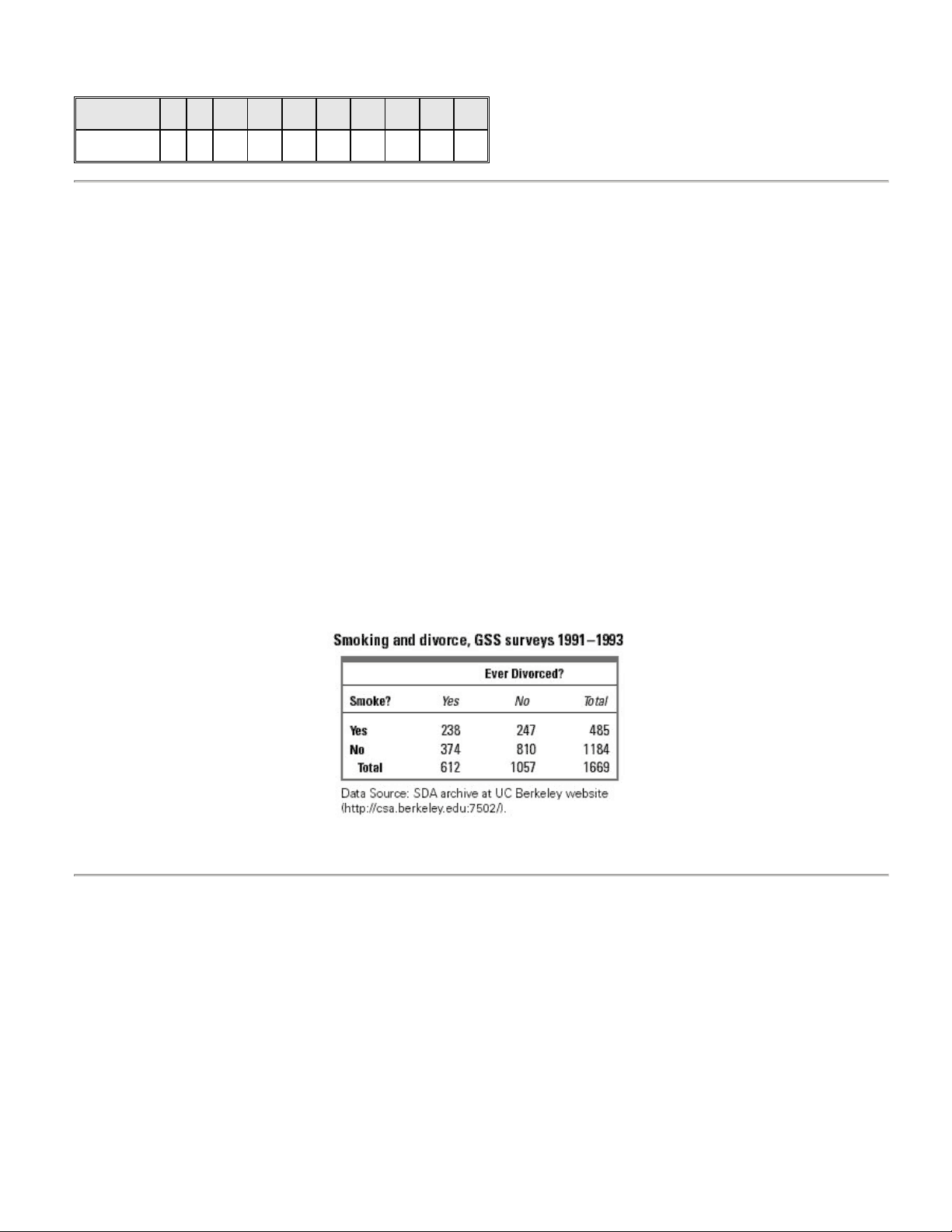
3 In Chapter 6 we discussed a random sample of people who had ever been married and demonstrated the proportions who smoked and who had ever been divorced. The numbers are shown again here.
Because this survey was based on a random sample in the United States in the early 1990s, the data should be representative of the adult population who had ever been married at that time. Assume a randomly selected member of that population.
Given that the person smoked, what is the probability that he or she had been divorced? Use at least 3 significant figures in your answer
4 A professor has noticed that, even though attendance is not a component of the grade for his class, students who attend regularly obtain better grades. In fact, 40% of those who attend regularly receive A's in the class, while only 10% of those who do not attend regularly receive A's. About 70% of students attend class regularly. Find the following percents:
Hint: pretend that there are 1000 students in the class and use the values given in the problem to construct the appropriate contingency table.
The percent who receive A's given that they attend class regularly.
Enter your answer as a percent.
The percent who receive A's given that they do not attend class regularly.
Enter your answer as a percent.
The overall percent who receive A's.
Enter your answer as a percent.
5 For this situation, decide if the probability described is a subjective (personal) probability or a relative frequency probability.
In a sample of 1000 students majoring in the humanities, 660 were female. The 66% (660/1000) chance of a humanities major being female is a a. Subjective probability b. Relative frequency probability
6 In Chapter 6 we discussed a random sample of people who had ever been married and demonstrated the proportions who smoked and who had ever been divorced. The numbers are shown again here.
Because this survey was based on a random sample in the United States in the early 1990s, the data should be representative of the adult population who had ever been married at that time. Assume a randomly selected member of that population.
What is the approximate probability that the person had ever been divorced? Use at least 3 significant figures in your answer
2. d **7.
4.** 1: 40
40% 40 % 2: 10 10% 10 % 3: 31 31% 31 % 9. b
5. b 10.
ANSWER KEY � Page 1
ANSWER KEY
HW 8 Probability