Download Sequences and Series: Arithmetic and Geometric Sequences, Sums, and Sigma Notation and more Exams Calculus in PDF only on Docsity!
13 SEQUENCES
AND SERIES
Objectives
After studying this chapter you should
- be able to recognise geometric and arithmetic sequences;
- understand ∑ notation for sums of series;
- be familiar with the standard formulas for ∑ r , ∑ r^2 and ∑ r^3 ;
13.0 Introduction
Suppose you go on a sponsored walk. In the first hour you walk 3 miles, in the second hour 2 miles and in each succeeding hour 2 3 of the distance the hour before. How far would you walk in 10 hours? How far would you go if you kept on like this for ever?
This gives a sequence of numbers: 3, 2, 1 13 , .. etc. This chapter is
about how to tackle problems that involve sequences like this and gives further examples of where they might arise. It also examines sequences and series in general, quick methods of writing them down, and techniques for investigating their behaviour.
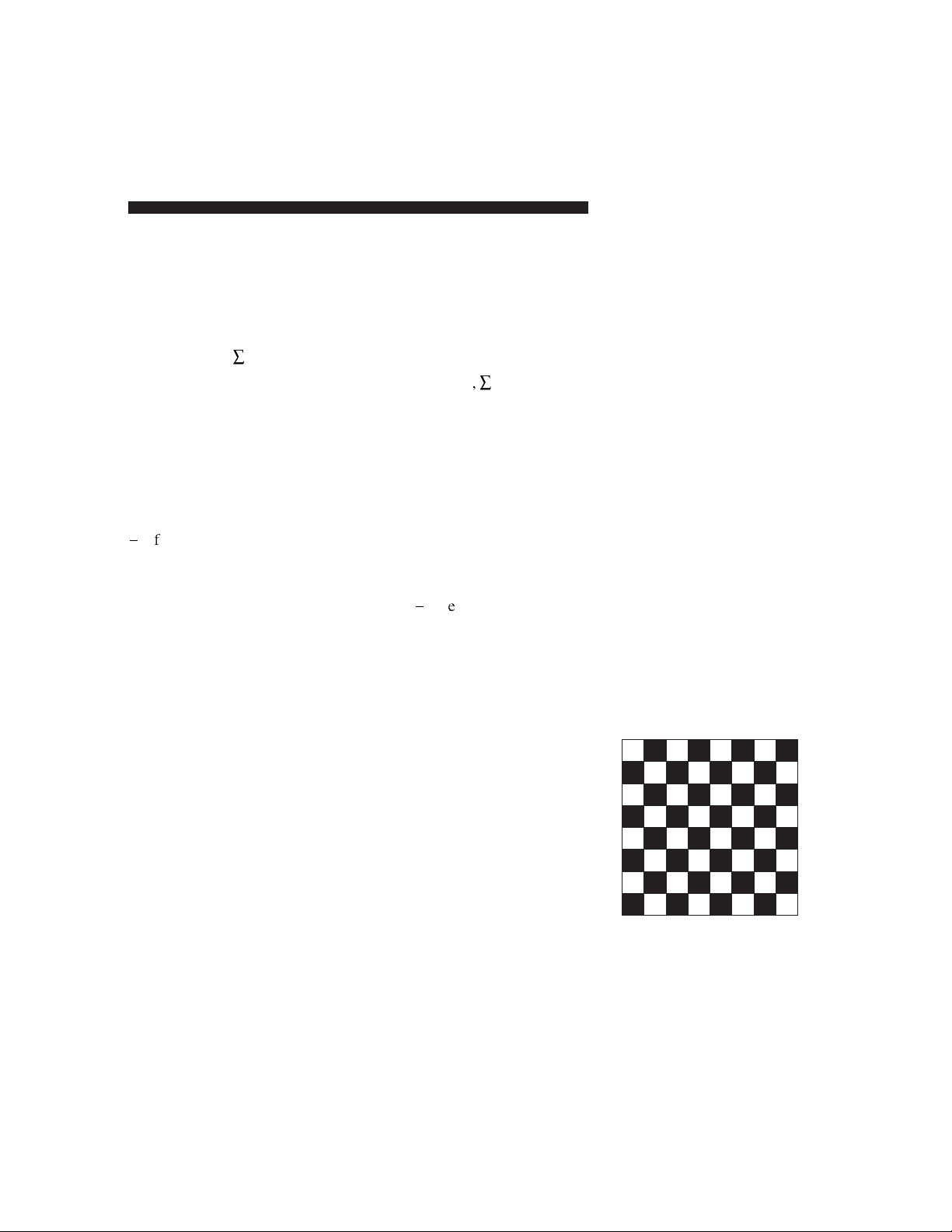
Legend has it that the inventor of the game called chess was told to name his own reward. His reply was along these lines.
'Imagine a chessboard.
Suppose 1 grain of corn is placed on the first square,
2 grains on the second, 4 grains on the third, 8 grains on the fourth,
and so on, doubling each time up to and including the 64th square. I would like as many grains of corn as the chessboard now carries.'
It took his patron a little time to appreciate the enormity of this request, but not as long as the inventor would have taken to use all the corn up.
1 2 4 8
Number of grains of corn shown
Activity 1
(a) How many grains would there be on the 64th square?
(b) How many would there be on the n th square?
(c) Work out the numerical values of the first 10 terms of the sequence.
2 0 , 2 0 + 21 , 2 0 + 21 + 2 2 etc.
(d) How many grains are there on the chessboard?
13.1 Geometric sequences
The series of numbers 1, 2, 4, 8, 16 ... is an example of a geometric sequence (sometimes called a geometric progression). Each term in the progression is found by multiplying the previous number by 2.
Such sequences occur in many situations; the multiplying factor does not have to be 2. For example, if you invested £2000 in an account with a fixed interest rate of 8% p.a. then the amounts of money in the account after 1 year, 2 years, 3 years etc. would be as shown in the table. The first number in the sequence is 2000 and each successive number is found by multiplying by 1.08 each time.
Accountants often work out the residual value of a piece of equipment by assuming a fixed depreciation rate. Suppose a piece of equipment was originally worth £35 000 and depreciates in value by 10% each year. Then the values at the beginning of each succeeding year are as shown in the table opposite. Notice that they too form a geometric progression.
The chessboard problem in Activity 1 involved adding up
20 + 21 + 22 + ... + (^263).
The sum of several terms of a sequence is called a series. Hence
the sum 20 + 21 + 22 + ... + 263 is called a geometric series (sometimes geometric progression, GP for short)
Activity 2 Summing a GP
In Activity 1 you might have found a formula for
1 + 2 + 2 2 +K+ 2 n −^1.
(a) Work out the values of
3 0 , 3 0 + 31 , 3 0 + 31 + 3 2
Number of Money in years account (£) 0 2000 1 2160 2 2332. 3 2159. 4 2720.
Year Value (£) 0 35 000 1 31 500 2 28 350 3 25 515 4 22 963.
Activity 3 Understanding and using the formula
(a) Sometimes it is useful to write
Sn =
a (^) ( 1 − r n ) 1 − r
instead of Sn =
a r ( n^ − (^1) ) r − 1
Why are these formulae identical? When might it be more convenient to use the alternative form?
(b) For what value of r do these formulas not hold? What is Sn in this case?
Example:
Find
(a) 4 + 6 + 9 + ... + 4 × (1.5 )^10
(b) 8 + 6 + 4.5 + ... + 8 × (0. 75 )^25
Solution
(a) First term a = 4, common ratio r = 1.5, number of terms n = 11 ;
S 11 =
4 1.
11 ( −^1 ) 1.5 − 1
= 684.0 to 4 s. f.
(b) First term a = 8, common ratio r = 0. 75, number of terms n = 26;
S 26 =
26 ( )
1 − 0. 75
= 31.98 to 4 s. f.
Example:
A plant grows 1.67 cm in its first week. Each week it grows by 4% more than it did the week before. By how much does it grow in nine weeks, including the first week?
Solution
The growths in the first 9 weeks are as follows :
1.67, 1.67 × 1.04, 1.67 × 1.04 2 ,K
Total growth in first nine weeks is
S 9 =
1.67 1.04( 9 − (^1) ) 1.04 − 1
= 17.67 cm to 4 s. f.
Example:
After how many complete years will a starting capital of £ first exceed £10 000 if it grows at 6% per annum?
Solution
After n years, the capital sum has grown to
5000 × (1.06 ) n
When is this first greater than 10 000, n being a natural number? In other words, the smallest value of n is required so that
5000 × (1.06 ) n^ > 10 000, n ∈ N
⇒ (1.06 ) n^ > 2
Now take logs of both sides:
n ln1.06 > ln 2
⇒ n >
ln 2 ln1. ⇒ n > 11.
After 12 years, the investment has doubled in value.
Activity 4 GP in disguise
(a) Why is this a geometric sequence?
1, –2, 4, –8, 16, ...?
What is its common ratio? What is its n th term? What is Sn?
(b) Investigate in the same way, the sequence
1, –1, 1, –1, ...
?
£
£10, 000
⇒
How many years later?
(c) If S 2 = t 1 + t 2 , what does S 2 represent? What does S (^) n mean?
Calculate S 10 , S 20 and S 50. How long after the first bounce does the ball stop bouncing altogether, to the nearest tenth of a second?
Activity 5 gave an example of a convergent sequence. Convergence, in this context, means that the further along the sequence you go, the closer you get to a specific value. For example, in part (a) the sequence to the nearest 0.1 cm is
100, 49.0, 24.0, 11.8, 5.8, 2.8, 1.4, ...
and the numbers get closer and closer to zero. Zero is said to be the limit of the sequence.
Part (b) also gave a sequence that converged to zero. In part (c),
the sequence of numbers S 1 , S 2 , S 3 , ... start as follows :
0.6321, 1.0746, 1.3844, 1.6012, 1.7530, ...
You should have found that this sequence did approach a limit, but that this was not zero. Hence the series has a convergent sum , that is, the sum S (^) n of the series also converges.
The series 1, 2, 4, 8 ...... is a divergent sequence. It grows without limit as the number of terms increases. The same is true, in a slightly different sense, of the sequence 1, –2, 4, – ...... Any sequence that does not converge is said to be divergent.
Activity 6 Convergent or divergent?
For each of these sequences
(i) write a formula for the n th^ term; (ii) find whether the sequence converges; (iii) find whether the sum S (^) n converges.
(a) 6, 2, 23 , 29 ,K
(b) 1, 1.5, 2.25, 3.375, ...
(c) 4, –3, 94 , – 2716 ...
(d) 1, 1.01, 1.012, 1.0123, ...
(e) 8, –9.6, 11.52, –13. ...
0
20
40
60
80
100
0 2 4 6 8 10
hn
n
0
1
2
0 2 4 6 8 10
Sn
n
Activity 7 Behaviour of r n
(a) What happens to r n^ as n gets larger (i.e. as n → ∞ )? (You might need to see what happens for a variety of different values of r , positive and negative, large and small.)
(b) The sum of the first n terms of a geometric sequence is given by
Sn =
a (^) ( 1 − r n ) 1 − r If r n^ converges to 0 as n → ∞ , what can you say about the limit of S (^) n as n → ∞?
Activity 8 Experimental verification
Conduct an experiment with a bouncing ball. Calculate the theoretical time from the first bounce until it stops bouncing. Then use a stop-watch to see how close the answer is to your calculation. You will need to know that:
If a ball is dropped from a height of 1 metre and rises after the first bounce to a height of h metres, then the time between the first and second bounce is given by
t 1 = 0.90305 h (^) ,
and the common ratio in the sequence t 1 , t 2 , t 3 K is h.
A geometric series, a + ar + ar^2 +... + ar n^ −^1 converges when
r < 1; i.e. for − 1 < r < 1. Since if r < 1, r n^ → 0 as n → ∞ and
Sn →
a 1 − r
as n → ∞
The limit a 1 − r
is known as the 'sum to infinity' and is
denoted S ∞.
Example
Find
(a) 8 + 4 + 2 + 1+ ...
(b) 20 – 16 + 12.8 – 10.24 + ...
13.3 Arithmetic sequences
Geometric sequences involve a constant ratio between consecutive terms. Another important type of sequence involves a constant difference between consecutive terms; such a sequence is called an arithmetic sequence.
In an experiment to measure the descent of a trolley rolling down a slope a 'tickertape timer' is used to measure the distance travelled in each second. The results are shown in the table.
The sequence 3, 5, 7, 9, 11, 13 is an example of an arithmetic sequence. The sequence starts with 3 and thereafter each term is 2 more than the previous one. The difference of 2 is known as the common difference.
It would be useful to find the total distance travelled in the first 6 seconds by adding the numbers together. A quick numerical trick for doing this is to imagine writing the numbers out twice, once forwards once backwards, as shown below
3 5 7 9 11 13
13 11 9 7 5 3
Each pair of vertical numbers adds up to 16. So adding the two sequences, you have 6 × 16 between them. Hence the sum of the original series is
1 2
× (6 × 16) = 48.
The sum of terms of an arithmetic sequence is called an arithmetic series or progression , often called AP for short.
Activity 9 Distance travelled
Use the example above of a trolley rolling down a slope to answer these questions.
(a) Work out the distance travelled in the 20th second.
(b) Calculate S 20 , the distance travelled in the first 20 seconds, using the above method.
(c) What is the distance travelled in the n th second?
(d) Show that the trolley travels a distance of n ( n +2) cm in the first n seconds.
cm travelled Second in second 1 3 2 5 3 7 4 9 5 11 6 13
Example
Consider the arithmetic sequence 8, 12, 16, 20 ...
Find expressions
(a) for un , (the n th term) (b) for S (^) n.
Solution
In this AP the first term is 8 and the common difference 4.
(a) u 1 = 8
u 2 = 8 + 4
u 3 = 8 + 2 × 4
u 4 = 8 + 3 × 4 etc.
un is obtained by adding on the common difference ( n − 1 )
times.
⇒ un = 8 + 4 ( n − 1 )
= 4 n + 4
(b) To find Sn , follow the procedure explained previously:
8 12 KKKK 4 n 4 n + 4
4 n + 4 4 n KKKK 12 8 Each pair adds up to 4 n + 12. There are n pairs.
So 2 Sn = n ( 4 n + 12 )
= 4 n n ( + 3 )
giving Sn = 2 n n ( + 3 ).
Exercise 13C
- Use the 'numerical trick' to calculate (a) 3 + 7 + 11 + ... + 27 (b) 52 + 46 + 40 + ... + 4 (c) the sum of all the numbers on a traditional clock face; (d) the sum of all the odd numbers between 1 and 99. 2. Find formulae for u (^) n and S (^) n in these sequences : (a) 1, 4, 7, 10, ... (b) 12, 21, 30, 39, ... (c) 60, 55, 50, 45, ... (d) 1, 2 12 , 4, 5 12 , K 3. A model railway manufacturer makes pieces of track of lengths 8 cm, 10 cm, 12 cm, etc. up to and including 38 cm. An enthusiast buys 5 pieces of each length. What total length of track can be made?
Example
The sum of the series 1 + 8 + 15 + ... is 396. How many terms does the series contain?
Solution This is an arithmetic sequence with first term 1 and common difference 7. Let the number of terms in the sequence be n.
Sn = 396
n 2 (^2 +^7 (^ n^ −^1 )) =^396
⇒ n ( 7 n − 5 ) = 792
⇒ 7 n^2 − 5 n − 792 = 0
⇒ ( 7 n + 72 ) ( n − 11 ) = 0
⇒ n = 11 since − 72 7
is not an integer.
The number of terms is 11.
Activity 10 Ancient Babylonian problem
Ten brothers receive 100 shekels between them. Each brother receives a constant amount more than the next oldest. The seventh oldest brother receives 7 shekels. How much does each brother receive?
Exercise 13D
- Find the sum of (a) 11 + 14 + 17 + ... to 16 terms (b) 27 + 22 + 17 + ... to 10 terms (c) 5 + 17 + 29 + ... + 161 (d) 7.2 + 7.8 + 8.4 + ... to 21 terms (e) 90 + 79 + 68 + ... – (f) 0.12 + 0.155 + 0.19 + ... to 150 terms
- The last three terms of an arithmetical sequence with 18 terms is as follows : ...67, 72, 77. Find the first term and the sum of the series. 3. How many terms are there if (a) 52 + 49 + 46 + ... = 385? (b) 0.35 + 0.52 + 0.69 + ... = 35.72? 4. The first term of an arithmetic series is 16 and the last is 60. The sum of the arithmetic series is 342. Find the common difference. 5. New employees joining a firm in the clerical grade receive an annual salary of £8500. Every year they stay with the firm they have a salary increase of £800, up to a maximum of £ p.a. How much does a new employee earn in total, up to and including the year on maximum salary?
13.4 Sigma notation
Repeatedly having to write out terms in a series is time consuming. Mathematicians have developed a form of notation which both shortens the process and is easy to use. It involves the use of the Greek capital letter ∑ (sigma), the equivalent of the letter S , for sum.
The series 2 + 4 + 8 + ... + 2 12 can be shortened to 2 r r = 1
12 ∑.
This is because every term in the series is of the form 2 r^ , and all the values of 2 r^ , from r =1 to r =12 are added up. In this example the ' 2 r^ ' is called the general term ; 12 and 1 are the top and bottom limits of the sum.
Similarly, the series
60 + 60 × (0.95 )+K+ 60 × ( 0.95)^30
can be abbreviated to
60 × (0.95 ) r
r = 0
30 ∑.
Often there is more than one way to use the notation. The series
1 2
2 3
3 4
99 100
has a general term that could be thought of as either
r r + 1 or as^
r − 1 r.^ Hence the series can be written as either
r r = 1 r^ +^1
99 ∑ or^
r − 1 r = 2^ r
100 ∑.
Example
Write out what ( 10 − r )^2
r = 1
9 ∑ means and write down another way
of expressing the same series, using ∑ notation.
Exercise 13E
- Write out the first three and last terms of:
(a) r^2 r = 5
15 ∑ (b) ( 2 r − 1 ) r = 1
10 ∑
(c) r r = 1
n ∑ (d)
r − 2 r = 3^ r
10 ∑
(e) ( r − 2) 2 r = 6
100 ∑
- Shorten these expressions using ∑ notation.
(a) 1+^12 + 13 +K+ 251
(b) 10 +11+12+K+
(c) 1+ 8 + 27+K+ n^3
(d) 1 + 3 + 9 + 27 +K+ 312
(e) 6 +11+16+K+ 5( n +1)
13.5 More series
Activity 11
(a) Write down the values of ( − 1 )^0 , (− 1 )^1 , ( − 1 )^2 , (− 1 )^3 etc.
Generalise your answers.
(b) Write down the first three terms and the last term of
(i) ( − 1 ) r^
r = 0 2 r
10
∑ (ii)^ (^ −^1 ) r^ +^1
r^2 r^2 + 1
r = 0
10 ∑
(c) How can you write the series
100 − 100 × (0.8 ) + 100 × ( 0.8)^2 ... to n terms
using ∑ notation?
Activity 12 Properties of ∑
(a) Calculate the numerical values of
r r = 1
5 ∑ r^2 r = 1
5 ∑ r^3 r = 1
5 ∑ (^) ( r^ +^ r^2 ) r = 1
5 ∑ 3 r r = 1
5 ∑
(f) 14 + 17 + 20 +K+ 62
(g) 5 + 50 + 500 +K+ 5 × 10 n^.
(h)
1 6
2 12
3 20
+K+
20 21 × 22
- Use ∑ notation to write: (a) the sum of all natural numbers with two digits; (b) the sum of the first 60 odd numbers; (c) the sum of all the square numbers from 100 to 400 inclusive; (d) the sum of all numbers between 1 and 100 inclusive that leave remainder 1 when divided by 7.
- Find alternative ways, using ∑ notation, of writing these:
(a) (^) ( 20 − r ) r = 1
19 ∑ (b)^ r^1 − 1 r = 2
41 ∑ (c)^ r^2 r =− 3
3 ∑
(b) If u 1 , u 2 , ... u (^) n and v 1 , v 2 , ..., v (^) n are two sequences of numbers, is it true that
(^ u (^) r +^ vr ) =^ ur +^ vr r = 1
n ∑ r = 1
n ∑ r = 1
n ∑?
Justify your answer.
(c) Investigate the truth or falsehood of these statements:
(i) ur v (^) r = ur r = 1
n ∑
^
r = 1
n ∑ v^ r r = 1
n ∑
^
(ii) ur^2 r = 1
n ∑ =^ ur r = 1
n ∑
2
(iii) α ur =α ur r = 1
n ∑
[^ α is any number.] r = 1
n ∑
Again, justify your answers fully.
(d) What is the value of ( r + 1 )
r = 1
5 ∑?
What is 1 r = 1
n ∑? and r r = 1
n ∑?
Exercise 13F
- Work out the numerical value of
(a) 1 r = 1
10 ∑ (b)^4 r = 1
25 ∑
(c) (3 + 5 r ) r = 0
16 ∑ (d)^3 ×^ (3.5)
r r = 0
30 ∑
(e) (0.7) r r = 1
∞ ∑ (f)^5 ×^ (–
2 3 )
r r = 0
∞ ∑
- Use ∑ notation to write these:
(a) 1 −
1 2
1 3
−
1 4
1 6 (b) –1 + 4 – 9 + 16 – ... + 144
(c) 12 – 12 × 0.2 +12 × 0.04 – ... +12 × ( 0.2)^50
- If you know that
u (^) r r = 1
n ∑ =^ 20 and^ v^ r r = 1
n ∑ =^64
calculate where possible:
(a) ( u r + v r )
r = 1
n ∑ (b)^ u (^) r v (^) r r = 1
n ∑
(c) u (^) r^2 r = 1
n ∑ (d)^12 r = 1
n ∑ v^ r
(e) ( v (^) r − u (^) r ) r = 1
n ∑ (f) (5 u (^) r − v (^) r ) r = 1
n ∑
(g) u (^) r r = 1
2 n ∑ (h)^ (–1) r^ v^ r r = 1
n ∑
Activity 15 Sum of squares
(a) Work out r r = 1
n
∑ ( r^ +^1 ) for^ n^ =^ 1, 2, 3, ...^.
Copy and complete the table of results opposite.
(b) Prepare formula for r r = 1
n
∑ (^ r^ +^1 ).
(c) Use your formulae for r r = 1
n
∑ ( r^^ +^1 )^ and^ r
r = 1
n ∑ to obtain a formula for
r^2 r = 1
n ∑.
Activity 16 Sum of cubes
(a) For n = 1, 2, 3 and 4, work out r r = 1
n ∑ and^ r^3 r = 1
n ∑.
Conjecture a formula for r^3 r = 1
n ∑.
(b) Prove this formula by starting from the statement
r^3 = (^) (( n + 1 ) − r )^3 r = 1
n ∑ r = 1
n ∑.
Why could a similar approach not be used to prove the formula for (^) ∑ r^2?
The results of the last few activities can be summarised as follows.
r r = 1
n ∑ =^
n n ( + 1 )
r^2 r = 1
n ∑ =^
n n ( + 1 ) ( 2 n + 1 )
r^3 =
r = 1 4
n
∑ n^2 ( n + 1 )^2
The useful fact that ∑ r^3 = (^) ( ∑ r )^2 is a coincidence (if there is such a thing in maths). It is not possible to extend this to find ∑ r^4 , ∑ r^5 etc. Formulae do exist for sums of higher powers, but they are somewhat cumbersome and seldom useful.
n r r ( + 1 )
r = 1
n ∑
Exercise 13G
- Write down the general term, and hence evaluate: (a) 1+ 2 + 3 + ... + 20 (b) 12 + 2 2 + 3 2 + ... + 10 2 (c) 2 + 8 +18 + ... + (2 × 15 2 ) (d) 2 + 4 + 6 + ... + (e) 1+ 3 + 5 + ... + 25 (f) 1+ 8 + 27 + ... +
- Work out r r = 10
20 ∑. Use the fact that
r r = 10
20 ∑ = r r = 0
20 ∑ − r r = 0
9 ∑.
13.7 Miscellaneous Exercises
- A piece of paper is 0.1 mm thick. Imagine it can be folded as many times as desired. After one fold, for example, the paper is 0.2 mm thick, and so on. (a) How thick is the folded paper after 10 folds? (b) How many times should the paper be folded for its thickness to be 3 metres or more? (About the height of a room.) (c) How many more times would it need to be folded for the thickness to reach the moon? (400 000 km away)
- Find formulae for the n th terms of each of these sequences: (a) 4, 6, 9, 13.5, ... (b) 250, 244, 238, 232, ... (c) 10, 2, 0.4, 0.08, ... (d) 0.17, 0.49, 0.81, 1.13, ...
- Evaluate these sums: (a) 12+15+18+21+ ... to 20 terms; (b) 4+12+36+108+ ... to 12 terms; (c) 5–2–9–16– ... –65; (d) 240+180+135+ ... to infinity.
- The first term of a geometric sequence is 7 and the third term is 63. Find the second term. 3. Use techniques similar to that in Question 2 to calculate (a) 112 + 12 2 + ... + 24 2 (b) 7 3 + 8 3 + ... + 15 3 (c) 21+ 23 + ... + 61 4. Calculate 21+23+25 ... + 5. Prove that r = n (^) ( 2 n + (^1) ) r = 0
2 n ∑
and hence that r = 1 2
n ( 3 n + 1 ) r = n + 1
2 n ∑
- Consider the arithmetic series 5+9+13+17+... (a) How many terms of this series are less than 1000? (b) What is the least value of n for which Sn > 1000?
- The ninth term of an arithmetic progression is 52 and the sum of the first twelve terms is 414. Find the first term and the common difference. (AEB)
- In an arithmetic progression, the eighth term is twice the 3rd term and the 20th term is 110. (a) Find the common difference. (b) Determine the sum of the first 100 terms. (AEB)
- The first term of a geometric progression is 8 and the sum to infinity is 400. (a) Find the common ratio. (b) Determine the least number of terms with a sum greater than 399. (AEB)
- The sum of the first and second terms of a geometric progression is 108 and the sum of the third and fourth term is 12. Find the two posible values of the common ratio and the corresponding values of the first term. (AEB)