Download 3.4 Thermal Energy Change and more Lecture notes Thermodynamics in PDF only on Docsity!
3.4 Thermal Energy Change
3.4. Explain the relationship among temperature change in a substance, the amount of heat transferred, the amount (mass) of the substance, and the specific heat of the substance. Page 474-478 in Text. Section 16.
Vocabulary – During this unit you will learn and understand the definitions of the following terms. Some are review. Also use this as a word bank for the notes and exercise.
Temperature Substance Even Heat Energy/ Thermal Kinetic Energy More/Less Specific Heat Capacity Heat Capacity^ Molecular Velocity^ mass^ times^ Increase/decrease
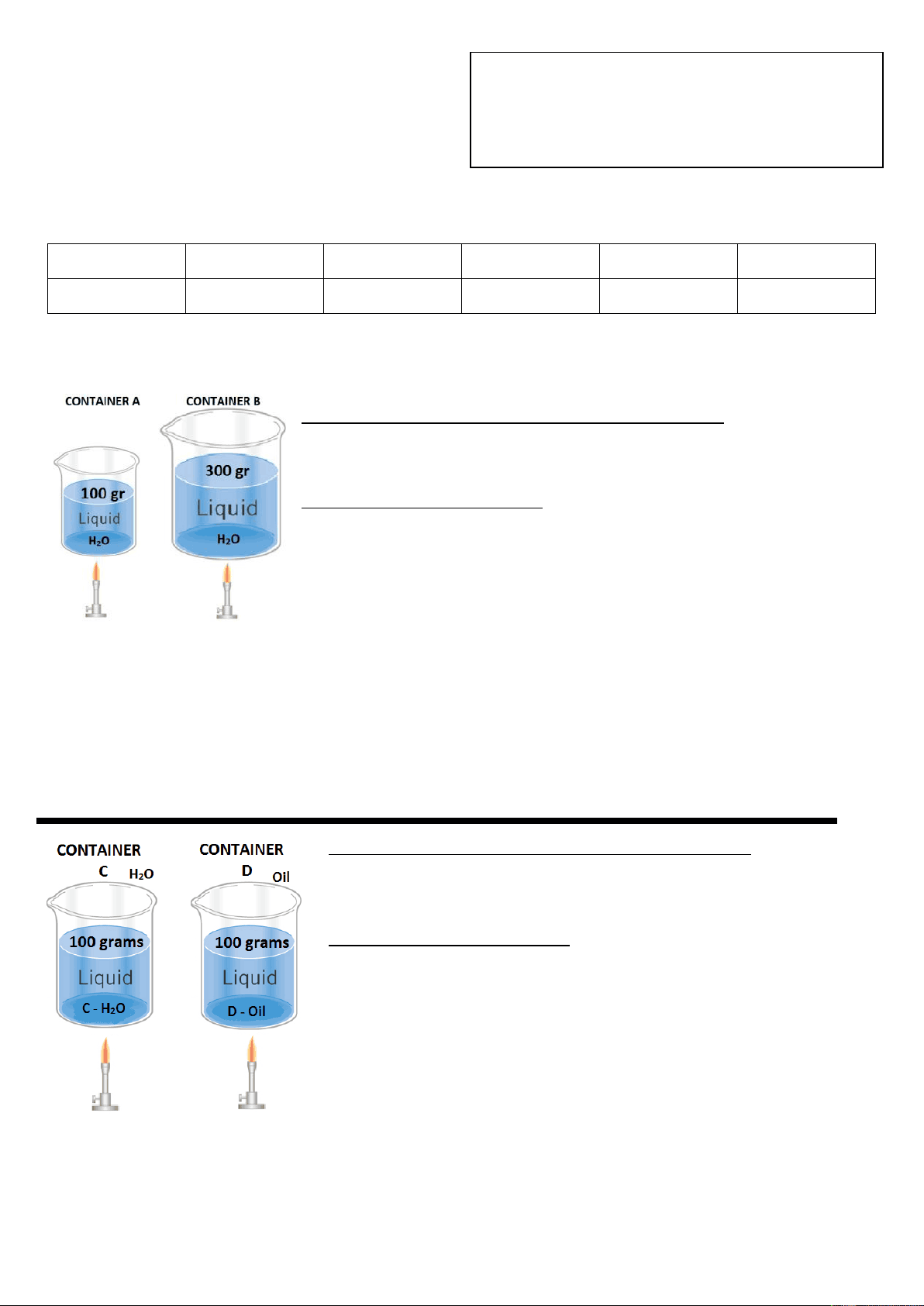
PUTTING #’S TO HEAT TRANSFER - Three things effect how heat is exchanged. Take a look at the following situations. Identify what makes the temperature change for the containers different.
The two things for this situation that are the same are: A -The subtance or material being heated (Water in both) B -The quantity of heat (One Bunsen burner for both)
The variable that is different is: mass Containers with different quantities of the same material are supplied with equal heat. Will the temps change equally? ( Yes or No ) Why?
This shows that varying m______ changes how the temperature will change.
More mass heats up __________ with the same quantity of heat added. Less mass heats up ___________ with the same quantity of heat added.
Heat is absorbed like a sponge soaking up water. A larger sponge can accept more water with less change. The larger mass of water requires ( more or less ) energy to change its temperature.
EXTREME CASE - Imagine trying to heat the amount of water in the ocean with a candle. Would the temperature change be large enough to measure?
The two things for this situation that are the same are: A -_____________________ B -_____________________
The variable that is different is: ___________________
Containers with the same masses of different substances are supplied with equal heat. Will the temps change equally? (Yes or No) Why?
This shows that varying the s________ changes how the temperature (and therefore the thermal energy) will change.
The property of how a substance heats up is called the SPECIFIC HEAT CAPACITY. It is “specific” to the substance. Specific heat is a measure of how a substance resists being heated. A sort of heat inertia.
Each substance has a unique specific heat.
Learning Objectives: What is Specific Heat? Heat Capacity? Tmeperature? When is energy converted from one form to another?
2.5 kg of Water
1.5 kg of Lead
The two things for this situation that are the same are: A -___________________________ B -______________________________
The variable that is different is: ___________________
Containers with the same masses of the same substance are heated with unequal quantities of thermal energy. Will the temp change be equal? (Yes or No) Why?
This shows that varying the Energy going into the Substance changes how the temperature (and therefore the thermal energy) will change.
More (heat) Thermal Energy creates a (larger or smaller ) temperature change. Less (heat) Thermal Energy creates a (larger or smaller ) temperature change.
Specific Heat is C
SPECIFIC HEAT CAPACITY – Resistance to Temperature Change for a substance
A high specific heat means the substance will not change temperature easily. A low specific heat means the substance will change temperature easily.
_Which will change temperature the most easily?______________
_Which will change temperature the least easily?______________
W______ ,which makes up a great deal of the surface of the Earth has a very _________ specific heat.
HEAT CAPACITY = (m x C)
HEAT CAPACITY – Resistance to Temperature Change for a known mass of substance
Heat Capacity is a measure of how easily an object changes temperature. Heat Capacity is the mass
_______ Specific heat: Heat Capacity = m x C
Heat capacity can be used to compare how easily two objects will change temperature.
EXAMPLE: Given equal quantities of thermal energy, which object will heat up more?
Heat Capacity for 2.5 kg of Water = (2.5 kg)x(4200 J/kgC) = 10,500 J/C
Heat Capacity for 1.5 kg of Lead = (1.5 kg)x(128 J/kgC) = 192 J/C
The water will require more than 50 times the energy to raise its temperature the same amount.
The Q Equation - This equation connects, Heat Energy (Q), mass (m) ,
Specific Heat (C) and the change in Temperature (ΔT)
Q = m C ΔT
Q = Heat Energy ( J), m = mass ( kg or g), C = Specific Heat ( J/kg C or J / g C), ΔT = Temperature Change ( degrees C)
LAST NAME __________________ FIRST NAME _____________________ DATE_____PERIOD____
3.4 SPECIFIC HEAT AND HEAT CAPACITY
Q is Thermal Energy is Energy so it has the units of _________________
Specific Heat of a substance has the units of ________ or __________.
Water has a very high Specific Heat ( 4,200 J/kg C) this means it will require ( a lot or not much ) Energy to change its temperature.
Specific Heat has the units of _______________.
Substances with ( high or low ) specific heats will heat up easily while substance with ( high or low ) specific heats will be more difficult to heat up.
A substance with a lower specific heat will heat up (MORE or LESS) than a substance with a high specific heat.
HEAT CAPACITY QUESTIONS: Heat Capacity = m x C
Which will require more energy to change its temperature, 1 kg of water or 10 kg of Copper?
Heat Capacity for 1 kg of Water = (1 kg)x(4200 J/kgC) = 4,200 J/C Heat Capacity for 10 kg of Copper = (10 kg)x(385J/kgC) = 3850 J/C
The water has a higher Heat Capacity so it will resist temperature change more. It will require more energy to change its temperature.
Determine which sample of the pairs will require more energy to change its temperature?
Sample A = 1 kg of Aluminum Sample B = 3 kg of Copper
Sample A = 9 kg of Steel Sample B = 1 kg of Water
Sample A = 2 kg of ice Sample B = 10 kg of lead
Sample A = 10 kg of wood Sample B = 20 kg of copper
Sample A = 3 kg of Lead Sample B = 1 kg of Steel
Sample A = 5 kg of Ice Sample B = 3 kg of water
Sample A = 3 kg of copper Sample B = 1 kg of Ice
Sample A = 8 kg of Aluminum Sample B = 2 kg of Water
Sample A = 20 kg of Copper Sample B = 5 kg of Water
Which will be easier to keep warm, a small house or a large house?
Do you think a house twice as large requires twice as much energy to keep it warm?
Calculating Energy Q = mC(ΔT)
EXAMPLE: How much energy (Q) is required to heat 15 kg of water from 20 degrees to 40 Celsius?
- How much energy (Q) must be added to 6 kg of wood to increase its temperature from 30 to 40 C? (102,000 J) List what you know (with units)
Unknown
Calculate
State the Equation
- How much energy (Q) must be removed from 10 kg of water to cool its temperature from 40 to 30 C? (420,000 J) List what you know (with units)
Unknown
Calculate
State the Equation
- How much energy (Q) must be added to 150 g of water to heat it from 30 to 40 C? (6,300 J) List what you know (with units)
Unknown
Calculate
State the Equation
- How much energy (Q) must be added to 200 g of copper to heat it from 25 to 40 C? (11,55 J) List what you know (with units)
Unknown
Calculate
State the Equation
List what you know (with units) m = 1 5 kg C= 4 200 J/(kg C) ΔT = 2 0 C State the Unknown Q =?
Calculate
Q=mC(ΔT) = (15 kg)( C= 4200 J/(kg C))(20 C) = 1,260,000 J
State the Equation
Q=mC(ΔT)
Solution 1,260,000 J