Download A&P 1 Theory Final Exam and more Quizzes Advanced Education in PDF only on Docsity!
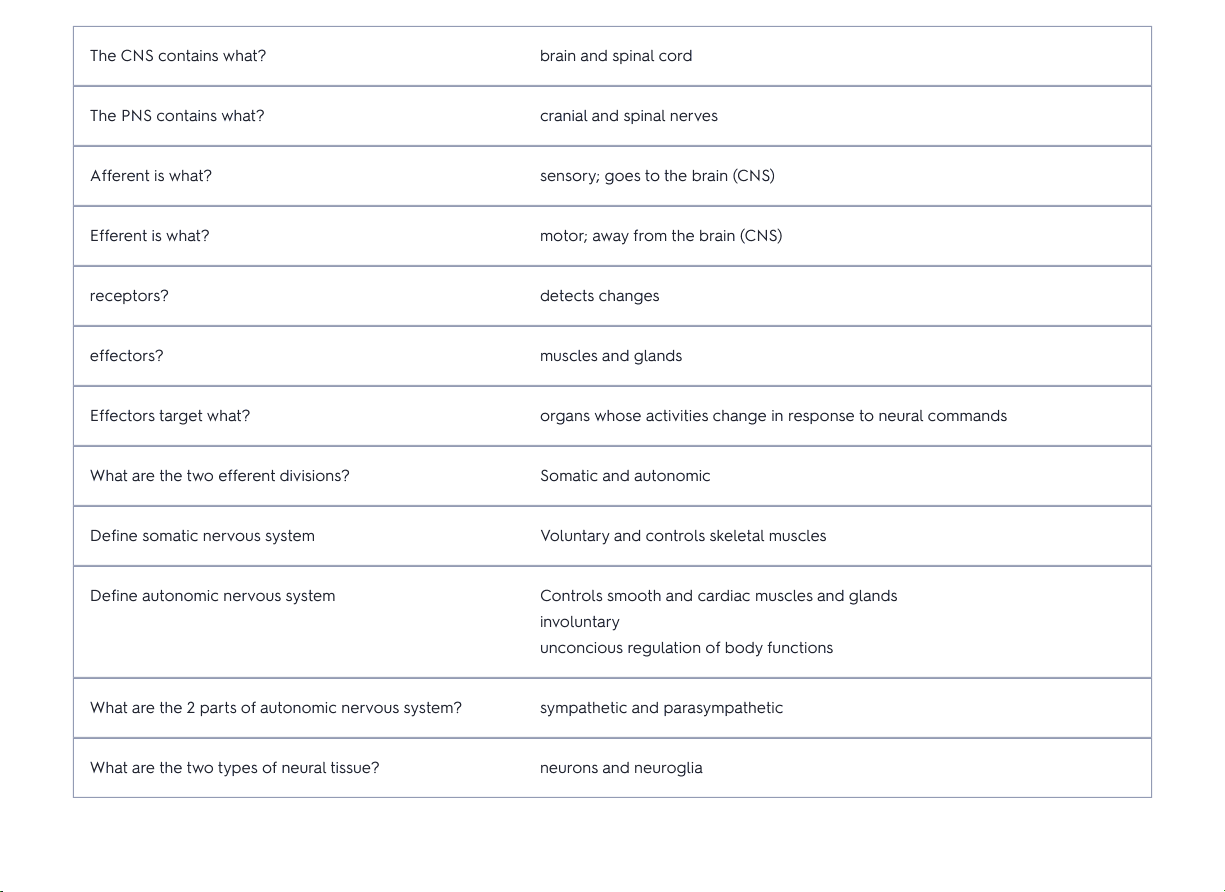
The CNS contains what? brain and spinal cord The PNS contains what? cranial and spinal nerves Afferent is what? sensory; goes to the brain (CNS) Efferent is what? motor; away from the brain (CNS) receptors? detects changes effectors? muscles and glands Effectors target what? organs whose activities change in response to neural commands What are the two efferent divisions? Somatic and autonomic Define somatic nervous system Voluntary and controls skeletal muscles Define autonomic nervous system Controls smooth and cardiac muscles and glandsinvoluntary unconcious regulation of body functions What are the 2 parts of autonomic nervous system? sympathetic and parasympathetic What are the two types of neural tissue? neurons and neuroglia
What are the 4 parts of the neuron? cell body, dendrites, axon and axon terminals What is the dendrites? receive signals What is the axon? carries signals away What is the axon terminal? synapse to connect What are the 3 types of neurons? unipolar, bipolar and multipolar Define unipolar only one process coming off; continuous define bipolar 2 processes; 1 dendrite coming in, 1 axon coming out define multipolar 2+ dendrites coming in, 1 axon coming out; most common in the CNS What are the 3 functional classifications of neurons? sensory/afferent, motor/efferent, interneurons What are the 4 types of neuroglial cells? astrocytes, oligodendrocytes, microglia, and ependymal cells What are astrocytes? blood/brain barriermaintain chemical environment
What are oligodendrocytes? myelinate axons and make myelin Myelin helps what? increase the speed of nerve transmission.Myelin is lipid rich
White matter has __________ and grey matter is __________ myelin; unmyelinated What is microglia? phagocytic cells from white blood cellsengulfing pathogens and waste
what is ependymal cells? line cavities and help with CFS. What are the two types of cells found in the PNS? Satellite cells and schwann cells What are satellite cells? maintain chemical environment in the PNS.protect cell bodies in PNS
What are schwann cells? they myelinate axons in the PNS. What does ganglia mean? swelling of cell bodies Bundles of axons are? nerves Spinal nerves = what? spinal cord
define postsynaptic neuron receiving signal; has receptors What happens when cholinergic synapses are activated? action potential arrives and depolarizes axon terminalACh is released and diffuses across synaptic cleft ACh binds to receptors and triggers depolarization of postsynaptic membraneACh is removed by AChE
What are other neurotransmitters? norepinephrine, dopamine, GABA, serotonine, nitric oxide, carbon monoxide Dopamine prevents what? unwanted muscle movement ACh and NE trigger what? depolarizationincreases chance of hitting threshold (Excitatory)
Dopamine, GABA and serotonine trigger what? hyperpolarizationfarther from threshold (inhibitory)
If all release excitatory?? action potential is triggered if all release inhibitory?? no action potential if half of both is released? they cancel each other out and no action potential What are the 6 regions of the brain? cerebrum, diencephalon, midbrain, pons, medulla oblongata, cerebellum Define cerebrum biggest and main partgray/white matter
Define diencephalon the "between" brain; parts of the brain between cerebral hemispheres and themidbrain. Thalamus's Define brain stem midbrain, pons and medulla oblongata cerebellum inferior and posterior portiondeals with balance
What is the purpose of CFS? cushions brain and spinal cordtransports nutrients, chemicals and wastes surrounds exposed surfaces of the CNSsupports the brain by "floating" it in fluid
Define CFS made by choroid plexuscirculates around absorbed across arachnoid granulations the primary areas are divided by what? central sulcus precentral gyrus of the frontal lobe contains? primary motor cortex
skeletal muscle has what type of movement? concious postcentral gyrus of parietal lobe contains? primary sensory cortex visual cortex =? occipital lobe gustatory cortex =? frontal lobe Auditory and olfactory cortex =? temporal lobe define corpus callosum connects left and right hemispheres define prefrontal cortex located in frontal lobecoordinates info from association areas of the entire cortex
left hemisphere is? language, analytical tasks and logical right hemisphere is? spatial analysis, emotional context and analyzing sensory input define fast memories specific bits of informationEX. Social security number
define skill memories learned motor skillEX. driving
define short-term memory doesn't last long but can be recalled immediately define long-term memory remains permanently define amnesia memory loss as a result from disease or trauma define limbic system deals with emotionsaids in long term memory storage and retrieval with help of hippocampus
define epithalamus posterior part contains pineal glandregulating day-night cycles
define thalamus all sensory info other than olfactory passes through define hypothalamus hormones, drives hunger/thirst and regulates body temperature define midbrain reticular formation deals with wakefullness what influences muscle tone? substantia nigra define pons deals with a little of respiration define ataxia disturbance of balance