
Animal Reproduction and Development: Stages, Modes, and Types, Study notes of Biology

An overview of animal reproduction and development, covering reproductive modes (asexual and sexual), stages of reproduction (gamete formation, fertilization, cleavage, blastula, gastrulation, organogenesis, and morphogenesis), and types of development (oviparous, ovoviviparous, and viviparous).

Typology: Study notes

Pre 2010

Uploaded on 09/17/2009

koofers-user-hmw-1
koofers-user-hmw-1 🇺🇸

10 documents

1 / 2

Toggle sidebar

This page cannot be seen from the preview

Don't miss anything!

bg1
Animal Reproduction and Development
BI 101, Prof. Baack 1
Animal Reproduction
and Development
Reproductive Modes
A) Asexual Reproduction
Examples: Binary Fission, Budding, Mitosis
B) Sexual Reproduction
But, Sexual reproduction is more “costly”
1. Specialized structures for gametes
2. Behavioral challenges (courtship)
3. Investment in offspring (nourishment)
Stages of Reproduction/ Development
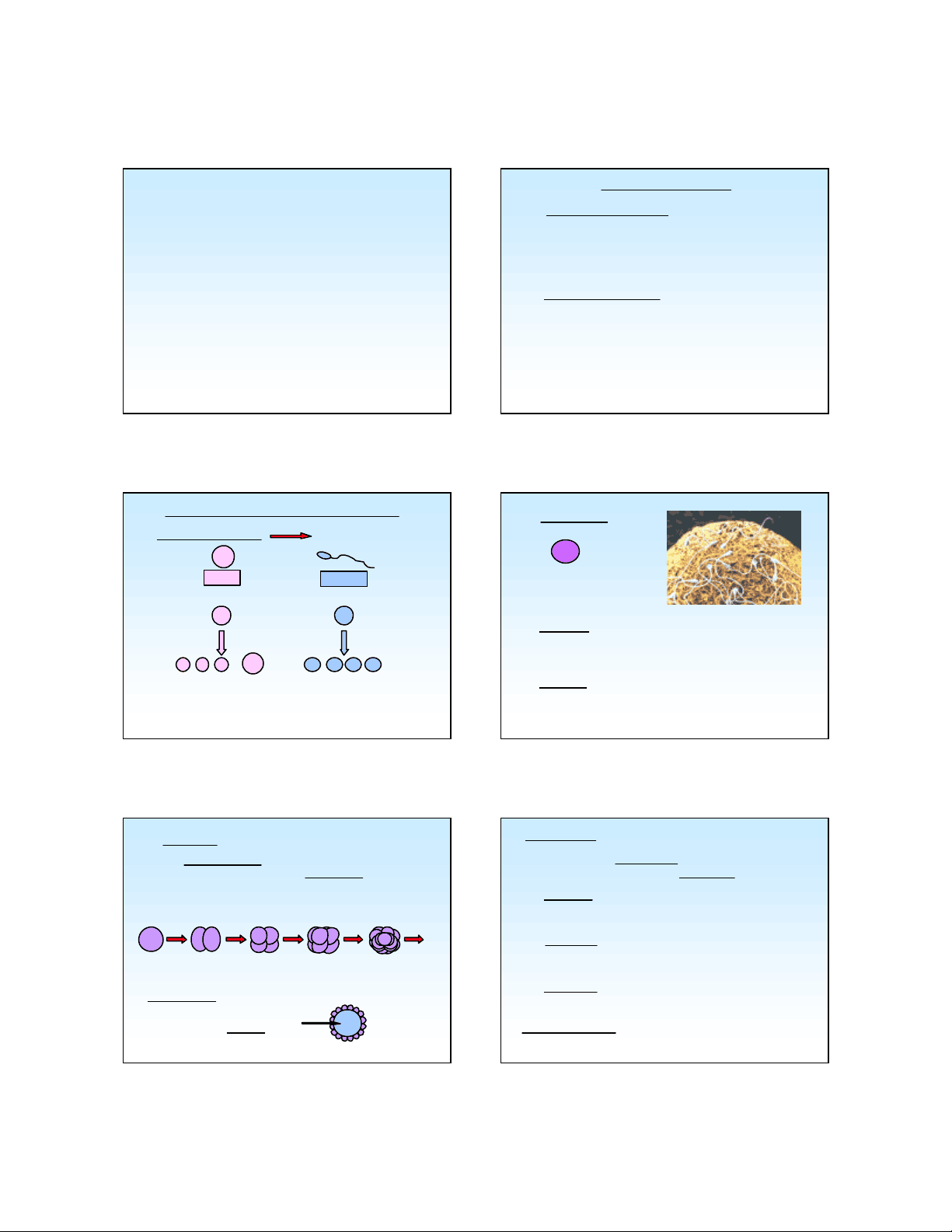
1) Gamete Formation MEIOSIS
Egg (n) Sperm (n)
Males produce 4 sperm
per germ cell
2n
n n n n
3 polar bodies
2n
n n n n
ovum 4 sperm cells
Gametes start out as (diploid) germ cells)
Females produce 1 egg
per germ cell
2) Fertilization
Zygote (2n)
Fertilization may occur…
b) Internally
land-dwellers
specialized structures for housing gametes
embryo more protected during development
a) Externally
aquatic habitats
gametes released into the environment
large numbers of gametes produced
3) Cleavage:
A cleavage furrow is formed as the egg dividesinto
numerous smaller cells called blastomeres
cleavage increases the number of cells but not the
overall volume of the egg
Early cleavage (2 -16 cells) Late cleavage (more than 16 cells)
4) Blastula: “hollow” ball of cells
Blastomeressurround a fluid-filled
cavity called a blastocoel
5) Gastrulation
a) Ectoderm
b) Mesoderm
c) Endoderm
cellular organization, invagination:
outermost layer
middle layer
innermost layer
cells become arranged into different germ layers
Cell differentiation:
pf2

Partial preview of the text

Download Animal Reproduction and Development: Stages, Modes, and Types and more Study notes Biology in PDF only on Docsity!

Animal Reproduction and Development

BI 101, Prof. Baack 1

Animal Reproduction

and Development

Reproductive Modes

A) Asexual Reproduction

  • Examples: Binary Fission, Budding, Mitosis

B) Sexual Reproduction

  • But, Sexual reproduction is more “costly”

1. Specialized structures for gametes

2. Behavioral challenges (courtship)

3. Investment in offspring (nourishment)

Stages of Reproduction/ Development

1) Gamete Formation MEIOSIS

Egg (n) (^) Sperm (n)

Males produce 4 sperm per germ cell

2n

n n n n

3 polar bodies

2n

n n n n

ovum 4 sperm cells

Gametes start out as (diploid) germ cells)

Females produce 1 egg per germ cell

2) Fertilization

Zygote (2n)

Fertilization may occur…

b) Internally

  • land-dwellers
  • specialized structures for housing gametes
  • embryo more protected during development

a) Externally

  • aquatic habitats
  • gametes released into the environment
  • large numbers of gametes produced

3) Cleavage:

  • A cleavage furrow is formed as the egg dividesinto numerous smaller cells called blastomeres
  • cleavage increases the number of cells but not the

overall volume of the egg

Early cleavage (2 -16 cells) (^) Late cleavage (more than 16 cells)

4) Blastula: “hollow” ball of cells

Blastomeres surround a fluid-filled cavity called a blastocoel

5) Gastrulation

a) Ectoderm

b) Mesoderm

c) Endoderm

  • cellular organization, invagination:
    • outermost layer
      • middle layer
      • innermost layer
  • cells become arranged into different germ layers
    • Cell differentiation:

Animal Reproduction and Development

BI 101, Prof. Baack 2

  • cell division, migration
  • tissue growth, folding
  • programmed cell death sculpts body parts

5) Organogenesis:

6) Morphogenesis:

Embryos may develop in several ways

A) Oviparous

  • Amniotic eggs have a fluid-filled sac to protect embryo
  • Some eggs encased in hard outer shell (birds)

B) Ovoviviparous

(“true” egg-layers)

C) Viviparous

  • young develop outside of the mother
  • feed off of egg yolk
  • hatch from egg
    • egg contained inside female
    • young feed off of yolk
    • “hatch” from egg within uterus
  • young develop inside mother
  • nourished directly by mother’s tissues ( placenta )
  • born live
  • mammals

Study Objectives

  1. Define asexual reproduction and give 3 examples.
  2. Define sexual reproduction. What are some costs of reproducing sexually?
  3. List the 7 stages of reproduction/development.
  4. Contrast external and internal fertilization. In general, which type of organisms carry out each of these processes?
  5. Define meiosis and fertilization. Contrast sperm and egg production.
  6. Define cleavage. How does cleavage occur and what does it accomplish?
  7. Define blastomere , blastula , and blastocoel.
  8. Explain what happens during gastrulation.
  9. What are the three germ layers? To what do these give rise in the mature organism?
  10. Define invagination. Define differentiation.
  11. Define organogenesis.
  12. Compare and contrast oviparous , ovoviviparous , and viviparous development.