Download Aromatic Compounds and more Study notes Chemistry in PDF only on Docsity!
Structure of benzene Page 119
Aromatic Compounds
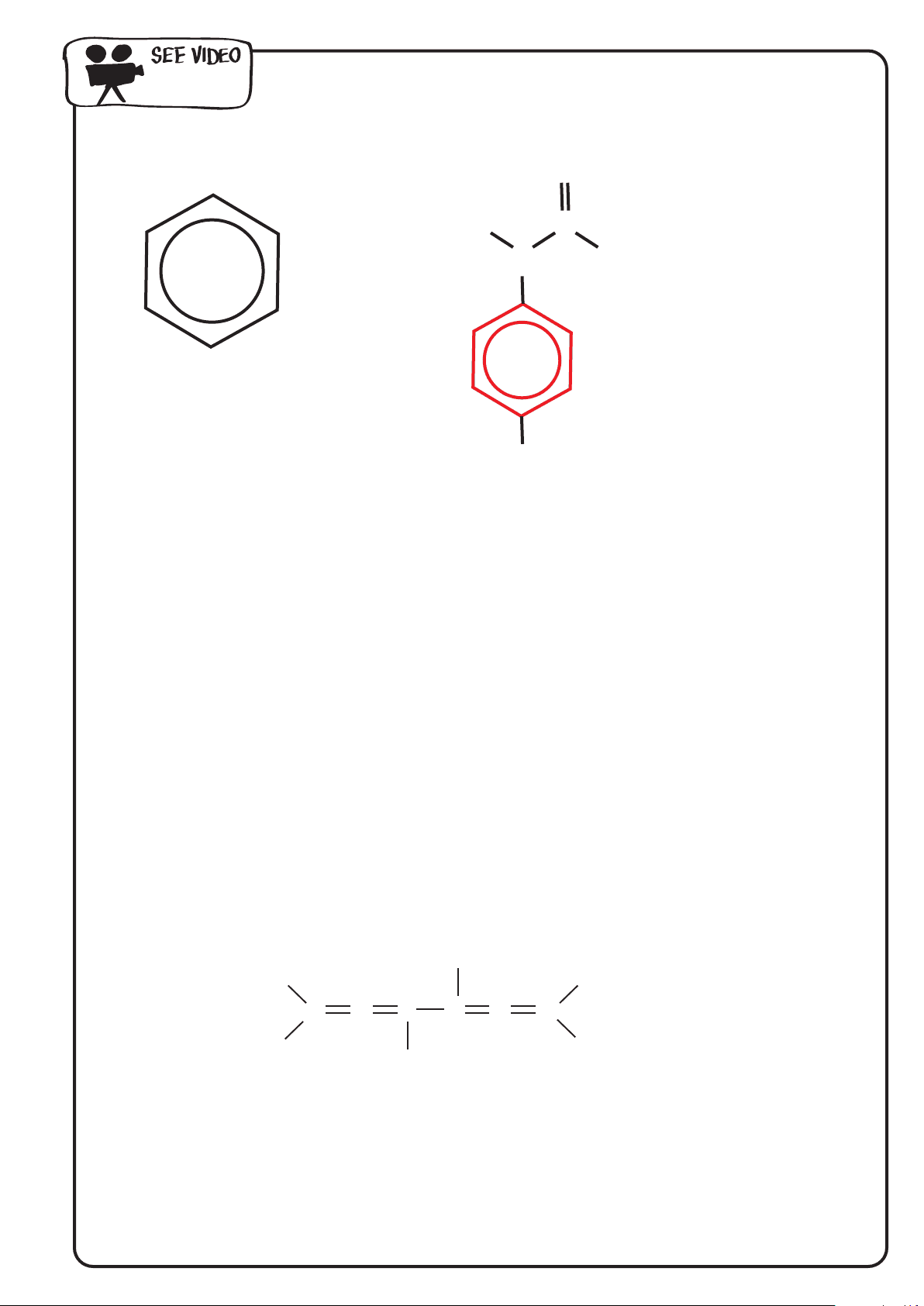
Aromatic compounds contain one or more benzene rings.
Benzene N
OH
H C
H
O
Paracetamol: This molecule contains a benzene ring and so is an aromatic compound
The strict chemical definition of what makes a compound aromatic is not required for A level chemistry but the term aromatic is derived from the latin word aroma meaning fragrance. However it should be noted that some aromatic compounds are in fact odourless.
Determination of the structure of benzene
The history for the discovery of the structure of benzene is an interesting one and is typical of how scientific theories evolve in the light of experimental evidence available at the time.
As early as 1825, Michael Faraday determined the empirical formula of benzene to be CH. Soon after it was confirmed that the molecular formula was C 6 H 6. It was suspected that owing to the high carbon to hydrogen ratio that benzene was an unsaturated compound, that is it contained carbon-carbon multiple bonds and was linear:
C C C C C C
H
H H
H
H
H
A suggested early non-cyclic unsaturated structure of benzene
28
Page 120 Structure of benzene
However, benzene does not undergo the electrophilic addition reactions typical of alkenes. It does not discolour bromine water for example which is a test for unsaturation.
when orange bromine water is added to benzene, it does not react and the bromine water does not discolour
In 1865, a german chemist called Kekulé suggested that benzene might be a ring structure with alternating double and single carbon to carbon bonds and he proposed a structure that we would call cyclohexa-1,3,5-triene.
the cyclohexa-1,3,5-triene structure proposed by Kekulé
However this structure still did not answer the question as to why benzene did not undergo the typical electrophilic addition reactions of alkenes.
28
Page 122 Structure of benzene
By doing this Lonsdale confirmed that the benzene molecule was flat, that all the bond angles were 120°, and, importantly, the carbon to carbon bond lengths were all the same. The carbon to carbon bond lengths were between those of a carbon to carbon single bond and carbon to carbon double bond.
all bond angles 120°
all carbon to carbon bond lengths the same (in between single and double)
six carbon atoms in a flat cyclic structure
Shape around each carbon
As a result of these finding the resonance model was developed which accounted for the experimental evidence.
Resonance model
With the resonance model of benzene, there are 6 carbons in a ring and 3 electrons from the outer shell of each carbon atom are used to form sigma bonds between two other carbon atoms and one hydrogen atom by direct overlap of orbitals. This then leaves a p-orbital with lobes above and below the plane of the molecule.
C C
H C C H
H H
C C
H H
28
Structure of benzene Page 123
28
C C
C C
C C
H H
H H
H H
The lobes of the p-orbitals merge above and below the plane of the molecule to produce pi clouds where the 6 pi electrons are delocalised meaning the electrons from the p orbitals are shared thoughout the entire ring rather than be just being shared in pairs between two carbon atoms as they would be in a normal carbon-carbon double bond.
pi clouds containing 6 delocalised pi electrons
The resonance model explains why benzene does not undergo the typical electrophilic addition reactions of alkenes as there are no high electron density carbon to carbon double bonds present that electrophiles can attack.
It also explains why the enthalpy of hydrogenation is lower than that expected for the Kekulé structure since the delocalisation of the electrons leads to a much more stable molecule which is lower in enthalpy. The difference between the enthalpy change expected for hydrogenation for the Kekulé structure and that observed for the benzene molecule is called the delocalised energy or resonance energy.
Enthalpy
Progress of reaction
∆H = -120 kJ mol -
∆H (^) expected = -360 kJ mol -
∆H = -208 kJ mol -
RESONANCE / DELOCALISATION ENERGY
Resonance/ delocalisation energy gives a measure of how much more the delocalised ring structure is stabilised compared with the Kekulé structure
Reactions of benzene Page 125
With benzene however, the pi electrons are not concentrated between 2 carbon atoms but are delocalised around the entire ring. The pi electron density is insufficient to induce a dipole in the non-polar bromine molecule.
C C
C C
C C
H H
H H
H H
pi electron density in benzene is insufficient to induce a dipole in the neutral bromine molecule
Br
Br
Although benzene will not react with weaker electrophiles like halogen molecules by themselves, it will react with halogens if a special type of catalyst called a halogen carrier is present. Halogen carriers include iron (III) halides like FeBr 3 and aluminium halides like AlCl 3. Iron itself added to a solution of halogen is also effective as you then form the iron halide in situ. The presence of a halogen carrier generates a much stronger electrophile of X +^ for example Br +^ or Cl +^ and is formed as follows:
Br 2 + A l Br 3 A l Br 4 -^ + Br +
Even then benzene undergoes electrophilic substitution reactions rather than electrophilic addition reactions where a hydrogen is substituted for the halogen.
Substitution reactions maintain the stability of the delocalised ring structure of benzene whereas if benzene underwent addition reactions the delocalised ring structure would be lost. It is energetically more favourable to maintain the delocalised ring structure.
Page 126 Reactions of benzene
29
The mechanism for electrophilic substitution of benzene goes like this:
Br+^ Br^ H
Br
H+
The electrophile is attracted to the high electron density of the benzene ring. Two pi electrons leave the pi ring and form a covalent bond with the electrophile
a short lived unstable intermediate is formed. The next step is very rapid. Two electrons from the carbon to hydrogen bond move to restore the pi ring structure...
...releasing a positive hydrogen ion
Nitration of benzene
The electrophile NO 2 +^ will react with benzene and the mechanism is similar to that for the positive halogen ion.
Since a H+^ is released, this can now react with the A l Br 4 -^ to regenerate the halogen carrier and consequently the halogen carrier is a catalyst as it is not consumed.
A l Br 4 -^ + H +^ A l Br 3 + HBr
NO 2 +^ NO 2 H
NO 2
H+
Page 128 Reactions of benzene
29
Nitro benzene is a useful as a starting material in the production of dyes, pesticides and medicines.
N
N
OH
N
OH
H C H
O
N
CH
H C N
O
CH 3 CH 3
CH 3
CH 3
A yellow dye isopruturon (pesticide)
paracetamol (medicine)
Toluene
A compound containing a methyl group on a benzene ring is not, surprisingly called methyl benzene but toluene. Toluene nitrates easier than benzene and can produce 2,4,6-trinitromethyl benzene which is more commonly known as TNT and is an explosive.
CH 3
Toluene
CH 3
NO (^2)
NO (^2)
NO (^2)
2,4,6-trinitromethyl benzene (TNT - explosive)
Friedal-Crafts reactions Page 129
30 Friedal-Crafts reactions
Adding groups onto a benzene ring has always been of interests to chemists as the resulting compounds may be useful. In the early days of synthetic chemistry, it was always very hard to replace one of the hydrogens in the benzene ring with an alkyl chain to make a substituted Benzene. This is because it involved breaking a carbon to hydrogen bond and making a carbon to carbon bond which is difficult to achieve.
However, in the late 1800s a French chemist, Charles Friedal and American chemist, James Crafts developed an electrophilic substitution reaction for adding on alkyl groups onto a benzene ring. This is referred to as a Friedal-Crafts reaction.
The mechanism is similar to the halogenation of benzene with a halogen carrier and the nitration using the NO 2 +^ ion that we have previously covered.
We will look at this example where we will add an ethyl group onto the benzene ring (^). We need to start with a halogenated ethane like chloroethane and add a halogen carrier like aluminium chloride although iron (III) chloride could also be used.
This will produce a reactive carbocation which is an electrophile and can attack the benzene ring.
CH 3 CH 2 Cl + AlCl 3 CH 3 CH 2 +^ + AlCl 4 - carbocation (electrophile)
A pair of electrons from the benzene ring are attracted towards the positively charged carbocation creating an intermediate with a positive charge within the ring.
H
H C C
H
H
H
H
H C C
H
H
H
H
C l A l C l
C l
C l
-
intermediate
Friedal-Crafts reactions Page 131
30 Friedal-Crafts reactions
Further substitutions can be minimised by having an excess of benzene which reduces the probability of the reactive carbocation coming into contact with an already substituted benzene molecule. The different substituted compounds can be separated by fractional distillation.
Friedal-Crafts acylation
Alternatively an acyl chloride like ethanoyl chloride can be used in Friedal-Crafts reactions in place of the haloalkane. The resulting ketone group on the benzene ring is electron withdrawing rather than electron donating and will pull negative charge from the benzene ring and make the ring less susceptible to electrophilic attack and consequently only produce a singly substituted product.
H C C
H
H O
C l
ethanoyl chloride
A l C l 3
relux under anhydrous conditions
H C C
H
H O
+ HC l
ketone group is electron withdrawing and pulls electrons away from the benzene ring making it less susceptible to electrophilic attack and resistant to further substitutions
The ketone can be reduced in a further reaction to make an alkyl chain if desired.
Page 132 Naming aromatic compounds
31
In Year 1 we learnt some IUPAC rules for the systematic naming of simple organic molecules. We will now extend the application of these rules to cover some aromatic compounds.
The aromatic molecules you come across may have benzene as the stem part of the name. The substituent groups on the ring often give the prefixes which you need to name and number if there is more than one possibility.
Naming aromatic compounds
C l Br
Here we have a benzene ring in which two hydrogens have been substituted with a bromine and a chlorine. You assign the highest priority position 1, to the group that comes first alphabetically. The substituent groups are named just like they were when we worked with the aliphatic molecules in year 1. So in this case we have a bromo group and a chloro group and the bromo, being alphabetically first, is given position 1 and the chloro group position 3. As we learned last year, numbering of the ring is done so that the lowest numbers are used.
C l Br
Number the positions on the ring to give the lowest numbers so here the chloro group is in position 3
C l Br
The chloro group is NOT in position 5
Page 134 Naming aromatic compounds
31
CH 3
NO 2 NO 2
1-methyl-2,4-dinitrobenzene Do note how we use hyphens to separate numbers from letters and commas to separate numbers.
In a substituted benzene, the benzene ring does not always have the highest priority functional group. For example, in this compound, the ketone group has the higher priority and so the STEM part of the name is ethanone.
H C C
H
H O
In such cases, the C 6 H 5 group is given the name phenyl and so this compound is 1-phenylethanone. Note: The prefix is 1-phenyl as the phenyl group (C 6 H 5 ) is in position 1 on the ethanone chain.
Phenols Page 135
32 Phenols
Phenols are aromatic alcohols and the structure of phenol itself consists of a benzene ring with an OH group replacing one of the hydrogens on one of the 6 carbon atoms.
OH
Benzene Phenol
For a compound to be considered a phenol it must have the oxygen from the OH group attached directly to the benzene ring. Having an oxygen bonded to a carbon from a benzene ring means one of the lone pairs of electrons in the p-orbitals of the oxygen can merge with the pi cloud of delocalised electrons from the aromatic ring and thereby increase the pi electron density of the ring.
C C
C C
C C
H H
H O
H H
H
C C
C C
C C
H H
H O
H H
H
lone pair in p orbital of oxygen
pi electron density of delocalised ring increased in phenol
The increased pi electron density activates the ring and makes phenols more reactive to electrophiles than benzene.
For example, when bromine water is added to benzene there is no reaction and the bromine water does not discolour but when bromine is added to phenol a white precipitate of 2,4,6-tribromophenol results.
Phenols Page 137
32
This is unlike OH groups in non aromatic alcohols which are not acidic.
C C O
H
H H
H
H H
the hydrogens from the OH group in aliphatic alcohols like ethanol are NOT acidic
Salts of phenols
Phenol will react with reactive metals like sodium and produce the sodium salt and hydrogen gas is given off.
OH
O
2 2 + H 2
sodium phenoxide (This is an ionic compound and you should show the charges) The salt can also be produced by reacting phenol with a base like potassium hydroxide where the potassium salt is produced.
OH
O
2 2 + H 2 O
Phenols being only very weak acids will not react with carbonates like sodium carbonate and so will not fizz if treated with carbonates; unlike carboxylic acids like ethanoic acid.
Page 138 2- and 4- directing effects of phenols
(^32) 2- and 4- directing effects of phenols
The hydrogens bonded to the carbon atoms in the aromatic ring of phenol are not all equivalent when it comes to being substituted during electrophilic substitution.
OH
H
H
H
H
H
The hydroxyl group on the benzene ring in phenol is electron donating meaning it pushes negative charge into the aromatic ring. OH
H
H
H
H
H
When an electron donating group is attached to a benzene ring, it results in hydrogens in positions 2 and 4 becoming the preferred hydrogens to be substituted. The electron donating effect of the hydroxyl group activates these hydrogens and these are substituted at a faster rate. OH
H
H
H
H
H