
Article 34 TFEU - Justifications-EU Law., Study notes of European Union law

This document focuses on Article 34 TFEU, which prohibits quantitative restrictions and measures having equivalent effect (MEQRs) on imports between EU Member States. It explains the scope of MEQRs, referencing key cases like Cassis de Dijon and Keck, and discusses the evolution of the "market access" test. The document also covers justifications for restrictions under Article 36 TFEU, including public morality, health, and environmental protection, and expands on Cassis mandatory requirements for indirect hindrances. It provides a structured analysis of when measures fall under Article 34 and how they can be justified, emphasizing proportionality and legitimate objectives.

Typology: Study notes

2024/2025

Available from 03/07/2025

charles-khama
charles-khama 🇮🇹

3.2

(20)

7.4K documents

1 / 10

Toggle sidebar

This page cannot be seen from the preview

Don't miss anything!

bg1
pf3
pf4
pf5
pf8
pf9
pfa

Partial preview of the text

Download Article 34 TFEU - Justifications-EU Law. and more Study notes European Union law in PDF only on Docsity!

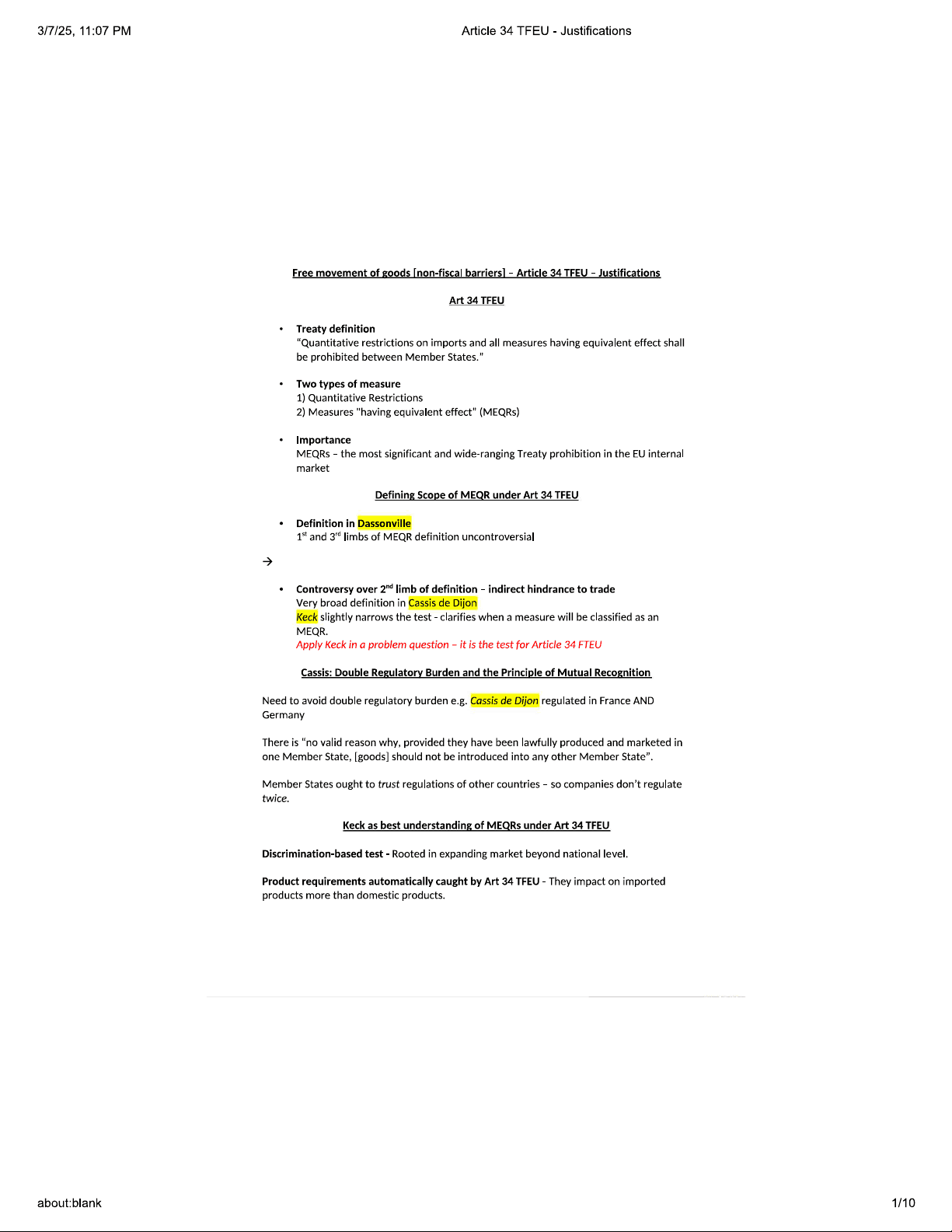
3/7/25, 11:07 PM about:blank Article 34 TFEU - Justifications Free movement of goods [nor iscal barriers] - Article 34 TFEt justifications Art 34 TFEU Treaty definition ions on imports and all measures having equivalent effect shall be prohibited between Member States.” ‘Two types of measure 1) Quantitative Restrictions 2) Measures "having equivalent effect” (MEQRs) + Importance MEQRs - the most significant and wide-ranging Treaty prohibition in the EU internal market Defining Scope of MEQR under Art 34 TFEU * Definition in 1* and 3° limbs of MEQR defi in uncontroversial Controversy over 2” limb of definition - Very broad definition in Keck slightly narrows the test - clarifies when a measure will be classified as an MEQR. Apply Keck in a problem question - it is the test for Article 34 FTEU irect hindrance to trade Cassis: Double Regulatory Burden and the Principle of Mutual Recognition Need to avoid double regulatory burden e.g. Cassis dé Dijon regulated in France AND Germany There is “no valid reason why, provided they have been lawfully produced and marketed in one Member State, [goods] should not be introduced into any other Member State”. Member States ought to trust regulations of other countries - so companies don't regulate twice. Keck as best understanding of MEQRs under Art 34 TFEU Discrimination-based test - Rooted in expanding market beyond national level. Product requirements automatically caught by Art 34 TFEU - They impact on imported products more than domestic products. 1/10