
Assignment 7 for Algorithms and Data Structures | CS 2420, Assignments of Computer Science

Material Type: Assignment; Professor: Jiang; Class: Algorithms and Data Structures--CS 3; Subject: Computer Science; University: Utah State University; Term: Fall 2008;

Typology: Assignments

Pre 2010

Uploaded on 07/30/2009

koofers-user-vcu
koofers-user-vcu 🇺🇸

10 documents

1 / 4

Toggle sidebar

This page cannot be seen from the preview

Don't miss anything!

bg1
Written 7 Page 1
CS 2420 Fall 2008
Written 7 – 10 Points
Due December 5, 2008
Turn in your written homework by folding it in half lengthwise and putting your names on the
outside or submit through eagle.
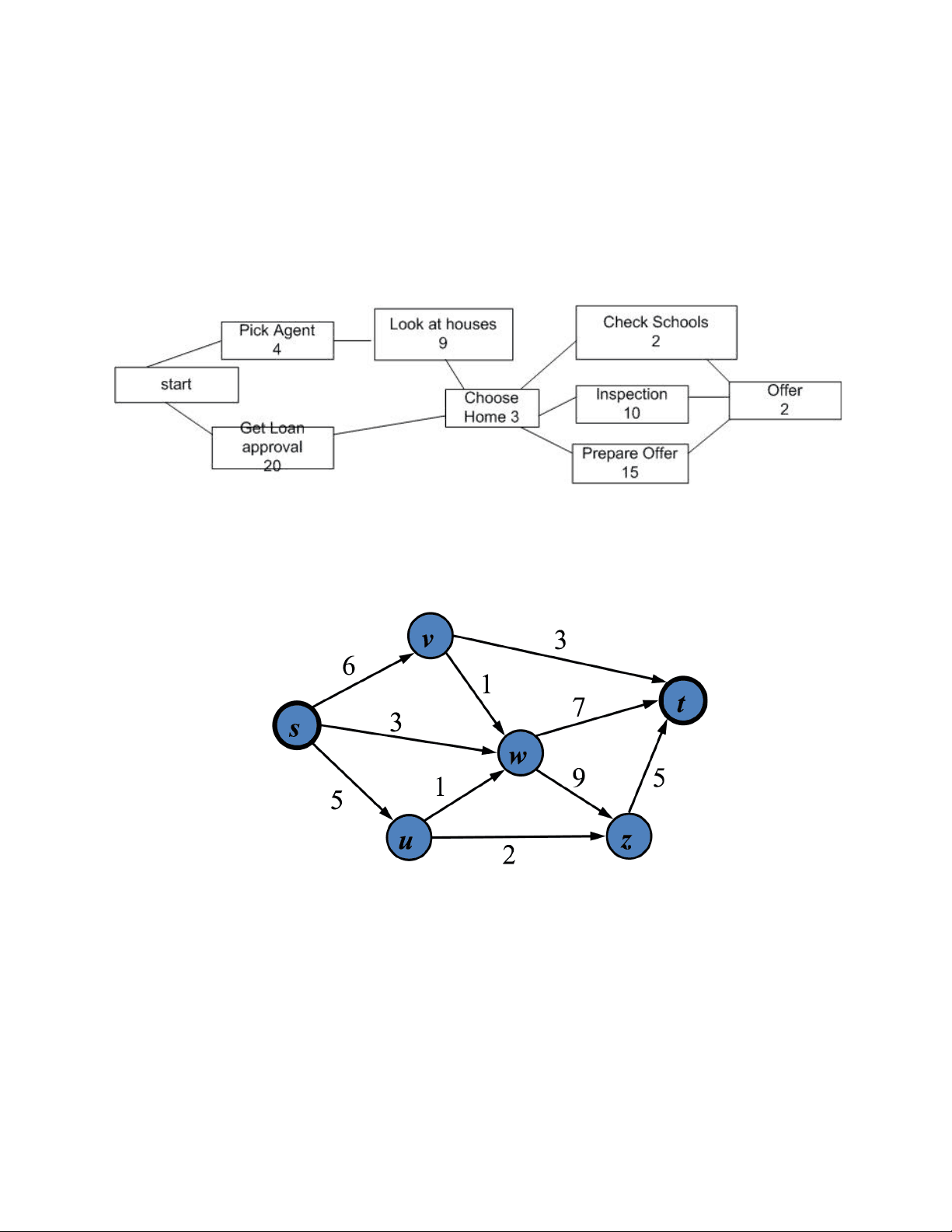
1. For the graph below for buying a home, create an event graph (by making the nodes arcs
and adding dummy arcs) show the critical path and the slack on each edge.
2. In the graph below, show the maximum flow. Show each step of your algorithm,
including the augmenting paths.
3. Find the minimum spanning tree for the graph shown below using Kruskal’s algorithm.
Show your work.
pf3
pf4

Partial preview of the text

Download Assignment 7 for Algorithms and Data Structures | CS 2420 and more Assignments Computer Science in PDF only on Docsity!

CS 2420 Fall 2008 Written 7 – 10 Points Due December 5, 2008 Turn in your written homework by folding it in half lengthwise and putting your names on the outside or submit through eagle.

  1. For the graph below for buying a home, create an event graph (by making the nodes arcs and adding dummy arcs) show the critical path and the slack on each edge.
  2. In the graph below, show the maximum flow. Show each step of your algorithm, including the augmenting paths.
  3. Find the minimum spanning tree for the graph shown below using Kruskal’s algorithm. Show your work.

__

  1. Using Prim’s algorithm, show the steps of finding the minimal spanning tree of the following graph. Start at A:
  2. For each graph below, indicate whether there is a. a Hamiltonian tour b. an Eulerian tour c. both d. neither
  1. For the graph below, find the strongly connected components using two depth-first searches (as in section 9.6.5). Show each step. The post order traversal number. The reverse graph. The nodes in each strongly connected component.