Average Velocity of a Car: Calculating the Continuous Function's Average Value, Exams of Advanced Calculus

How to find the average velocity of a car over a given time period using the concept of the average value of a function. It discusses the importance of considering the velocity between observations and the definition of average value of a function. The document also includes an example of finding the average value of the function sin(x) on the interval [0, π].

Typology: Exams

2021/2022

Uploaded on 09/27/2022

laalamani
laalamani 🇺🇸

5

(2)

218 documents

1 / 3

Toggle sidebar

This page cannot be seen from the preview

Don't miss anything!

bg1
Average Value of a Function
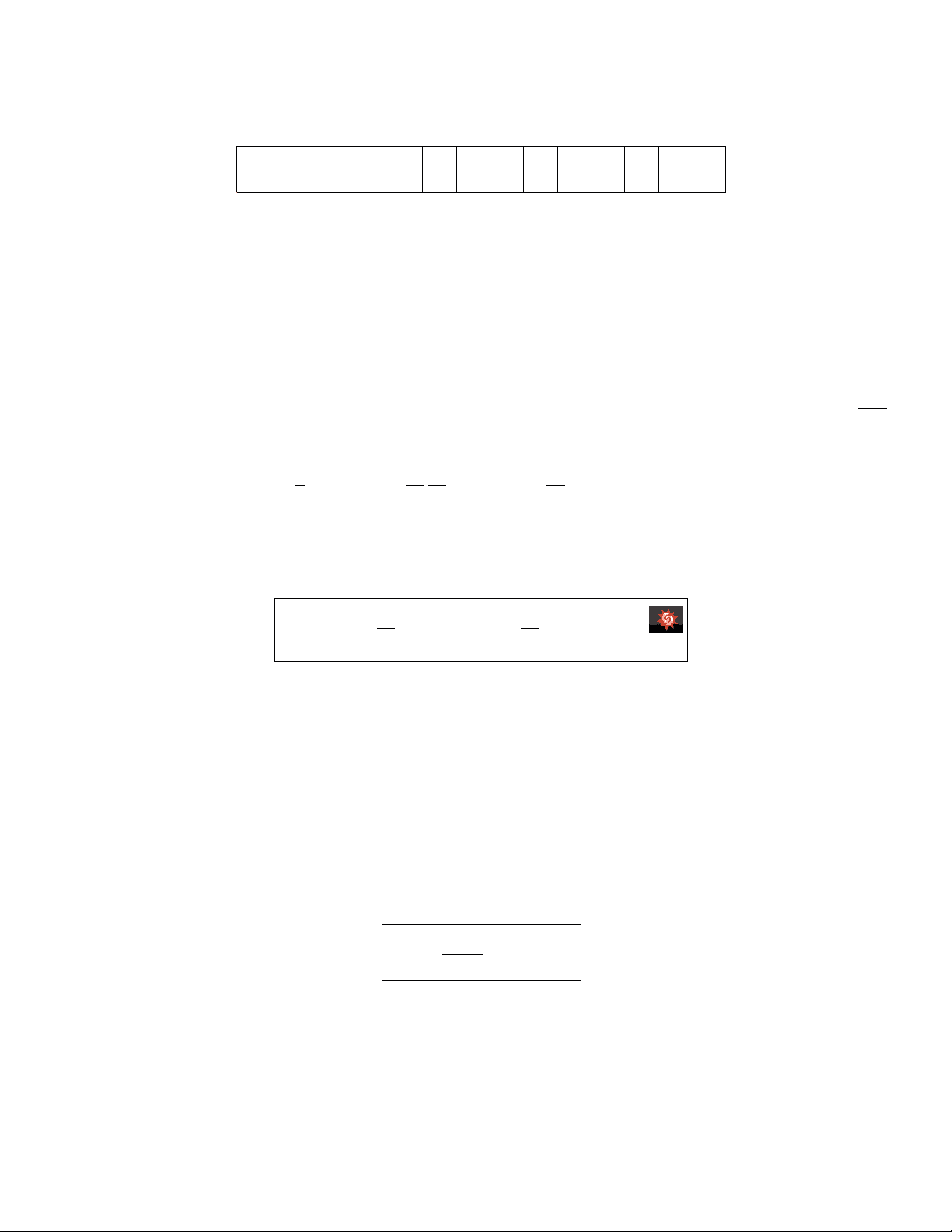
The table below shows a record of the velocity of a car in miles per hour every 5 seconds over a period
of 50 seconds:
T ime(s) 0 5 10 15 20 25 30 35 40 45 50
V elocity(v(t)) 0 20 30 45 50 60 55 50 60 65 70
To find the average speed of the car in the 50 second time period, we could use the average of the data
given above (omitting the 0 mph when t= 0)
20+30+45+50+60+55+50+60+65+70
10 =
However these numbers do not take into consideration the velocity of the car at the many points in the
5 second intervals between the observations and the velocity may vary on these intervals. Since velocity
is a continuous function, we do not expect it to vary wildly on a small interval. To get a better estimate
of the average velocity we could take observations over smaller time intervals with length x=500
n
and compute the average of the collected data
1
n
n
X
i=1
v(xi) = 1
50
50
n
n
X
i=1
v(xi) = 1
50
n
X
i=1
v(xi)∆x.
In fact we define the average velocity of the car over the time interval [0,50] to be the limit of this sum
as the time intervals approach zero. Thus the average velocity of the car over the 50 second period is
given by
vave = lim
x0
1
50
n
X
i=1
v(xi)∆x=1
50 Z50
0
v(t)dt.
(Note if we do not have a formula for v(t) or a way to find an antiderivative for v(t), the best way to
calculate the velocity is to use data with as many observations as possible as above.)
Note we might also calculate the average velocity of the car on the time interval [0,50] by calculating
the change in displacement and dividing by 50. Why does this give us the same answer?
Definition If f(x) is a function defined on the interval [a, b], the average value of fon the interval [a, b]
is
fave =1
baZb
a
f(x)dx.
(provided that fis integrable on [a, b].)
Example Find the average value of f(x) = sin xon the interval [0, π].
1
pf3

Partial preview of the text

Download Average Velocity of a Car: Calculating the Continuous Function's Average Value and more Exams Advanced Calculus in PDF only on Docsity!

Average Value of a Function The table below shows a record of the velocity of a car in miles per hour every 5 seconds over a period of 50 seconds:

T ime(s) 0 5 10 15 20 25 30 35 40 45 50 V elocity(v(t)) 0 20 30 45 50 60 55 50 60 65 70

To find the average speed of the car in the 50 second time period, we could use the average of the data given above (omitting the 0 mph when t = 0)

20 + 30 + 45 + 50 + 60 + 55 + 50 + 60 + 65 + 70 10

However these numbers do not take into consideration the velocity of the car at the many points in the 5 second intervals between the observations and the velocity may vary on these intervals. Since velocity is a continuous function, we do not expect it to vary wildly on a small interval. To get a better estimate of the average velocity we could take observations over smaller time intervals with length ∆x = (^50) n−^0 and compute the average of the collected data

1 n

∑^ n

i=

v(xi) =

n

∑^ n

i=

v(xi) =

∑^ n

i=

v(xi)∆x.

In fact we define the average velocity of the car over the time interval [0, 50] to be the limit of this sum as the time intervals approach zero. Thus the average velocity of the car over the 50 second period is given by

vave = lim ∆x→ 0

∑^ n

i=

v(xi)∆x =

0

v(t)dt.

(Note if we do not have a formula for v(t) or a way to find an antiderivative for v(t), the best way to calculate the velocity is to use data with as many observations as possible as above.)

Note we might also calculate the average velocity of the car on the time interval [0, 50] by calculating the change in displacement and dividing by 50. Why does this give us the same answer?

Definition If f (x) is a function defined on the interval [a, b], the average value of f on the interval [a, b] is

fave =

b − a

∫ (^) b

a

f (x)dx.

(provided that f is integrable on [a, b].)

Example Find the average value of f (x) = sin x on the interval [0, π].

Note that if f (x) ≥ 0 on the interval [a, b], then (b−a)fave =

∫ (^) b a f^ (x)dx^ = area under the curve^ y^ =^ f^ (x) on the interval [a, b]. Hence a rectangle with base b − a and height fave has the same area as that under the curve y = f (x) on the interval [a, b].

2

1

    • 1
    • 2

-^! 2 –^! 4! 4! 2 34!^!^54!

2/!

g ( x ) = (^2)!

f ( x ) = sin ( x )

Mean Value Theorem for Integrals

If f is a continuous function on [a, b], then there exists a number c in [a, b] such that

f (c) = fave =

b − a

∫ (^) b

a

f (x)dx

that is (^) ∫ b

a

f (x)dx = f (c)(b − a).

Proof We can apply the mean value theorem for derivatives to the function

F (x) =

∫ (^) x

a

f (t)dt

to get F (b) − F (a) b − a

= F ′(c)

for some c in the interval [a, b]. Hence we get

1 b − a

∫ (^) b

a

f (x)dx = f (c)

for some c in the interval [a, b].

Note We see with f (x) = sin x above that c is not necessarily unique.

Example (a) Find the average value of f (x) = 3x^2 − 3 on the interval [1, 3].