Download The Rise of the Byzantine Empire: A Study of Justinian and Theodora and more Exams Art in PDF only on Docsity!
Byzantine^ Empire
The
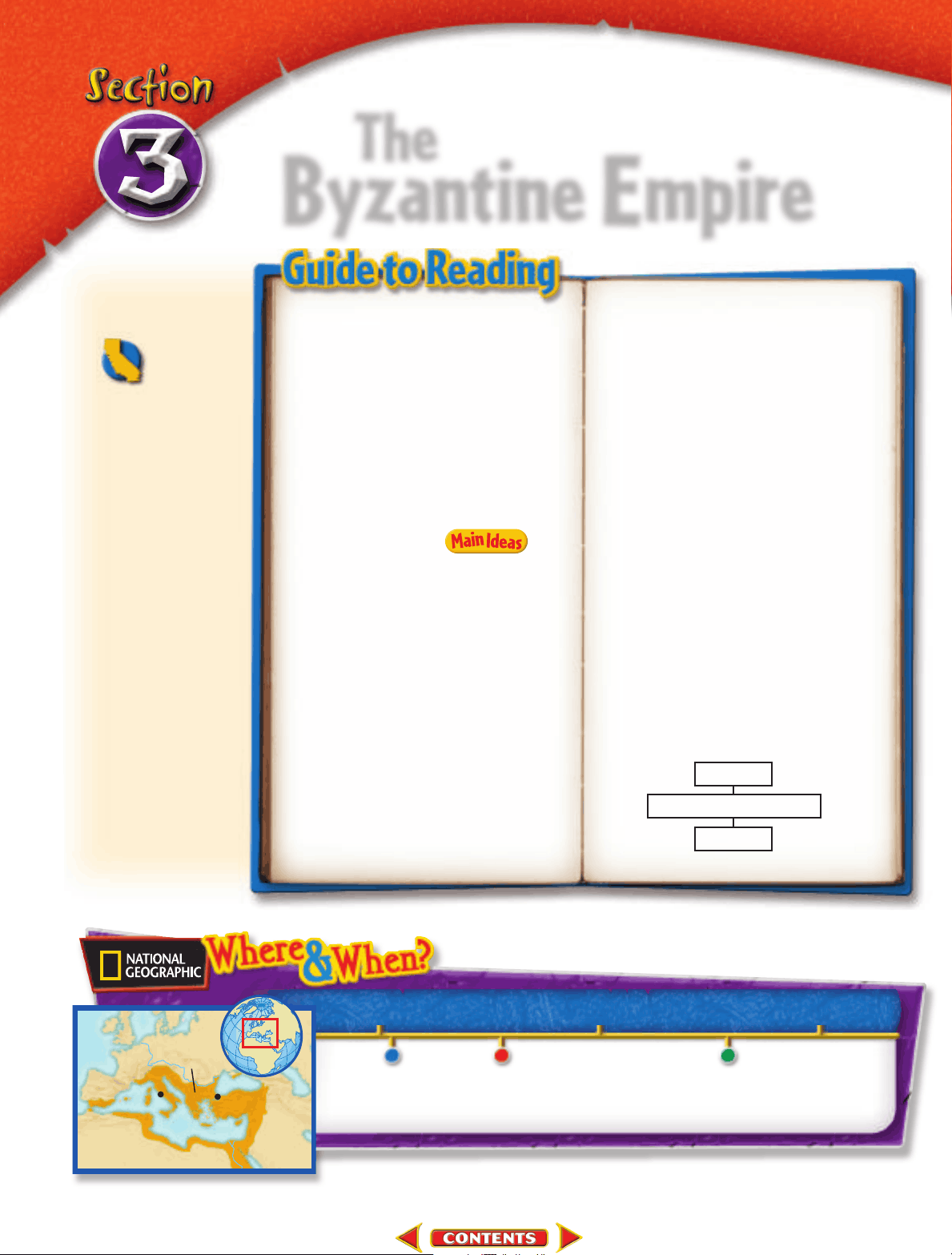
A .D. 527
Emperor Justinian begins rule
A .D. 565
Justinian dies
A .D. 537
Hagia Sophia completed
Constantinople Rome
SPAIN ITALY
BALKAN PENINSULA
ASIA MINOR
EGYPT
A A. .DD. 525. 525 AA. .DD. 550. 550 AA ..DD. 575. 575
Looking Back, Looking Ahead In the last section, you learned that even though the Roman Empire in the West fell, the Eastern Roman Empire survived and prospered. It became known as the Byzantine Empire. The Byzantines developed a new civilization based on Greek, Roman, and Christian ideas.
Focusing on the
- The Eastern Roman Empire grew rich and powerful as the Western Roman Empire fell. (page 485)
- The policies and reforms of Emperor Justinian and Empress Theodora helped make the Byzantine Empire strong. (page 486)
- The Byzantines developed a rich culture based on Roman, Greek, and Christian ideas. (page 489)
Locating Places Black Sea
Aegean Sea (ih•JEE•uhn)
Meeting People
Justinian (juh•STIH•nee•uhn)
Theodora ( THEE • uh•DOHR•uh)
Belisarius ( BEH • luh•SAR•ee•uhs)
Tribonian (truh•BOH•nee•uhn)
Content Vocabulary
mosaic (moh•ZAY•ihk)
saint (SAYNT)
regent (REE•juhnt)
Academic Vocabulary
income (IHN•KUHM )
rely (rih•LY)
enormous (ih•NAWR•muhs)
Reading Strategy Cause and Effect Complete a chart to show the causes and effects of Justinian’s new law code.
Causes New Code of Laws Effects
History Social Science Standards WH7.1 Students analyze the causes and effects of the vast expansion and ultimate disintegration of the Roman Empire.
484 CHAPTER 10 • Roman Civilization
WH7.1.3 Describe the establishment by Constantine of the new capital in Constantinople and the development of the Byzantine Empire, with an emphasis on the consequences of the development of two distinct European civilizations, Eastern Orthodox and Roman Catholic, and their two distinct views on church-state relations.
CHAPTER 10 • Roman Civilization 485
The Rise of the Byzantines
The Eastern Roman Empire grew rich
and powerful as the Western Roman Empire fell.
Reading Connection Think of your own community.
How have groups of people from different backgrounds
contributed to its character? What would your town or
city be like without these contributions from all the dif-
ferent groups? Read to learn about the different groups
that made up the Byzantine Empire.
The Eastern Roman, or Byzantine, Empire reached a high point in the A.D. 500s. At this time, the empire stretched west to Italy, south to Egypt, and east to the border with Arabia. Greeks made up the empire’s largest group, but many other peoples were found within the empire. They included Egyptians, Syrians, Arabs, Armenians, Jews, Persians, Slavs, and Turks.
Why Is Constantinople Important? In the last section, you learned that Emperor Constantine moved the capital of the Roman Empire from Rome to a new city called Constantinople. Constantine’s city became the capital of the Byzantine Empire. By the A.D. 500s, Constantinople had become one of the world’s great cities. One reason for Constantinople’s success was its location. It lay on the waterways between the Black Sea and the Aegean Sea
(ih • JEE • uhn). Its harbors offered a safe shel-
ter for fishing boats, trading ships, and war- ships. Constantinople also sat at the crossroads of trade routes between Europe and Asia. The trade that passed through made the city extremely wealthy. Constantinople had a secure land loca- tion. Residing on a peninsula, Constantinople was easily defended. Seas protected it on three sides, and on the fourth side, a huge wall guarded the city. Invaders could not eas- ily take Constantinople.
Influence of Greek Culture The Byzantines at first followed Roman ways. Constan- tinople was known as the “New Rome.” Its public buildings and palaces were built in the Roman style. The city even had an oval arena called the Hippodrome, where chariot races and other events were held. Byzantine political and social life also were based on that of Rome. Emperors spoke Latin and enforced Roman laws. The empire’s poor people received free bread and shows. Wealthy people lived in town or on large farming estates. In fact, many of them had once lived in Rome.
The ancient walled city of Constantinople
Web Activity Visit ca.hss.glencoe.com and click on Chapter 10 — Student Web Activity to learn more about Roman civilization.
Stapleton Collection, UK/Bridgeman Art Library
CHAPTER 10 • Roman Civilization 487
Justinian’s wife, the empress Theodora
( THEE • uh • DOHR • uh), helped him run the
empire. Theodora, a former actress, was intelligent and strong-willed, and she helped Justinian choose government offi- cials. Theodora also convinced him to give women more rights. For the first time, a Byzantine wife could own land. If she became a widow, she now had the income to take care of her children. In A. D. 532 Theodora helped save Justinian’s throne. Angry taxpayers threat- ened to overthrow Justinian and stormed the palace. Justinian’s advisers urged him to leave Constantinople. Theodora, however, told him to stay and fight. Justinian took Theodora’s advice. He stayed in the city and crushed the uprising. By doing this, Justinian not only restored order but also strengthened his power to rule.
Justinian’s Conquests Justinian wanted to reunite the Roman Empire and bring back Rome’s glory. To do this, he had to conquer Western Europe and northern Africa. He
ordered a general named Belisarius (BEH •
luh • SAR • ee • uhs) to strengthen and lead the
Byzantine army. When Belisarius took command, he reor- ganized the Byzantine army. Instead of foot soldiers, the Byzantine army came to rely on cavalry—soldiers mounted on horses. Byzantine cavalry wore armor and carried bows and lances, which were long spears. During Justinian’s reign, the Byzantine military conquered most of Italy and northern Africa and defeated the Persians in the east. However, Justinian conquered too much too quickly. After he died, the empire did not have the money to main- tain an army large enough to hold all of the territory in the west. About three years after he died, much of northern Italy was lost to an invading tribe of Germans.
Justinian’s Law Code Justinian decided that the empire’s laws were disorganized and too difficult to understand. He ordered a group of legal scholars headed
by Tribonian (truh • BOH • nee • uhn) to inter-
pret and reform the law code. The group’s new simplified code became known as the Justinian Code. Officials, businesspeople, and individuals could now more easily understand the empire’s laws. Over the years, the Justinian Code has had a great influence on the laws of almost every country in Europe. Explain What did Justinian accomplish during his reign?
EMPRESS THEODORA c A.D. 500–
Theodora began life in the lower class of Byzantine society but rose to the rank of empress. The historian Procopius recorded the events of her early life. According to Procopius, Theodora’s father worked as a bear keeper at the Hippodrome. After his death, Theodora followed her mother’s advice and became an actress. A career in acting was not as glamorous then as it is now. It was a job of the lower class, like wool spinning, which was Theodora’s other job. Even though Theodora was of the lower class, she began dating Justinian. Justinian was attracted to Theodora’s beauty and intelligence. Because Justinian wanted to marry Theodora, his uncle, the emperor, changed the law that prevented upper-class nobles from marrying actresses. The two were married in A.D. 525. Justinian considered Theodora his intellectual equal. In his writings, Justinian said he asked for Theodora’s advice on laws and policies. At Theodora’s urging, he granted more rights to women. Some historians believe Theodora had great power within the royal court, perhaps more than Justinian. For example, nearly all the laws passed during Theodora’s reign as empress mention her name. Theodora and Justinian had no children together. When Theodora died from cancer in A.D. 548, Justinian was overcome with grief. He had her portrait incorporated into many works of art, including numerous Byzantine mosaics.
488
Empress Theodora advises Emperor Justinian.
“She was extremely clever and had a biting wit.” —Procopius, The Secret History
Name a modern-day female political leader that you think has great influence in making and changing laws. Explain your choice.
WH7.1.3 Describe the establishment by Constantine of the new capital in Constantinople and the development of the Byzantine Empire, with an emphasis on the consequences of the development of two distinct European civilizations, Eastern Orthodox and Roman Catholic, and their two distinct views on church-state relations.
Andre Durenceau/National Geographic Society Image Collection
Byzantine Art and Architecture The Byzantine Empire lasted approximately 1,000 years. For much of that chapter in history, Constantinople was the largest and richest city in Europe. The Byzantines were highly educated and creative. They preserved and passed on Greek culture and Roman law to other peoples. They gave the world new tech- niques in the arts. Justinian and many of his successors supported artists and architects. They ordered the building of churches, forts, and public buildings throughout the empire. Constantinople was known for its hundreds of churches and palaces. One of Justinian’s greatest achievements was building the huge church called
Hagia Sophia (HAH • jee • uh soh • FEE • uh),
or “Holy Wisdom.” It was completed in A.D. 537 and became the religious center of the Byzantine Empire. It still stands today in Istanbul. Inside Hagia Sophia, worshipers could see walls of beautiful marble and
mosaics. Mosaics (moh • ZAY • ihks) are pic-
tures made from many bits of colored glass or stone. They were an important type of art in the Byzantine Empire. Mosaics mainly showed figures of saints (SAYNTS), or Christian holy people.
Byzantine Women The family was the foundation of social life for most Byzantines. Religion and the government stressed the importance of marriage and family life. Divorces were rare and diffi- cult to get. Byzantine women were not encour- aged to lead independent lives. They were expected to stay home and take care of their families. Despite this tradition, women did gain some important rights, thanks to Empress Theodora. Some
Byzantine Mosaics Imagine taking bits
of glass and turning them into beautiful
masterpieces. Byzantine artists did just
that starting around A.D. 330. Roman
mosaics were made of natural-colored
marble pieces and decorated villas and
buildings. Byzantine mosaics were
different. They were made of richly
colored, irregular pieces of glass and
decorated the ceilings, domes, and
floors of Byzantine churches.
Byzantine mosaics were created to
honor religious or political leaders. The
centers of domes—because they were
the highest points of the churches—
were commonly reserved
for images of Jesus.
Mosaics were
expensive. They were
ordered and paid for
by emperors, state
officials, or church
leaders. Many mosaics
are still intact and
can be seen today
inside churches,
monasteries, and
museums.
Connecting to the Past
1. Why do you think the name of the person who paid for the mosaic— rather than the name of the person who made the mosaic—was often recorded in the inscription? 2. What types of art do present-day artists make with glass?
Mosaic from the Byzantine Empire
The Art Archive/Haghia Sophia Istanbul/Dagli Orti
CHAPTER 10 • Roman Civilization 491
Reading Summary Review the
- With its capital at Constantinople and strong Greek influences, the Byzantine Empire grew powerful and wealthy.
- The Byzantine emperor, Justinian, reconquered much of the land that had been held by the old Roman Empire in the Mediter- ranean. It also issued a new law code known as the Justinian Code.
- As the Byzantine Empire grew wealthy from trade, art, architec- ture, and education flourished. 1. What is a mosaic, and where were mosaics found in the Byzantine Empire? 2. How did silk weaving develop in the Byzantine Empire?
Critical Thinking
3. Organizing Information Draw a diagram like the one below. Fill in details about Constantinople’s location. 4. Describe What were the con- sequences of Justinian’s wars in Italy, North Africa, and Persia? 5. How did geogra- phy influence Byzantine trade? 6. Analyze What important service did Byzantine writers provide to the rest of the world? Explain its significance. 7. Geography Study the map on page 486. Explain why geography made it hard for the Byzantine Empire to expand north or west. CA CS3.
CA HI2.
CA CS3.
CA 6RC2.
Location of Constantinople
CA 6RC2.
Byzantine women became well educated and involved in politics. Several royal women
served as regents. A regent (REE • juhnt) is a
person who stands in for a ruler who is too young or too ill to govern. A few ruled the empire in their own right.
Byzantine Education The Byzantines val- ued education. In Byzantine schools, boys studied religion, medicine, law, arithmetic, grammar, and other subjects. Wealthy Byzantines sometimes hired tutors to teach their children. Girls usually did not attend schools and were taught at home. Most Byzantine authors wrote about religion. They stressed the need to obey God and save one’s soul. To strengthen faith, they wrote about the lives of saints. Byzantine writers gave an important gift to the world. They copied and passed on the
writings of the ancient Greeks and Romans. Without Byzantine copies, many important works from the ancient world would have disappeared forever. Identify What church is one of Justinian’s greatest achievements?
This Byzantine religious text is beautifully illustrated. What did Byzantine boys study at school?
What Did You Learn?
Study Central Need help understanding the rise of the Byzantine Empire? Visit ca.hss.glencoe.com and click on Study Central.
Ancient Art & Architecture Collection
CHAPTER 10 • Roman Civilization 493
“Empire for Sale”
O ne of the main problems that faced Rome was how to choose a new emperor. The following pas- sage by Dio Cassius describes the imperial crisis of A.D. 193. Didius Julianus... when he heard of the death of [Emperor] Pertinax, hastily made his way to the [Praetorian] camp and, standing at the gates of the enclosure, made bids to the soldiers for the rule over the Romans.... For, just as if it had been in some market or auction room, both the city and its entire Empire were auctioned off. The sellers were the ones who had slain their emperor, and the would-be buyers were Sulpicianus and Julianus, who vied to outbid each other.... They gradually raised their bids up to 20,000 sesterces per sol- dier. Some of the soldiers would carry word to Julianus, “Sulpicianus offers so much; how much more do you bid?” And to Sulpicianus in turn, “Julianus promises so much; how much do you raise him?” Sulpicianus would have won the day.... had not Julianus raised his bid no longer by a small amount but by 5,000 at one time.... So the soldiers, capti- vated by this extravagant bid... received Julianus inside and declared him emperor.
—Dio Cassius, “Empire for Sale”
Justinian’s Laws
S lavery was common in both the Roman Empire and the Byzantine Empire. The use of enslaved workers during a time of high unemployment helped weaken the Roman Empire. When the Byzantine emperor Justinian created his law codes, he included regulations about slavery based on the old Roman slave laws. The following laws come from the Institutes, a collection of some of Justinian’s laws. Book I, Chapter III
4. Slaves either are born or become so. They are born so when their mother is a slave; they become so either by the law of nations, that is, by captivity, or by the civil law, as when a free person, above the age of twenty, suffers himself to be sold, that he may share the price given for him. Book I, Chapter VIII 1. Slaves are in the power of masters, a power derived from the law of nations: for among all nations it may be remarked that masters have the power of life and death over their slaves, and that everything acquired by the slave is acquired for the master. 2. But at the present day none of our subjects may use unrestrained violence towards their slaves, except for a reason recognized by law. —The Institutes
“Bread and Circuses”
1. How did the grain doles help keep order? 2. Why was it important for emperors not to neglect actors? Why was this more important than the grain dole? “Empire for Sale” 3. How did Julianus become emperor? 4. What does this process of choosing an emperor say about the loyalty and power of the soldiers?
Justinian’s Laws
5. Besides being born enslaved, what other ways could a person become enslaved? 6. Based on the laws shown, how do you think enslaved people were treated? Explain. Read to Write 7. Write a short essay using these primary sources to answer this question: What problems do these sources reveal that may have helped cause the Roman Empire to fall? CA HR4.
Giraudon/Art Resource, NY
N
S
W E
Lambert Azimuthal Equal-Area projection
0 500 km
0 500 mi.
(^40) °N
30 °N
(^20) °N
0 ° 10 °E 20 °E ATLANTIC OCEAN
Danube R.
Me d i t e r r a n e anS e a
SPAIN ITALY
Crete
Sicily
Sardinia
Corsica Rome Constantinople
Carthage
Critical Thinking
16. Cause and Effect Why did Alaric’s cap- ture of Rome shock the Roman people? 17. Predict How do you think history would have been different if Theodosius had not divided the Roman Empire?
Geography Skills Study the map below and answer the follow- ing questions.
18. Place Which areas were conquered by Justinian’s military? 19. Human/Environment Interaction Why do you think Justinian decided to conquer lands to the west of his empire? 20. Movement What made it difficult for the Byzantine Empire to hold on to Justinian’s conquests? (^) CA CS3.
CA CS3.
CA CS3.
CA HI2.
CA HR5.
Review Content Vocabulary Match the definitions in the second column to the terms in the first column. ___ (^) 1. anatomy a. pictures made of many bits of colored glass or stone
___ (^) 2. inflation b. rapidly increasing prices ___ (^) 3. gladiator c. father of a family
___ (^) 4. regent d. emotional poem about life’s ups and downs
___ (^) 5. mosaic e. study of the body’s structure
___ (^) 6. paterfamilias f. a person who stands in for a ruler who cannot govern ___ (^) 7. ode g. a warrior who fought animals and people in public arenas
Review the Section 1 • Life in Ancient Rome
8. What did the Romans borrow from the Greeks? What did they develop on their own? 9. What were the lives of the rich and poor like in Rome? Section 2 • The Fall of Rome 10. What weakened the Roman Empire? 11. What caused the fall of Rome? 12. In what areas of today’s society can we see Roman influence? Section 3 • The Byzantine Empire 13. Which half of the former Roman Empire was most successful? 14. What policies and reforms helped make the Byzantine Empire strong? 15. What different groups of people contributed to the Byzantine culture?
Byzantine Empire
494 CHAPTER 10 • Roman Civilization
KEY Byzantine Empire before Justinian, A.D. 527 Byzantine Empire after Justinian's conquests, A.D. 565
Standards WH6.7 & WH7.