Download Cathodic Protection Specialist Practice Exam PDF - CP4 Certification Test Q&A and more Exams Maritime Law in PDF only on Docsity!
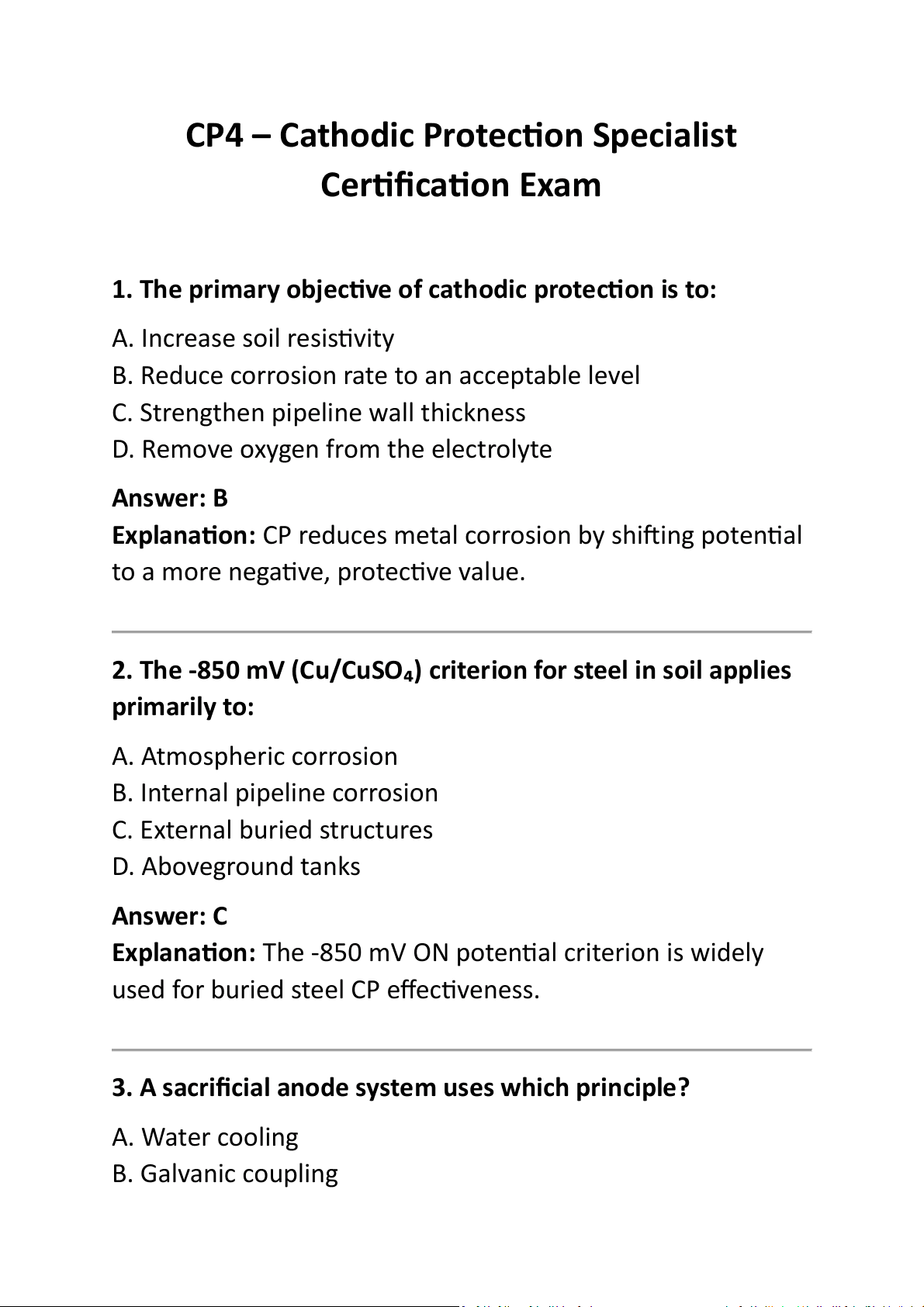
CP4 – Cathodic Protection Specialist
Certification Exam
1. The primary objective of cathodic protection is to:
A. Increase soil resistivity B. Reduce corrosion rate to an acceptable level C. Strengthen pipeline wall thickness D. Remove oxygen from the electrolyte
Answer: B Explanation: CP reduces metal corrosion by shifting potential to a more negative, protective value.
2. The -850 mV (Cu/CuSO₄) criterion for steel in soil applies primarily to:
A. Atmospheric corrosion B. Internal pipeline corrosion C. External buried structures D. Aboveground tanks
Answer: C Explanation: The -850 mV ON potential criterion is widely used for buried steel CP effectiveness.
3. A sacrificial anode system uses which principle?
A. Water cooling B. Galvanic coupling
C. Electrochemical coating D. Ion exchange
Answer: B Explanation: A more active metal (anode) corrodes preferentially to protect the structure.
4. Which anode material is most common in seawater impressed current systems?
A. Magnesium B. Zinc C. Graphite D. MMO/Ti (Mixed Metal Oxide on Titanium)
Answer: D Explanation: MMO/Ti anodes provide long life and high efficiency in seawater.
5. The polarization of a protected structure is defined as:
A. Total circuit resistance B. Shift from native potential due to CP C. Change in pipe thickness D. Amount of coating damage
Answer: B Explanation: Polarization is the change in structure potential achieved by cathodic protection.
Answer: A Explanation: Rectifiers convert AC to DC to drive current to the structure.
9. A coating holiday is best described as:
A. A surface roughness zone B. A defect in coating exposing bare metal C. An area of overprotection D. A type of anode
Answer: B Explanation: Holidays expose bare steel, increasing CP current demand.
10. CP interference can occur when:
A. Structures are deeply buried B. CP current affects nearby metallic structures C. Soil resistivity is high D. Coating is high quality
Answer: B Explanation: Stray currents may leave adjacent structures, causing accelerated corrosion.
11. The primary corrosion cell in soil involves:
A. Two metals in direct contact B. Oxygen gradient in soil
C. Magnetic field interaction D. Electrostatic discharge
Answer: B Explanation: Variations in oxygen content create anodic and cathodic soil regions.
12. Anode groundbeds are classified into:
A. Hot and cold B. Shallow, deep, and distributed C. AC and DC D. Linear and radial
Answer: B Explanation: Groundbeds vary in depth and configuration depending on soil design.
13. An indication of over-protection on steel pipelines is:
A. pH decrease B. Coating disbondment C. Soil drying D. Voltage sag
Answer: B Explanation: Excessively negative potentials may generate hydrogen → coating disbondment.
14. Stray current corrosion is more likely from:
17. In CP design, the coating condition primarily influences:
A. Rectifier / transformer temperature B. CP current requirements C. AC interference D. Pipe diameter
Answer: B Explanation: More coating defects = higher CP current demand.
18. Current requirement testing involves:
A. Applying AC B. Temporarily connecting a test anode C. Removing coatings D. Using only soil resistivity
Answer: B Explanation: A temporary anode simulates CP system performance before design.
19. Which is the most common method for locating coating defects?
A. UT scanning B. DCVG (Direct Current Voltage Gradient) C. MT testing D. RT testing
Answer: B Explanation: DCVG identifies coating holidays through voltage gradients.
20. A depolarized potential is measured after:
A. Applying null current B. CP current interruption for some time C. Lowering soil moisture D. Increasing anode output
Answer: B Explanation: Depolarization measures how much CP effect remains after current is removed.
21. The driving voltage in galvanic anode systems depends on:
A. Pipeline coating B. Difference in natural potentials between anode and structure C. Air-gap resistance D. Soil grain size
Answer: B Explanation: Galvanic protection relies on natural potential differences.
22. Magnesium anodes are best suited for:
25. When measuring ON potential, IR drop is caused by:
A. Soil resistivity and CP current B. Coating defects only C. Oxygen content D. Air pockets
Answer: A Explanation: IR drop arises from current flowing through the soil resistance.
26. Pipeline AC interference becomes hazardous when AC voltage exceeds:
A. 5 V B. 15 V C. 30 V D. 50 V
Answer: C Explanation: Above ~30 VAC increases risk of AC corrosion and personnel hazard.
27. Deep anode groundbeds are used primarily for:
A. Poor soil resistivity B. High water table C. Urban areas with limited space D. Concrete structures
Answer: C Explanation: Deep wells minimize footprint while providing good current distribution.
28. Stray current corrosion occurs when:
A. Current leaves the metal B. Current enters the metal C. Metal is isolated D. Voltage is zero
Answer: A Explanation: Metal loses electrons where stray current discharges → corrosion.
29. A polarized potential of -900 mV (Cu/CuSO₄) indicates:
A. Under-protection B. Over-protection C. Adequate protection D. No protection
Answer: C Explanation: Potential more negative than -850 mV meets criteria.
30. Increasing soil resistivity causes:
A. Lower CP current demand B. Higher CP current requirement
33. Hydrogen embrittlement risk increases in CP systems when:
A. Potential is too negative B. pH increases C. Coating is intact D. Soil is dry
Answer: A Explanation: Overprotection promotes excessive hydrogen absorption.
34. What does a current interrupter do?
A. Raises voltage B. Alternates AC to DC C. Switches rectifier current ON/OFF for potential measurements D. Eliminates soil resistivity
Answer: C Explanation: Interrupters isolate IR-free OFF potentials.
35. CIPS (Close Interval Potential Survey) is used to evaluate:
A. Soil resistivity B. Pipeline potentials along its length C. Anode consumption D. Coating thickness
Answer: B Explanation: CIPS measures potential profiles to identify CP deficiencies.
36. A DCVG survey identifies:
A. Soil pH B. Pipe temperature C. Coating defects D. Metal thickness
Answer: C Explanation: Voltage gradients reflect holiday location and severity.
37. AC corrosion on pipelines is most severe when:
A. Coating is good and shielding occurs B. Coating is damaged C. Soil is dry D. Potentials are positive
Answer: A Explanation: High AC density through tiny coating defects causes metal dissolution.
38. The primary purpose of bonding between structures is:
A. Reduce soil resistivity B. Equalize potentials and reduce interference
41. A rectifier output of 10 V and 5 A indicates system resistance of:
A. 1 Ω B. 0.5 Ω C. 2 Ω D. 5 Ω
Answer: C Explanation: Using Ohm’s law: R = V/I = 10/5 = 2 Ω.
42. Impressed current CP systems use inert anodes because they:
A. Must dissolve quickly B. Need long life C. Produce hydrogen D. Reduce soil resistivity
Answer: B Explanation: Inert anodes last many years without significant consumption.
43. A typical sign of stray current corrosion is:
A. General uniform corrosion B. Deep pits at isolated areas C. Coating blistering only D. Hydrogen cracking
Answer: B Explanation: Stray currents cause localized high-rate metal loss.
44. The pipeline potential becomes more negative when:
A. Anode output increases B. Soil resistivity increases C. Coating improves D. Reference electrode dries out
Answer: A Explanation: More CP current = more negative potential.
45. Which factor most affects groundbed design?
A. Soil resistivity B. Pipeline age C. Diameter D. Coating color
Answer: A Explanation: Groundbed resistance is governed heavily by soil resistivity.
46. AC mitigation often uses:
A. Insulators B. Zinc grounding cells
49. Coating disbondment can be caused by:
A. Low CP levels B. Overprotection and hydrogen generation C. Insufficient backfill D. High soil pH
Answer: B Explanation: Too negative potentials promote hydrogen lifting the coating.
50. To prevent interference during CP surveys, the best practice is:
A. Use AC measurements B. Turn off all rectifiers C. Synchronize interrupters on all rectifiers D. Disconnect bonds
Answer: C Explanation: Synchronization ensures consistent ON/OFF cycles for accurate data.
51. A rectifier should be checked for proper operation:
A. Once per year B. Every 6 months C. Monthly D. Daily
Answer: C Explanation: Industry standards recommend monthly rectifier inspections to ensure reliable CP current output.
52. The resistance of a deep anode groundbed generally:
A. Increases with depth B. Decreases with depth C. Remains constant D. Doubles every 100 ft
Answer: B Explanation: Deeper groundbeds reach lower-resistivity strata and spread current more effectively.
53. For a buried pipeline, the typical protective potential criterion is:
A. -550 mV Cu/CuSO₄ B. -850 mV Cu/CuSO₄ C. -1050 mV Cu/CuSO₄ D. -150 mV Cu/CuSO₄
Answer: B Explanation: -850 mV ON potential is widely recognized as the minimum protective level.
54. A holiday in pipeline coating increases: