CHEM 210 Final Exam – (2026) Actual Questions & Answers (Biochemistry) 100% Guarantee Pass, Exams of Biochemistry

CHEM 210 Final Exam includes actual 2026 biochemistry questions with verified answers covering amino acid metabolism, glycolysis, citric acid cycle, carbohydrate metabolism, organic chemistry reactions, biomolecules, and comprehensive CHEM 210 final exam concepts. Ideal for quizzes, cumulative finals, exam review, and last-minute study preparation. CHEM 210 Final Exam, CHEM 210 Final Exam Questions, CHEM 210 Final Exam Answers, CHEM 210 Biochemistry Exam, CHEM 210 Test Bank, CHEM 210 Practice Test, CHEM 210 Study Guide, CHEM 210 Final Exam PDF, CHEM 210 Review, Glycolysis Questions, Citric Acid Cycle Exam, Amino Acid Metabolism, Carbohydrate Metabolism, Organic Chemistry Reactions, Biomolecules Exam, CHEM 210 Quiz Answers, CHEM 210 Verified Answers, College Chemistry Final, Biochemistry Practice Questions, CHEM 210 Comprehensive Exam, CHEM 210 Latest Exam, CHEM 210 Midterm and Final, Chemistry Final Review, Metabolism Questions, Biochemistry Study Notes

Typology: Exams

2025/2026

Available from 07/02/2026

Academvia
Academvia 🇺🇸

1.2K documents

1 / 30

Toggle sidebar

This page cannot be seen from the preview

Don't miss anything!

bg1
1 / 10
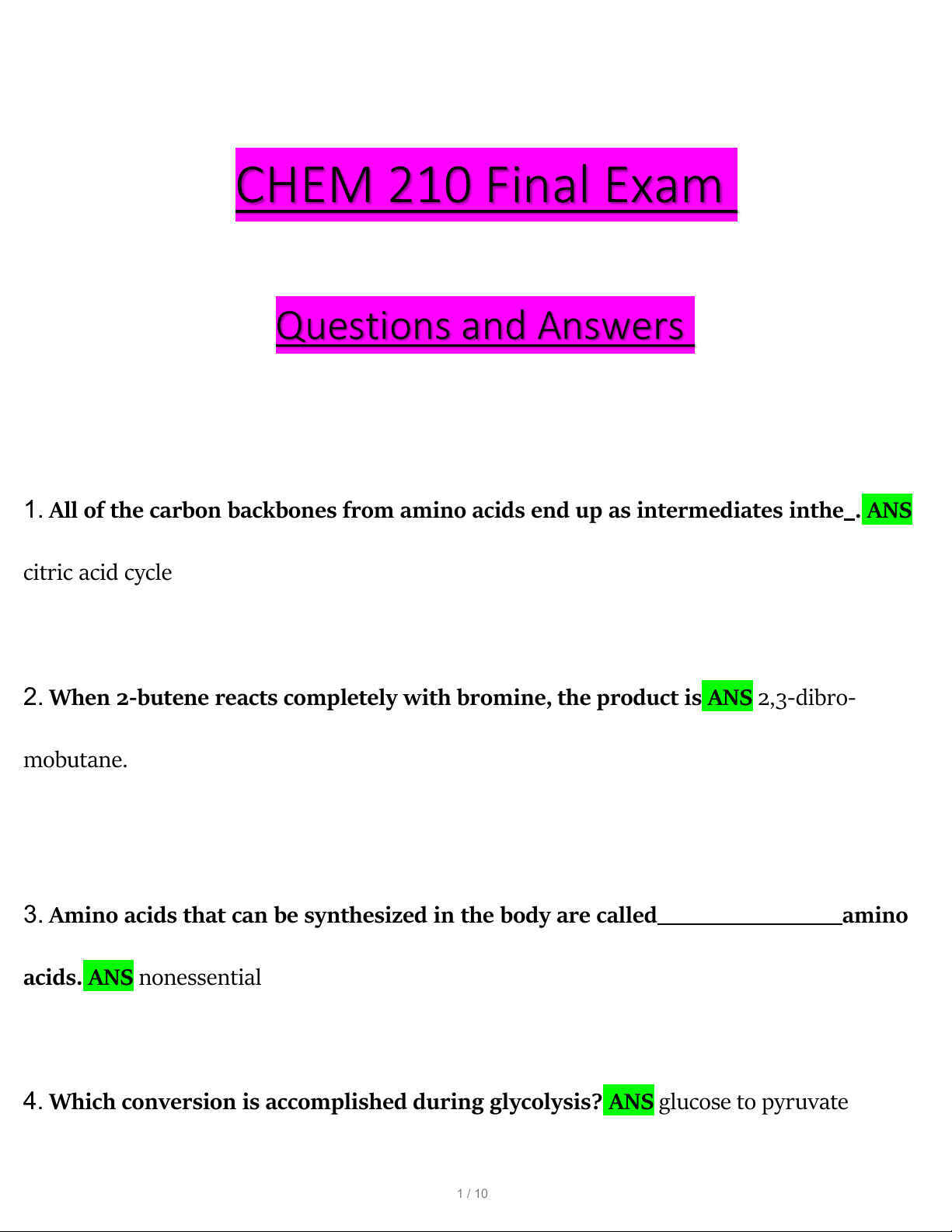
CHEM 210 Final Exam
Questions and Answers
1. All of the carbon backbones from amino acids end up as intermediates in the . ANS
citric acid cycle
2. When 2-butene reacts completely with bromine, the product is ANS 2,3-dibro-
mobutane.
3. Amino acids that can be synthesized in the body are called amino
acids. ANS nonessential
4. Which conversion is accomplished during glycolysis? ANS glucose to pyruvate
pf3
pf4
pf5
pf8
pf9
pfa
pfd
pfe
pff
pf12
pf13
pf14
pf15
pf16
pf17
pf18
pf19
pf1a
pf1b
pf1c
pf1d
pf1e

Partial preview of the text

Download CHEM 210 Final Exam – (2026) Actual Questions & Answers (Biochemistry) 100% Guarantee Pass and more Exams Biochemistry in PDF only on Docsity!

CHEM 210 Final Exam

Questions and Answers

  1. All of the carbon backbones from amino acids end up as intermediates inthe. ANS citric acid cycle
  2. When 2-butene reacts completely with bromine, the product is ANS 2,3-dibro- mobutane.
  3. Amino acids that can be synthesized in the body are called amino acids. ANS nonessential
  4. Which conversion is accomplished during glycolysis? ANS glucose to pyruvate
  1. Every turn of the citric acid cycle directly produces molecule(s) of ATP. ANS one
  2. The process of converting ADP to ATP in the mitochondrion takes place bya process known as ANS oxidative phosphorylation.
  3. Which family of organic molecules is a hydrocarbon? ANS aromatic
  4. All of the following can be classified as biomolecules except ANS all of them are biomolecules
  5. A genetic map is a(an) ANS list of locations of markers that relate to inheritable traits.
  6. Which type of amine will react with mineral acids to form soluble ammoni-um
  1. Which chemical is produced from pyruvate when it is metabolized inmuscle cells under aerobic conditions? ANS acetyl-SCoA
  2. When hydrocarbons undergo incomplete combustion, the product(s)is(are) ANS CO2, H20 and Soot 19. All of the following statements concerning digestion are correct except ANS - the same enzymes are used in the digestion of carbohydrates, lipids, and proteins.
  1. Which compound has the lowest boiling point? ANS The one with just C
  2. Which molecule would be the most acidic? ANS phenol
  3. The reaction of amino acids to give peptides involves which pair of func-tional groups? ANS an amino and a carboxyl group 23. Which of the following is common to the structures of NAD+, and FAD? ANS - ADP
  4. Which molecule is not associated with synthesis of triacylglycerides? ANS car-nitine
  5. Insulin increases the rate at which ANS more than one response is correct
  1. Endergonic reactions are those that are and that liber- ate free energy. ANS nonspontaneous; do not
  2. Which amino acid can form covalent sulfur-sulfur bonds? ANS Cysteine
  3. The potassium or sodium salt of a long chain carboxylic acid is calleda ANS soap 33. The number of hydrogen bonds between guanine and adenine in DNA is . ANS zero
  4. Which pathway converts glucose to its storage form in animals? ANS glycoge-nesis
  5. Which statement is true concerning the relationship between FAD andFADH2? ANS FADH2 is the reducced form of FAD
  6. All of the statements concerning the carbonyl group in aldehydes and ketones are true except ANS because the bond is polar, carbonyl groups readily formhydrogen bonds with each other.
  7. When energy from stored triacylglycerols is needed, they are , and then transported in the bloodstream via as fatty acids. ANS hy- drolyzed; albumins
  1. In a pair of coupled reactions, if the favorable reaction releases more energy than the amount required by the unfavorable reaction, the excess energy is ANS released as heat and used to maintain body temperature.
  2. A promoter sequence is. ANS a DNA sequence that determines which genes are turned on for coding.
  3. All of the following compounds are amines except ANS aspirin
  4. Molecules such as erythrose and threose, which are stereoisomers but not mirror images, are referred to as a pair of. D- and L-threose are mirror images and are referred to as a pair of. ANS diastereomers; enantiomers
  5. When a monosaccharide forms a ring by interaction of one of its hydroxylgroups with its aldehyde group, the bond is referred to as a(an) linkage. ANS hemiacetal
  6. Which equation correctly represents the dissociation of a carboxylic acidin water? ANS CH3COOH + H2O CH3COO- + H3O+
  7. Fatty acids are activated for breakdown by conversion to. ANS fattyacid SCoA's
  8. All of the following terms are associated with recombinant DNA except ANS ri-

reactions coupled to electron transport, the process is referred to as phosphorylation. ANS sub-strate level

  1. In addition to producing ATP, the citric acid cycle produces as high energy molecules and as its major chemical waste product. ANS - reduced coenzymes; CO
  2. The ion formed from a carboxylic acid is called the ANS carboxylate anion 57. In steps 5-8 of the citric acid cycle, the high-energy molecules , , and are produced, and is regenerated to begin another turn of the cycle. ANS GTP; FADH2; NADH; oxaloacetate
  3. which molecule is not a ketone body ANS they are all ketone bodies
  4. Which alcohol should be used to produce 2-methyl-3-pentene by dehydra-tion? ANS 4-methyl-2-pentanol 60. When an amide is hydrolyzed under acidic conditions, the products are ANS - ammonium and carboxylic acid
  5. The reaction of a simple sugar with an alcohol produces a. ANS all ofthe above
  6. An amine that is insoluble in water can be made to dissolve by adding itto an aqueous solution of ANS HCL
  7. The purine bases are ANS fused 5 and 6 membered ring systems containing 4
  1. Where do the first chemical changes in the digestion of dietary fats takeplace? ANS small intestine
  2. An enzyme that catalyzes the conversion of a cis double bond to a transdouble bond is classified as a(an) ANS isomerase
  1. Which amino acid is classified as basic? ANS lysine
  2. The peptide bond joining amino acids into proteins is a specific exampleof the bond. ANS amide
  3. Hormones which regulate glucose metabolism are , , and. ANS insulin; glucagon; epinephrine
  4. Transcription and translation of the mRNA involved in protein synthesis occur in two different locations in the cell. Translation occurs in the ANS cytoplasm
  5. chemicals that cause mutations are called ANS mutagens 81. What is the IUPAC name of the compound shown?

CH3CH2COOCH3 ANS propyl methanoate

  1. All of the following are globular proteins except ANS myosin
  2. All of the following statements about oxidation of carbonyls are true ex-cept ANS oxidation of ketones produces esters.
  3. Which atom is most likely to form a polar covalent bond with carbon? ANS O
  4. In biochemical reactions, reduction of carbonyl groups is carried outby ANS NADH
  5. The alcohol which contains two carbon atoms and has the common nameof grain

Adenosine + Pi

  1. What is the product of oxidation of butanal? ANS butanoic acid
  1. A multi-step biochemical process in which the rate of an early step is affected by the concentration of products of a later step is said to be subjectto ANS feedback control
  2. The urea cycle is because it. ANS endergoinic; costs 3 ATP
  3. The process of making multiple copies of DNA is accomplished by aprocess called ANS polymerase chain reaction
  4. Each of the following phrases correctly describes enzymes except ANS be-have as substrate
  5. Which statement does not correctly describe structural differences be-tween DNA and RNA? ANS all of the statemetns are correct
  6. A gene mutation that results in the coding change for one amino acid ina protein sequence is known as a mutation. ANS missense
  7. Which molecule is associated with transport of fatty acids into the mito- chondrial matrix? ANS carnitine
  8. Reduction of aldehydes and ketones is a ANS two-step reaction involving the H-and H+ ions.
  9. All of the statements concerning citric acid are true except ANS it is producedonly
  1. Which of the following is the usual reactant in the urea cycle? ANS carbamoyl phosphate
  2. The similarities in properties of carboxylic acids, esters, and amides canbest be explained by ANS their polarity and structural similarities
  1. Which substance is not reactive with respect to alkanes? ANS H
  2. Which is the correct term for the inactive form of an enzyme, often usedfor transport or storage? ANS zymogen
  3. Which of the following monosaccharides is present in nucleic acids? ANS ri-bose
  4. Alkenes and simple aromatics are similar in all of the following propertiesexcept ANS lack of toxicity
  5. The reaction in which ATP is converted to ADP with release of 7.3 kcal isa(an) reaction. ANS Hydrolysis
  6. Each of the following metabolic intermediates is a precursor to one ormore amino acids except ANS fumarate
  7. An amino acid whose R group is predominantly hydrocarbon would beclassified as ANS non-polar
  8. The most characteristic feature of all the bases found in either DNA orRNA is that ANS they are all nitrogen-containing aromatic compounds. 126. The bond connecting the two monosaccharides in maltose is a(an) linkage. ANS ±-1,4glycosidic
  9. When a molecule other than the correct substrate interacts with some part of an