Download Coefficient of Kinetic Friction - Physics - Exam Paper and more Exams Physics in PDF only on Docsity!
PHYS 1121 Test 1, 2005
Question 1 (23 marks)
a) Investigators at the scene of an accident see that a car has left black rubber marks ("skid marks") that are L = 22 m long on a flat section of road. The car is stationary at one end of the marks, and it is assumed that the car began to skid at the other end. The coefficient of kinetic friction between the rubber and the wheels is μk = 0.80 and the skid marks show that all four wheels begin to skid simultaneously. Calculate the speed of the car at the beginning of the skid. Express your answer in kilometres per hour.
b) A bird flies at speed vb = 5.0 m.s-1^ in a straight line that will pass directly above you, at a height h = 5.0 m above your head. You are eating grapes and it occurs to you that the bird might want one and so you decide to throw it a grape. Of course, you don't want to hurt the bird, so you will throw the grape so that, at some time t, it has the same position, same height and same velocity as the bird. (Hint for 1221: what will be the height and velocity of the grape when the bird takes it?) You throw the grape from a position very close to your head, with intial speed v 0 and at an angle θ to the horizontal. Air resistance is assumed to be negligible.
i) Should the bird be behind you, or ahead of you when you throw the grape, and by how much? Explain your answer briefly. (3-5 clear sentences should suffice.)
ii) Calculate the required values of vt and θ.
iii) If air resistance on the grape were not negligible, how would that change your answer to (i)? A qualitative but explicit answer is required.
Question 2 (10 marks)
R
bucket
brick
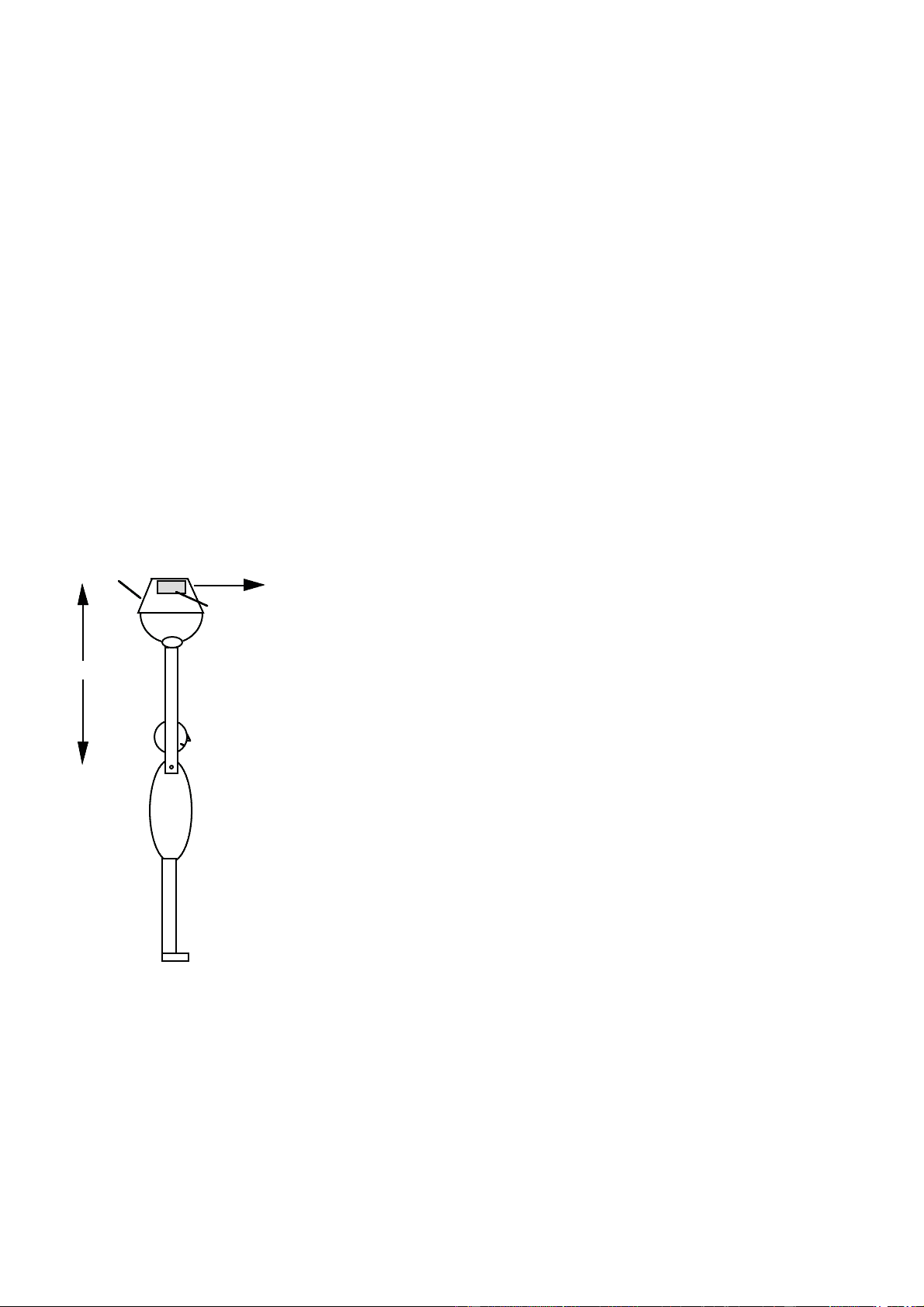
v i)^ A physics lecturer swings a bucket in a vertical circle, about his shoulder, as shown. It executes circular motion with period T. The bucket contains a brick. Derive an expression for the maximum period T that the motion can have in order that that the brick stay in contact with the bucket. Assume that the motion has constant angular velocity. ii) Put in appropriate values to give a numerical estimate of the period. iii) Is the assumption of constant angular velocity reasonable? Comment briefly.
Question 3. (19 marks)
i) Assuming the orbit of the Earth about the sun to be a circle with radius R = 1.50 x 10¹¹ m, calculate the magnitude of the Earth's centripital acceleration. Neglect the motion of the sun.
ii) State the direction of the centripital acceleration in (i).
iii) The constant of Gravitation is G = 6.67 x 10 -11^ Nm^2 kg-2. Use this value and your answer to (i) to determine the mass M of the sun.
iv) The moon has mass m (^) m 7.36 x 10 22 kg. The Earth has mass m = 5.98 x 10 24 kg. The sun has a mass M = 1.99 x 10 30 kg.
The distance sun-earth = R = 1.50 x 10¹¹ m. The distance earth-moon = r = 3.82 x 10⁸ m.
At new moon, the moon lies on a line between the Earth and the sun and is at a distance r = 3.82 10^8 m from the Earth. Calculate the total gravitational force on the moon due to the sun and the Earth. (Hint: a diagram may be helpful)
v) State the direction of the force in (iv)
vi) State the magnitude of the acceleration of the moon at new moon, due to the forces exerted by the sun and the earth.
vii) State the direction of the acceleration in (vi).
viii) Compare your answers for (i & ii) and (vi & vii) and comment briefly (about two or three sentences).
Question 4 (13 marks)
x
M
m
v
bathroom
scales
Can a bathroom scale (a device usually used for measuring one's weight) be used to measure the speed of a bullet fired from a gun? A student decides to find out. When she stands on the scale, it accurately reads her mass (60 kg). She observes that, when she stands on the scale, its lid is lowered by 5.0 mm. Assume that the scale behaves like an undamped spring, with spring constant k. i) Calculate the value of the spring constant k. (Hint: be careful with units.) The student then mounts the scale vertically, and fixes a block (M = 10 kg) on its surface. Its mass is considerably greater than that of the scale. In this orientation, and with the block fixed, the scale reads zero. In a preliminary experiment, she discovers that the bulet does not penetrate through the block, and comes to rest inside it. Her research tells her that a particular model gun fires bullets at a speed of v = 400 m.s-1^ (called its muzzle velocity) and that the bullets have a mass m = 6.0 g.
ii) Showing all working, and using the values given, calculate the maximum compression of the scale when a bullet is fired into it at normal incidence (as shown in lower diagram). State any assumptions you make and justify any conservation laws that you use.
iii) Calculate the reading on the scale at this point.
(Under no circumstances should you try to answer this problem experimentally.)