Download Isomorphism and Graph Theory: Understanding Vertices, Edges, and Isomorphic Graphs and more Study notes Mathematics in PDF only on Docsity!
Mat 3770
Week 2
Spring 2009
1
Section 1.2. Isomorphism
I (^) Two graphs G = ( VG ; EG ) and H = ( VH ; EH ) are said to be isomorphic if there exists a bijection f : VG → VH 3 < u ; w >∈ EG IFF < f ( u ); f ( w ) >∈ EH
I (^) I.e., we can relabel the vertices of G to be vertices of H , maintaining the corresponding edges in G and H ; pairs are adjacent in G IFF pairs are adjacent in H 1
6
2
3
5 4
U V W X Y Z
I The mapping from VG to VH given by f(1) = u, f(2) = v, f(3) = w, f(4) = x, f(5) = y, f(6) = z is the requisite bijection. 2
Isomorphism
I (^) These two graphs are not isomorphic since deg(1) = 4, and no vertex in graph H has degree 4.
G H
U
V
W
X
Y
I (^) Note: degrees are preserved under isomorphism
3
Isomorphic Graphs
I (^) Same number of vertices
I (^) Same number of edges
I (^) same number of vertices with a given degree
I (^) corresponding edges are maintained between vertices of same degree as preñimage.
A graph H = ( VH ; EH ) is a subgraph of G = ( VG ; EG ) if VH ⊆ VG and EH ⊆ EG.
4
Isomorphic Subgraphs
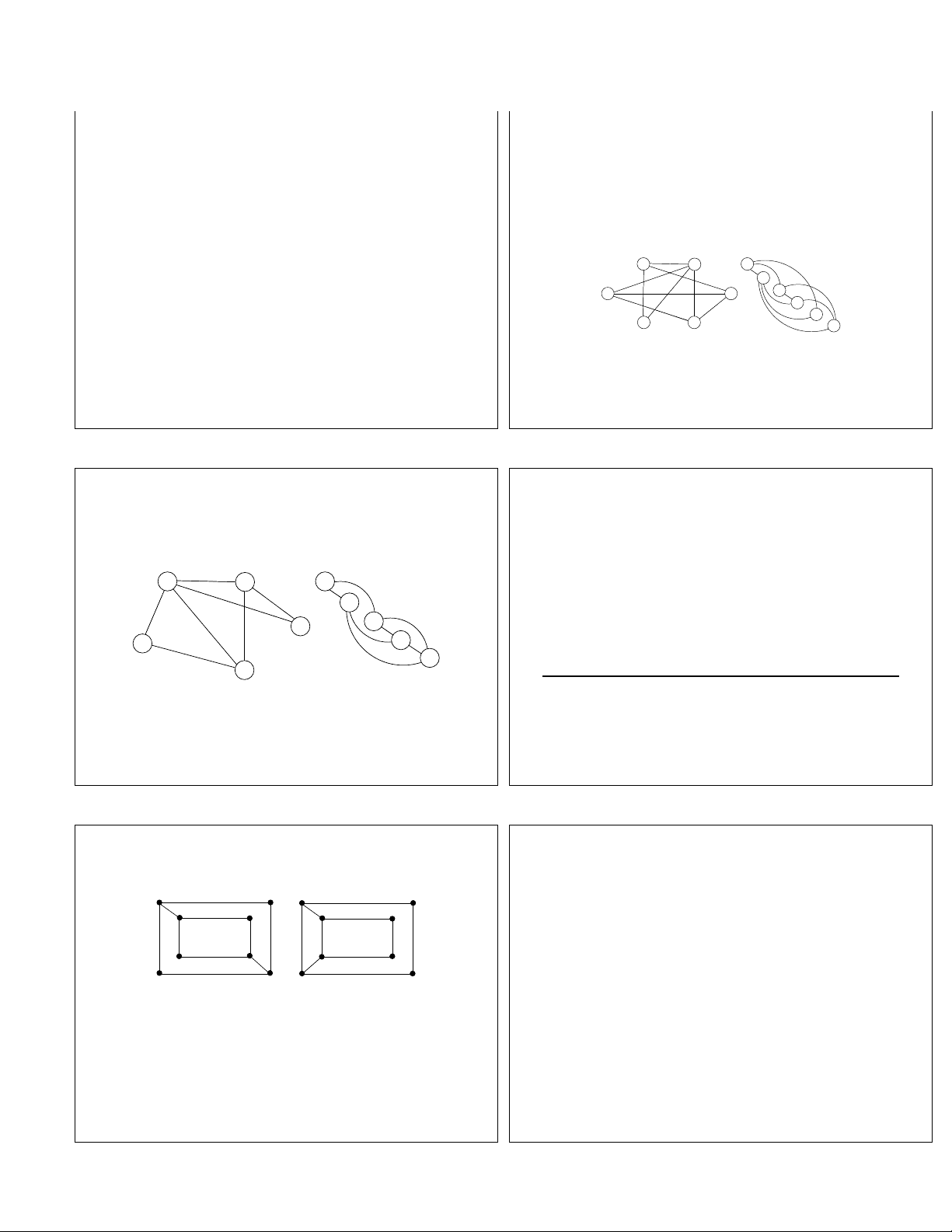
I (^) If we cannot �nd isomorphic subgraphs, then the graphs are not isomorphic.
2 3
5
6 7
8
b c
e
f g
h
a (^) d 1 4
deg 2: b,d,f,h 3,4,8,
deg 3: a,c,e,g 1,2,5,
I (^) Subgraphs containing these (deg 2) vertices must be isomorphic.
I No edges between b,d,f, or h (within same set), while
edges <3,4> and <7,8> exist. Therefore the two graphs
are not isomorphic.
Recall
I (^) Matching : Set of edges, none of which share the same endpoint
I (^) Maximum matching : Maximum cardinality of all matchings
I (^) Edge Cover : Set of vertices which contains at least one endpoint of all edges in graph
I (^) Independent Set : Set of vertices no two of which share an edge
I (^) Maximal Independent Set : Cannot add any other vertex in the graph and remain independent (i.e., every vertex not in the set is adjacent to some vertex in the set)
I (^) Maximum Independent Set : Maximum cardinality of all Independent sets
I (^) Theorem : Given a graph G=(V, E), if S⊂V is independent, then vS is an edge cover and vice versa
7
Applications
Connected Components
I (^) One of the incentives for developing the Internet was the threat of war and the fear of having communications between various installations in the United States severed.
I (^) Given a graph, can we determine if there is a critical edge, one whose removal disconnects the graph?
8
9
Applications
Edge Cover
The Manhattan Police Department (MPD) knows several heads of organized crime are meeting in a particular area of the city and want to keep the streets there under surveillance. Unfortunately, owing to budget constraints, they need to use the fewest of�cers possible.
10
a b^ c
e f^ g
i
j k
h
d
How can we determine on which corners to place of�cers to maximize their usefulness (the number of adjacent blocks they can observe) while minimizing the number of of�cers?
5
2
3 4
6 7
8
1
We can replace the original 14 graph edges with the 8 contiguous line segments which they comprise, forming another, slightly different graph to model the problem.
Find a Vertex Basis
19
Find a Vertex Basis
20
Are these graphs isomorphic?
a
b
c
d e
f
g 2
1
3
4 5
6
7
Exercise : Find nonñisomorphic directed graphs with three vertices:
21
Section 1.3. Edge Counting
I (^) Theorem 1. In any graph, the sum of the degrees of all vertices is equal to twice the number of edges.
I (^) Q1. Given G = (V, E), how many vertices are there in V if there are 15 edges in E, and all vertices have degree 3?
I Corollary. In any graph, the number of vertices of odd degree is even.
I (^) Q2. How many edges are in Kn , a complete graph over n vertices?
22
Mountain Range Problem
Example 4, which begins on page 29, is worded a bit obscurely. Part of the homework for this section is to ìrephraseî the problem in simple English.
Bipartite Graphs and Circuits
I (Recall) The length of a circuit or path is the number of edges in it.
I (^) Theorem 2. A graph G is bipartite IFF every circuit in G has even length.
A B C D E
4
3
2
1
LEFT^ RIGHT
Section 1.4 Planar Graphs
I (^) A graph is planar if it can be drawn on a plane with no edges crossing. For example:
The graph on the left can be redrawn with no edges crossing; therefore, it is a planar graph.
25
Figure 1.21a, Pg 35 ñ Not so Obvious!
A
C
B
D
E
F
26
But It Is Planar
A
C
B
D
E
F
A
C D B
E
F
27
ComputerñRelated Uses
I (^) wiring diagrams for each layer on a computer chip ó if wires cross, they share electricity (not good)
I (^) robotic motion planning (2ñD) ó plot obstacles, determine path
I (^) Map Coloring How many colors are needed to color counties (states, etc.) on some map in order that adjacent counties all have different colors?
A map can be modeled by a planar graph. USA map: states are vertices; edges indicate ìshare a borderî
28
US State Map
IL IN
MI
MO KY
IA
MN WI
OH WV
TN
Modeling Maps with Graphs
MN
IA
MI
WI
IL
MO
TN
WV
KY
OH
IN
K 5
K 5 : a complete graph of 5 vertices. Is it planar?
A
B
E
D
C
37
More on Planarity
I (^) Subdividing a graph: adding vertices to the middle of zero or more edges: A (^) B A B
Note: subdividing a nonñplanar graph cannot make it planar.
I (^) K 3 ; 3 Con�guration : a (sub)graph obtained by subdividing a K 3 ; 3.
I (^) K 5 Con�guration : a (sub)graph obtained by subdividing a K 5.
I (^) Theorem 1. A graph is planar IFF it does not contain a subgraph that is a K 5 or a K 3 ; 3 con�guration.
38
More Theoretical Results
I (^) Theorem 2 (Euler's Formula). If G is a connected planar graph with j V j = v and j E j = e, then a planar depiction of G will always have r = e v + 2 regions (areas); r is also known as the number of faces.
I (^) Corollary. If G is a connected planar graph with e > 1, then e � 3 v 6.
note : This is not an IFF statement. If e 6 � 3 v 6, the graph is nonñplanar; but if e � 3 v 6, and the graph is connected, there is not enough information to determine if it is planar.
Children, Goats, and Rabbits
I Page 53, #16: Suppose there are three farms each with a child (C), a goat (G), and a rabbit (R).
- The male child on the farm with goat Ga and the male child on the farm with rabbit Rc are competing for the attention of the female child Cb on the third farm.
- Goat GC and rabbit Rb are not on the same farm
- The boy on the farm with rabbit Ra is not Ca
Ga Gb Gc
Ra
Rc
Rb
Ca
Cb
Cc