Download Constant for Projectile - Physics - Past Exam Paper and more Exams Physics in PDF only on Docsity!
Page 1 of 21 Physics 3204 June 2006
PART I
Total Value: 50%
Instructions: Shade the letter of the correct answer on the computer scorable answer sheet provided.
- Which is constant for any given projectile?
(A) horizontal displacement (B) horizontal velocity (C) vertical displacement (D) vertical velocity
- Which demonstrates projectile motion?
(A) ball rolling up a hill (B) car driving down a street (C) horse galloping around an oval track (D) rock rolling off the edge of a cliff
- If a projectile is launched at an angle of 65 o^ from the horizontal at a speed of 2.1 m/s, what is the maximum height reached by the object?
(A) 0.040 m (B) 0.097 m (C) 0.18 m (D) 0.23 m
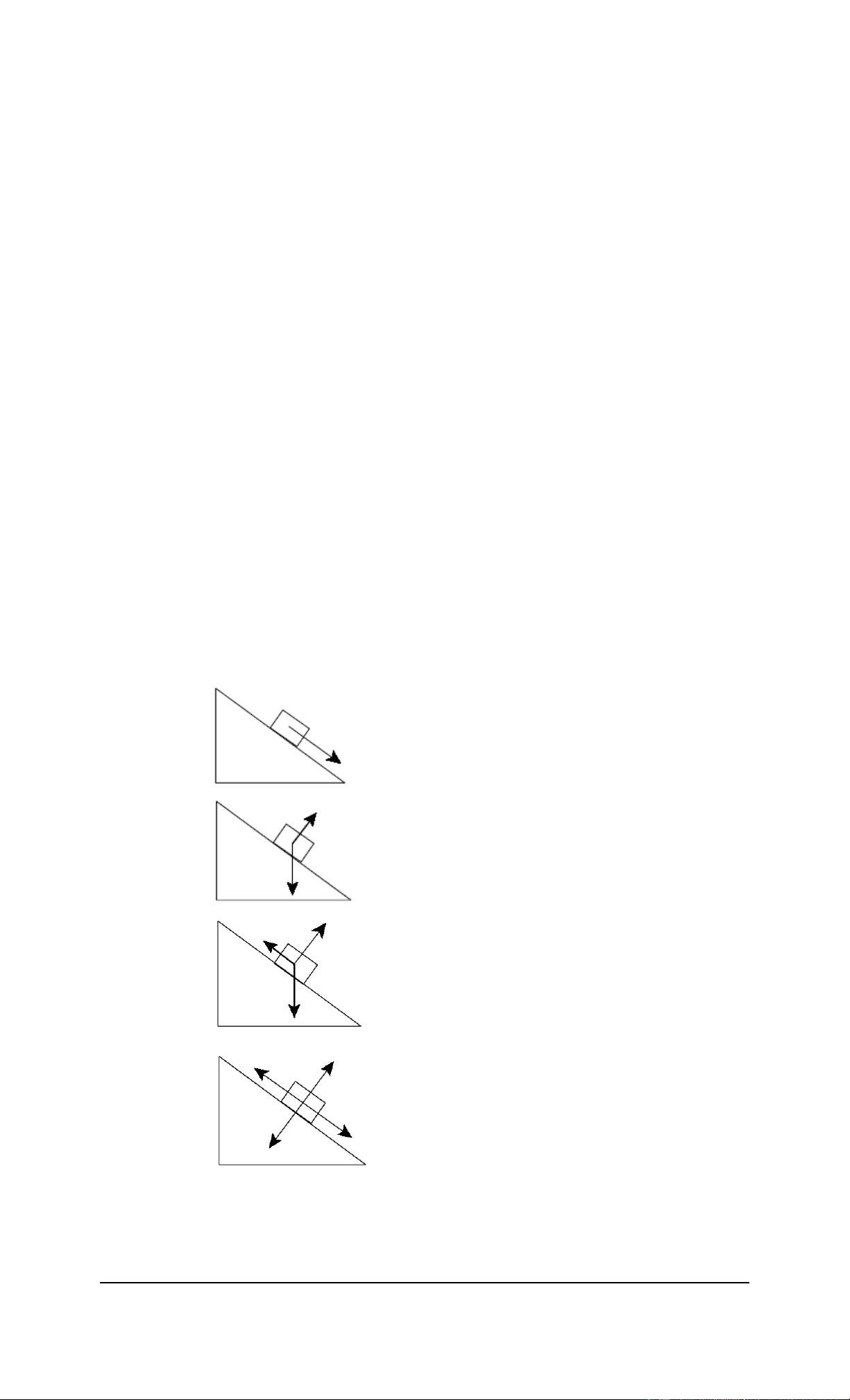
- Which free body diagram represents a box sliding down an inclined plane with friction?
(A)
(B)
(C)
(D)
Physics 3204 June 2006 Page 2 of 21
- The diagram below shows a projectile moving with speed, v, at the top of its path.
Which vector best represents the acceleration of the projectile at position A?
(A)
(B)
(C)
(D)
- If a steel ball was launched horizontally from a height of 90.0 cm and lands 1.3 m from the base, what was the initial velocity?
(A) 0.30 m/s (B) 2.7 m/s (C) 3.0 m/s (D) 7.1 m/s
- In the diagram below, the two blocks are at rest. W 1 represents the weight of block 1. If block 2 is hanging from a cord that passes over a frictionless pulley, what is the weight of block 2? (Assume the inclined plane is frictionless.)
(A)
1 o
W
cos 30
(B) W 1 cos 30 o
(C) (^1) o
W
sin 30
(D) W 1 sin 30 o
- A force acts on an object that travels along a circular path with a constant speed. By what factor should the force change for the object to travel at twice its speed?
(A) ¼ (B) ½ (C) 2 (D) 4
Physics 3204 June 2006 Page 4 of 21
a
K
Magnitude Direction
(A) changes changes
(B) changes constant
(C) constant changes
(D) constant constant
F
K
F
K
a
K
- What is true of the velocity of an object experiencing uniform circular motion?
- Which best represents the acceleration, , and force, , for an object travelling along a circular path?
(A)
F
K
a
K
(B)
F
K
a
K
(C)
F
K
a
K
(D)
- The diagram below shows a 3.0 kg ball, suspended by a string, travelling in a horizontal circular path. If the tension in the string is 37.8 N and the radius of the circle is 1.2 m, what is the speed of the ball?
(A) 3.1 m/s (B) 3.4 m/s (C) 3.9 m/s (D) 9.5 m/s
Page 5 of 21 Physics 3204 June 2006
- What is torque?
(A) rF⊥
(B) rF&
(C) r cos θ
(D) r sin θ
- In which situation will an object be in static equilibrium?
(A) colliding (B) falling (C) motionless (D) rotating
- The wire below supports a horizontal massless beam. What is the tension in the wire?
(A) 2.89 × 10^1 N
(B) 5.00 × 10^1 N
(C) 5.77 × 10^1 N
(D) 1.00 × 10^2 N
- If a board was used to lift a box, in which case would the greatest torque be exerted on the board?
(A)
(B)
(C)
(D)
Page 7 of 21 Physics 3204 June 2006
- Which best illustrates the electric field between parallel plates with opposite electric charges?
(A)
(B)
(C)
(D)
- What is the electric field strength 2.4 m from an object with a charge of 7.5 × 10G^7 C?
(A) 1.8 × 10G^6 N/C (B) 8.5 × 10G^4 N/C (C) 1.2 × 10^3 N/C (D) 2.8 × 10^3 N/C
- If a series circuit contains two 15 S light bulbs, three 25 S light bulbs, and a 24 V battery, how much current passes through each bulb?
(A) 0.15 A (B) 0.23 A (C) 0.60 A (D) 1.7 A
Physics 3204 June 2006 Page 8 of 21
- Which best represents the relationship between resistance, R, and cross-sectional area, A, of copper wire?
(A)
(B)
(C)
(D)
- What are the readings of V 1 and V 2 in the circuit below?
V 1 (volts) V 2 (volts)
(A) 2 4
(B) 4 2
(C) 3 3
(D) 6 6
- A string of 20 identical lights is connected in series across a 120 V source, and each light consumes 2.4 W. What is the resistance of each bulb?
(A) 6.0 S (B) 15 S (C) 48 S (D) 120 S
Physics 3204 June 2006 Page 10 of 21
- In the diagram below, a current travels through a cell phone antenna. What is the direction of the magnetic field around the antenna?
(A) clockwise (viewed from above) (B) counterclockwise (viewed from above) (C) down (D) up
- In which diagram does the current-carrying conductor experience a magnetic force out of the page?
(A)
(B)
(C)
(D)
- The bar magnet below is moved into a solenoid as shown. What will be the direction of the current induced in the solenoid?
(A) A
(B) B
(C) C
(D) D
Page 11 of 21 Physics 3204 June 2006
- Which is the strongest magnet?
(A)
(B)
(C)
(D)
- What is the magnetic field strength at 0.15 m from a long, straight conductor carrying an 11 A current?
(A) 4.7 × 10G^6 T (B) 1.5 × 10G^5 T (C) 6.8 × 10^4 T (D) 2.1 × 10^5 T
- A 0.20 m long conductor is placed in a magnetic field of 0.85 T. If the conductor is perpendicular to the magnetic field and the magnetic force acting on the conductor is 0.028 N, what is the current flowing through the conductor?
(A) 0.16 A (B) 6.1 A (C) 4.8 × 10G^3 A (D) 6.6 × 10G^3 A
- A proton moving at 1.2 × 10 6 m/s enters a magnetic field at a 90.0° angle where it experiences a force of 5.4 × 10G^14 N. What is the magnetic field strength?
(A) 0.28 T (B) 0.40 T (C) 2.5 T (D) 3.6 T
- Which best describes the wavelength of photons with 7.95 × 10 -15^ J or less?
(A) 0.0250 nm or longer (B) 0.0250 nm or shorter (C) 0.0500 nm or longer (D) 0.0500 nm or shorter
- What is the energy of a single photon in a beam of light with 8 = 450 nm?
(A) 2.0 eV (B) 2.5 eV (C) 2.8 eV (D) 4.2 eV
- What is the wavelength of a photon which has momentum of 5.60 × 10 -27^ kg A m/s?
(A) 1.98 × 10⁻¹²^ m (B) 3.64 × 10⁻⁹^ m (C) 1.18 × 10⁻⁷^ m (D) 8.45 × 10^6 m
Page 13 of 21 Physics 3204 June 2006
PART II
Total Value: 50%
Instructions: Complete all items in this section. Your responses must be clearly presented in a well organized manner with proper use of units, formulae and significant figures where appropriate. Value 2% 51.(a) A parcel is dropped from a plane flying overhead with a constant horizontal speed of 75 m/s. If the range is 1.2 × 10 3 m, from what height was the parcel dropped? Assume air resistance is negligible. Show workings.
4% (b) A strike in baseball occurs between 0.50 m and 1.0 m directly above home plate. A pitcher, 18.0 m from home plate, throws a ball with an initial velocity of 17.0 m/s at 15 o^ above the horizontal. If the ball is released 2.0 m above the ground, will the pitch be a strike? Show workings.
Physics 3204 June 2006 Page 14 of 21
Value 4% 51.(c) The diagram below shows two blocks connected by a massless string over a frictionless pulley. What is the acceleration of the system of blocks? Show workings.
(d) A pail of water on the end of a string revolves at a uniform rate in a vertical circle of radius 85.0 cm. Its speed is 4.15 m/s and the mass of the pail and water together is 1.00 kg.
2% (i) Calculate the magnitude of the tension in the string when the pail is at the top of its path.
2% (ii) At what minimum speed must the pail be travelling when upside down at the top of the circle so that the water does not fall out?
Physics 3204 June 2006 Page 16 of 21
Value 2% 52.(a) Three different pith balls are suspended by separate strings. Use the information below to determine the charges on the blue and green balls. Explain.
- The yellow ball was charged by induction using a negatively charged rod.
- The blue ball repels the green ball.
- The blue ball is attracted to the yellow ball.
3% (b) What is the magnitude and direction of the electric field below at point P? Show workings.
Page 17 of 21 Physics 3204 June 2006
Value 4% 52.(c) A student measured the potential difference across, and the current through, two circuit elements, X and Y, and obtained the following data. Element X Element Y
Potential difference (V)
Current (A)
Potential difference (V)
Current (A)
1 1 5 1
10 3 15 3
35 5 25 5
(i) Draw a clearly labelled voltage vs. current graph for each element.
V
(volts)
I
(amperes)
(ii) Which element obeys Ohm’s law? Explain.
(iii) Calculate the resistance of the element in (ii).
Page 19 of 21 Physics 3204 June 2006
Value 52.(e) The diagram below shows a proton and an electron entering identical uniform magnetic fields of intensity 0.025 T with the same initial speed of 1.4 × 10^5 m/s.
v
G
v
G
B
G
B
G
2% (i) What is the magnitude of the magnetic force on the electron?
2% (ii) Using the diagram below, sketch the shape of the path taken by the proton and electron after they enter the magnetic fields.
Proton Electron
3% (f) A proton moves with a speed of 3.6 × 10 5 m/s at right angles to a uniform 0.75 T magnetic field. What is the radius of curvature for the motion of the proton?
Physics 3204 June 2006 Page 20 of 21
Value 2% 53.(a) A metal surface has a work function of 4.20 eV. What is the kinetic energy, in joules, of the emitted electrons if the wavelength of light is 250 nm?
3% (b) A photon of light is emitted from a hydrogen lamp when an electron falls from the third energy level to the second energy level. Calculate the energy and the wavelength for this photon.
3% (c) Iodine - 131 has a half-life of 8.04 days. If a sample originally has an activity of 2.00 × 10 6 Bq, how long will it take for it to have an activity of 1.85 × 10 6 Bq?