Download Functions, Inverses, and Permutations & Combinations: A Comprehensive Guide and more Assignments Mathematics in PDF only on Docsity!
1.1: Functions
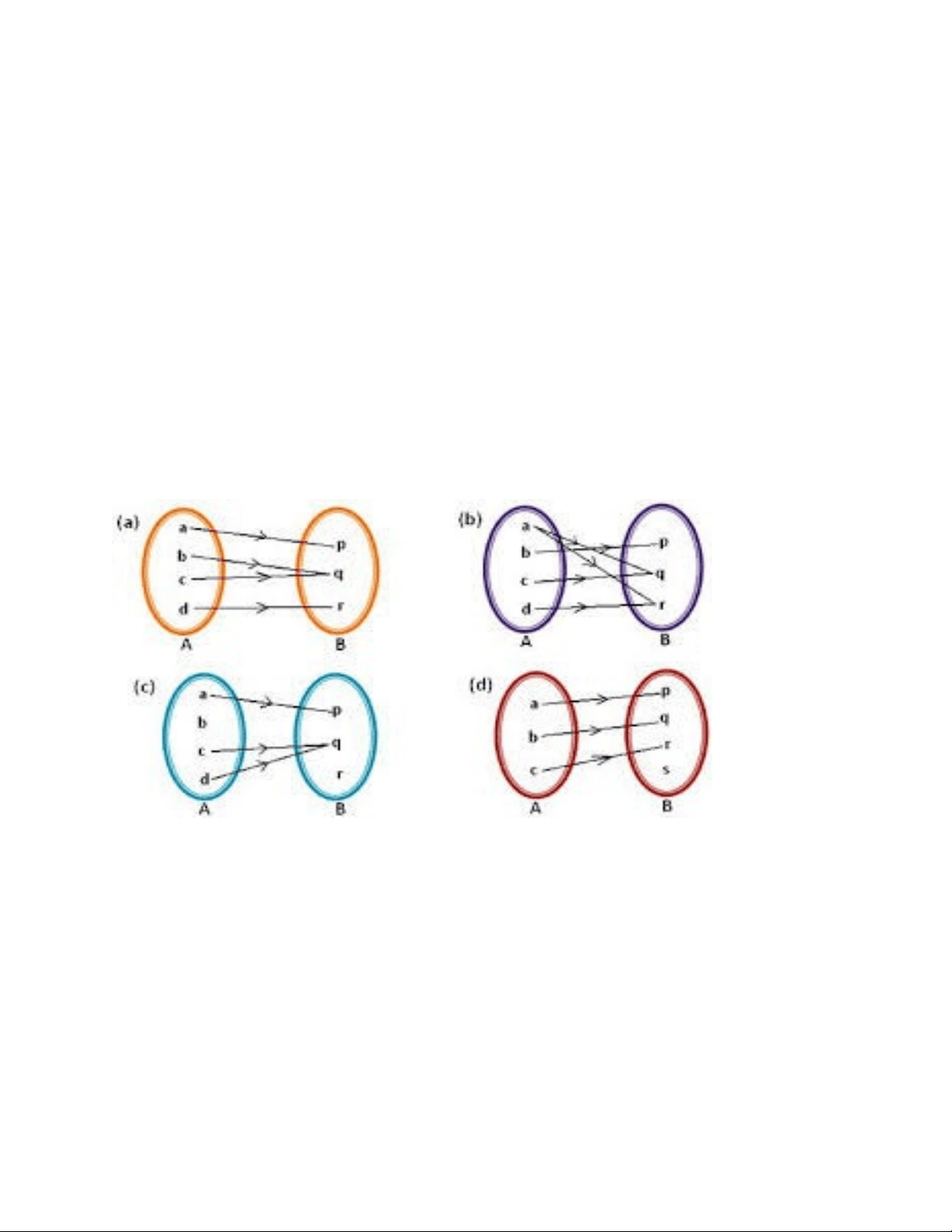
We can define a function as a special relation which maps each element of set A with one and only one element of set B. Both the sets A and B must be non-empty. A function defines a particular output for a particular input. Hence, f: A → B is a function such that for a ∈ A there is a unique element b ∈ B such that (a, b) ∈ f. Here Arrow diagram (a & d) are functions but AD (b & c) are not functions. Reason: In Arrow diagram (b), domain ‘a’ has two different images ‘q & r’, while in the arrow diagram (d), domain ‘b’ has no image, that is why these are not functions.
1.2: Types of Functions
1.2.1: One to One Function A function f: A → B is One to One if for each element of A there is a distinct element of B. It is also known as Injective. Consider if a 1 ∈ A and a 2 ∈ B, f is defined as f: A → B such that f (a 1 ) = f (a 2 ). 1.2.2: Many to One Function It is a function which maps two or more elements of A to the same element of set B. Two or more elements of A have the same image in B.
1.2.5: Floor Function: For any real number x, the floor of x is written as x and it equal to the greatest integer less than or equal to x. 1.2.6: Ceiling Function: For any real number x, the ceiling of x is written as ^ x , is the least integer greater than or equal to x. 1.3: Inverse of a Function
What is the Inverse of a Function? We have learned that a function f maps x to f( x ). The inverse of f is a function which maps f( x ) to x in reverse. The inverse of the function f is denoted by f
- . The inverse of a function is found by interchanging its range and domain. The domain of f becomes the range of the inverse and the range of f becomes the domain of the inverse of f. The inverse of a function is not always a function and should be checked by the definition of a function. A function only has an inverse if it is one-to-one. How to find the inverse of a function? The steps involved in getting the inverse of a function are: Step 1: Determine if the function is one to one. Step 2: Interchange the x and y variables. This new function is the inverse function Step 3: If the result is an equation, solve the equation for y. Step 4: Replace y by f
(x), symbolizing the inverse function or the inverse of f.
Solution : Because all three elements of the codomain are images of elements in the domain, we see that f is onto. This is illustrated in Figure 2. Note that if the codomain were {1,2,3,4}, then f would not be onto. Fig: 2
4. Let f be the function from{a,b,c}to{1,2,3}such that f(a)=2, f(b)=3, and f(c)=1. Is f invertible, and if it is, what is its inverse? Solution: The function f is invertible because it is a one- to-one correspondence. The inverse function f − reverses the correspondence given by f, so f − (1) = c, f − (2) = a, and f − (3) = b. 5. Let f : Z→Z be such that f(x)= x +1. Is f invertible, and if it is, what is its inverse? Solution: The function f has an inverse because it is a one-to-one correspondence, as follows from Examples 10 and 14. To reverse the correspondence, suppose that y is
the image of x, so that y = x +1. Then x = y −1. This means that y −1 is the unique element of Z that is sent to y by f. Consequently, f−1(y) = y −1.
6. Let f be the function from R to R with f(x)= x 2 . Is f invertible? Solution: Because f (−2) = f (2) =4, f is not one-to-one. If an inverse function were defined, it would have to assign two elements to 4. Hence, f is not invertible. (Note we can also show that f is not invertible.). The Graphs of Functions We can associate a set of pairs in A×B to each function from A to B. This set of pairs is called the graph of the function and is often displayed pictorially to aid in understanding the behavior of the function. 1. Display the graph of the function f(n) =2n+1 from the set of integers to the set of integers.
Q: Display the graph of the function f(x)= x 2 from the set of integers to the set of integers.
Permutation & Combination: Permutation: A permutation is an ordered arrangement of r objects chosen from n objects. Combination: A combination is an arrangement of r objects chosen from n objects and the order is not important. How to know when to use combinations or permutations? Both combination and permutation count the ways that (r) objects can be taken from a group of (n) objects, but permutations are arrangements (sequence matters), while combinations are selections (order does not matter). For example, how many ways can you seat people at a table? That's permutation. How many poker hands are available in five-card draw? That's a combination. Example: Given a set of seven letters: {a, b, c, d, e, f, g} 1: How many permutations of three letters? 2: How many combinations of three letters? 3: I have 20 students in a class. I am going to pick 5 students for a prize. The first person I pick will get 1st prize, the second student 2nd prize and so on. How many ways can I choose the students?