




Study with the several resources on Docsity

Earn points by helping other students or get them with a premium plan

Prepare for your exams
Study with the several resources on Docsity
Earn points to download
Earn points by helping other students or get them with a premium plan
This document consists of eight quiz questions related to civil procedure, specifically covering topics such as jurisdiction, in personam and in rem, quasi-in-rem, long arm statute, and diversity jurisdiction. The questions test the ability to apply legal concepts to factual scenarios.
Typology: Exercises
1 / 8

This page cannot be seen from the preview
Don't miss anything!
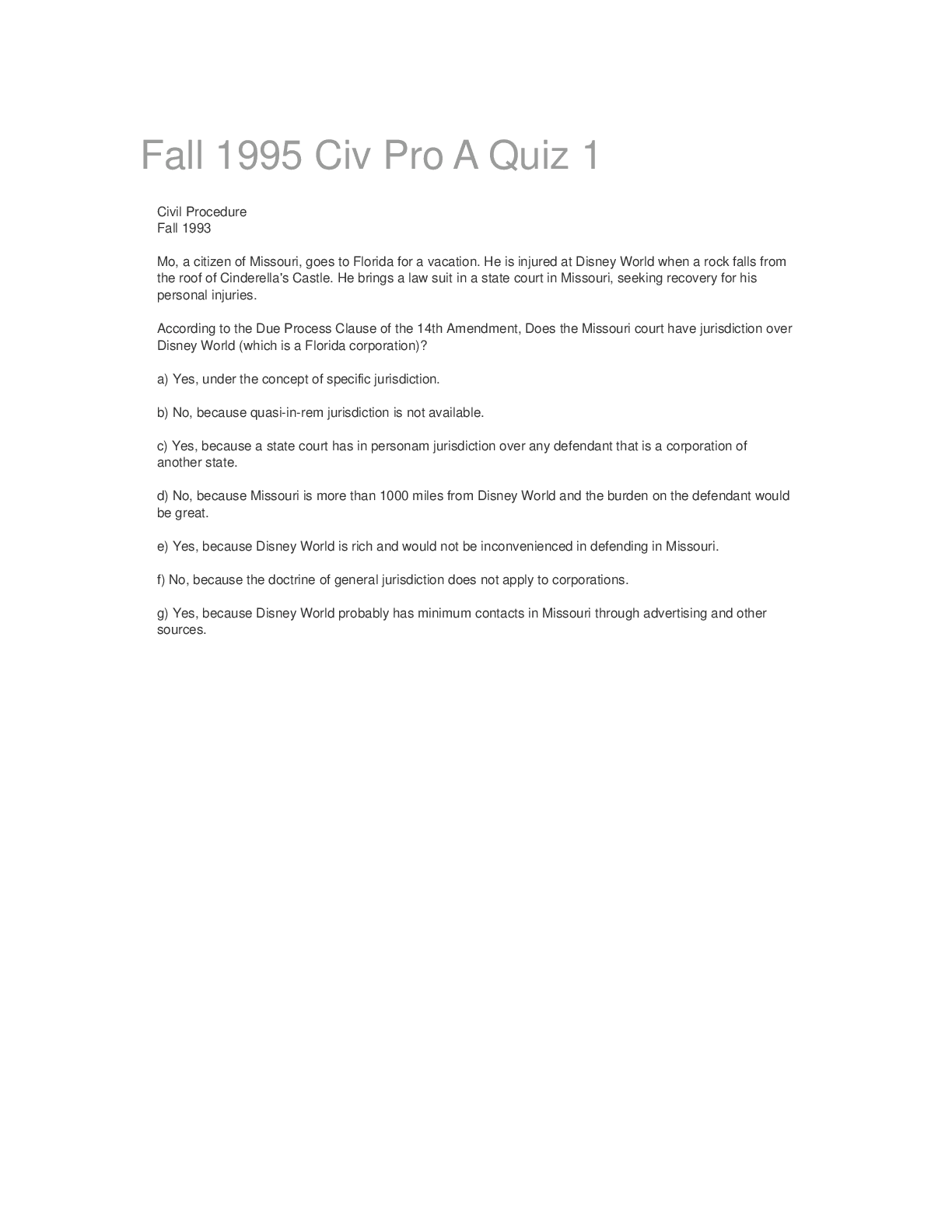
Civil Procedure Fall 1993 Mo, a citizen of Missouri, goes to Florida for a vacation. He is injured at Disney World when a rock falls from the roof of Cinderella's Castle. He brings a law suit in a state court in Missouri, seeking recovery for his personal injuries. According to the Due Process Clause of the 14th Amendment, Does the Missouri court have jurisdiction over Disney World (which is a Florida corporation)? a) Yes, under the concept of specific jurisdiction. b) No, because quasi-in-rem jurisdiction is not available. c) Yes, because a state court has in personam jurisdiction over any defendant that is a corporation of another state. d) No, because Missouri is more than 1000 miles from Disney World and the burden on the defendant would be great. e) Yes, because Disney World is rich and would not be inconvenienced in defending in Missouri. f) No, because the doctrine of general jurisdiction does not apply to corporations. g) Yes, because Disney World probably has minimum contacts in Missouri through advertising and other sources.
Civil Procedure Fall 1995 Only one of the following examples/statements is correct. Which one? A) Blackacre is located in the State of Oregon. A dispute has arisen over the ownership of Blackacre. Citizens of Oregon, Montana and Canada claim title to the land. An Oregon court needs in personam jurisdiction over the three citizens to resolve the dispute. B) The plaintiff is injured in Texas in a car accident with a citizen of Texas. Plaintiff returns to his home in Arkansas and sues for damages. Plaintiff commences the lawsuit by seizing the stock that the defendant owns in an Arkansas corporation. The Arkansas court has properly acquired quasi-in-rem jurisdiction over the Texas defendant. C) A citizen of Tennessee is injured while hiking in the woods. The land is owned by a citizen of New York. The plaintiff sues for damages in a Tennessee court. The Tennessee needs in rem jurisdiction over the defendant. D) A citizen of Michigan is slandered by a citizen of Ohio. The Ohio defendant has never been to Michigan, but owns Greenacre in Michigan. The Michigan plaintiff sues for damages in a Michigan court and commences the lawsuit by attaching Greenacre. The case law is uncertain as to whether quasi in rem jurisdiction has properly been acquired.
Civil Procedure Fall 1995 A Wyoming statute provides that in a replevin lawsuit to recover an automobile, the person with possession of the automobile must be notified of the commencement of the action by a notice attached to the automobile. Further the Wyoming statute provides that while most lawsuits in Wyoming give the defendant 20 days to answer the complaint and make an appearance in court, in a replevin lawsuit the defendant only has 5 days. In the instant case of Peter v. Debbie, the defendant was informed of the lawsuit by a notice placed on the windshield of the car, and is given 6 days to answer and make an appearance. Is the statute as applied in this instance valid under the Due Process Clause? a) No. The Due Process Clause requires 20 days notice before any court hearing. b) Yes. The plaintiff notified the defendant of the lawsuit by the means specified by the legislature. c) No. Notices attached to automobiles can easily be removed and are therefore not "reasonably calculated to give notice." d) Yes. Because automobiles can easily be moved from one place (and even one state) to another, the Due Process requirement for a hearing does not apply. e) No. The Due Process Clause requires personal service in all lawsuits that may be described as involving "in personam" jurisdiction.
Civil Procedure Fall 1995 The process server comes to the home of the defendant with a summons. The defendant is absent, but the daughter of the defendant is playing basketball at the house. The daughter is a mature and responsible 13 year old. She does not live at the house. She is visiting her father, the defendant, for 3 hours. She accepts the summons and give them to her father, when he comes home. Service is: a) proper under the Arkansas rules and the federal rules. b) proper only under the Arkansas rules. c) proper only under the federal rules. d) improper under both federal and Arkansas rules. e) inadequate according to the Due Process Clause.
Civil Procedure Fall 1995 Quiz #7 (Alternative) Ted (a citizen of Texas) and Alice (a citizen of Arkansas) are not relatives, but they met while attending a seminar at the Fayetteville office of a national brokerage house. The brokerage house is incorporated in Texas and has its principal place of business in Texas. Following the presentation, Ted purchased $60, of XYZ stock, and Alice purchases $3,000 of XYZ stock. XYZ has now declined in value. Both Ted and Alice are discouraged and they are convinced the brokerage house was engaged in fraudulent activities. On their behalf, an attorney files a lawsuit in Arkansas circuit court, seeking $60,000 for Ted in Count I and $3,000 for Alice in Count II. The claims of Ted and Alice are separate and independent of each other. The complaint alleges common law fraud as defined under the common law of Arkansas. The Texas defendant has filed a petition in federal court to remove. A) The federal court must take both Count I and Count II. B) The federal court must take Count I, and has discretion to take Count II. C) The federal court must take Count I, but has no authority to take Count II. D) The federal court must take Count II, and has discretion to take Count I. E) The federal court must take Count II, but has no authority to take Count I. F) The federal court cannot take either Count I or Count II.
Civil Procedure Fall 1995 Patsy Plaintiff files an action in federal court in Idaho under diversity jurisdiction, alleging breach of contract by Dan Defendant. She seeks $55,000 in compensatory damages and $100,000 in punitive damages. Under Idaho case law punitive damages may be awarded in a breach of contract case if the breach was egregious. This view is contrary to the view prevailing in almost every other jurisdiction. The defendant moves to dismiss the request for punitive damages. The federal trial judge: A) must follow the Idaho law because it is substantive in nature. B) may follow the Idaho law on punitive damages, but is not compelled to do so because the Idaho position is such a radical departure from the general law. C) may ignore Idaho law because it does not for certain affect the outcome. D) must ignore Idaho case law because the failure of the Idaho legislature to enact a statute shows that the issue is not integral or essential to the state of Idaho. E) may ignore the Idaho law because it is procedural in nature.
