Download Electricity and Magnetism - ProblemSet 3 Solution - Physics and more Study notes Physics in PDF only on Docsity!
Solutions for class #10 from Yosumism website
Yosumism website: http://grephysics.yosunism.com
Problem 1:
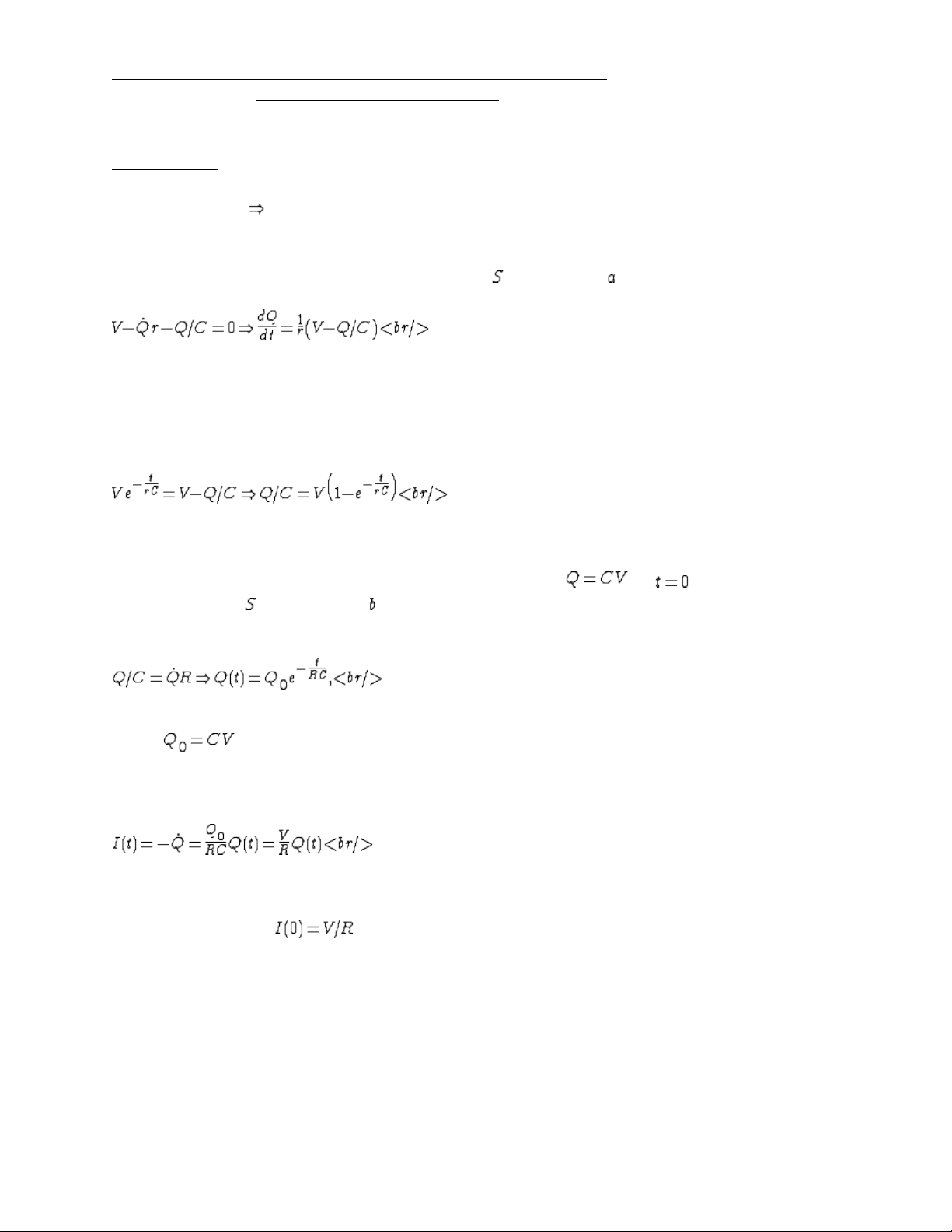
Electromagnetism }RC Circuit One can immediately eliminate plots A, C, E, since one would expect an exponential decay behavior for current once the switch is flipped. More rigorously, the initial circuit with the switch connected to has the following equation, Once integrated, the equation becomes, The charge stored on the capacitor after it is fully charged is (at ). When the switch is switched to , the equation becomes, where from the initial connection. Current is the negative time derivative of charge, and thus, The initial current IS , and thus choice (B) is right.
YOUR NOTES:
Problem 2:
Electromagnetism }Faraday Law Recall Faraday's Law. Dot both sides with the area. Recalling Stokes' Theorem ( ), the left side can be converted to the potential, i.e., the emf . Finally, from Ohm's Law , one can obtain the current. (Note that V is the voltage of the battery. The voltage induced acts to oppose this emf from the battery.) The problem gives. The area is just. Thus, the induced emf is, Thus, , since.
YOUR NOTES:
Problem 3:
Electromagnetism }Potential Recall the elementary equations,.
Problem 19:
Electromagnetism }Coulomb's Law The particle obeys a Coulomb's Law potential,. In this case particle 1 is a Helium atom, which has charge , while particle 2 is silver, with. Thus, Conservation of energy requires that when the incident particle is at its closest approach,
. Recall that , , convert everything to to get
YOUR NOTES:
Problem 24:
Electromagnetism }Conductors This problem involves applying Coulomb's Law to conductors. The charge travels from conductor to conductor and equilibriates instantaneously due to the requirement that two touching conductors must be at an equipotential. This means that if conductors 1 and 2 touch then their potentials are related by. Because the problem involves spherical conductors, the potential has the form. The initial force between the two conductors is , where. After C is touched to A, the charge becomes , since each conductor shares the same charge out of a total of (to wit: each has half of the total charge). When C is touched to B, the charge becomes , since each conductor shares the same charge out of a total of (to wit: for each conductor). When C is removed, one calculates the force from Coulomb's law and the final charges on A and B determined above to be, , as in choice (D).
(E) This is false, since , initially. In the final state, each capacitor has energy. The sum of energies is thus.
YOUR NOTES:
Problem 26:
Electromagnetism }Resonance Frequency One wants to tune one's radio to the resonance frequency (a.k.a. the frequency at which impedance is matched). The resonance frequency of an LRC circuit is given by , where the quantities involved are angular frequency, inductance, and capacitance. Solving for C, one has. This is choice (C). The hardest part of his problem, of course, is doing the math without a calculator. Easy.
YOUR NOTES:
Problem 43:
Electromagnetism }Stokes Theorem Recall Stokes' Theorem. The left side of the equality is easier to evaluate, so evaluating that, one has. The area is , and thus.
YOUR NOTES:
Problem 46:
Electromagnetism }Faraday Law Recall Faraday Law, , where. Since the magnetic field is constant, the equation simplifies to for this case. , and thus. Solving for angular momentum, one has. Alternatively, one has. Since , one has
. Plug it into Faraday Law and solve for angular velocity.
YOUR NOTES:
Ey =? (E’y – vB’z) By =? (B’y – v/c^2 E’z) Ez =? (E’z – vB’y) Bz =? (B’z – v/c^2 E’y)
Since (with all other primed components 0), the transformed field is just , as in choice (C). (Recall that , where ) If one forgets the Lorentz-transformed fields, one can also quickly derive the answer for this case. Since the transformed charge density is Lorentz contracted in one of its area dimensions, one has. One can tell by symmetry of the surface that the other field components cancel, and one again arrives at the result for as above.
YOUR NOTES: