Download Electrostatic Effects - Geochemistry - Lecture Slides and more Slides Geochemistry in PDF only on Docsity!
Page 14
Electrostatic Effects on the Activities of Surface
Species
(X z^ )surface = (X z^ )soln [e−ψF /RT^ ]z
The activity of a species X with charge
z on the surface is
Here, ψ is the electrostatic potential
resulting from the charge on the
surface. We need to develop a
model for the surface charge
distribution and the resulting
electrostatic potential.
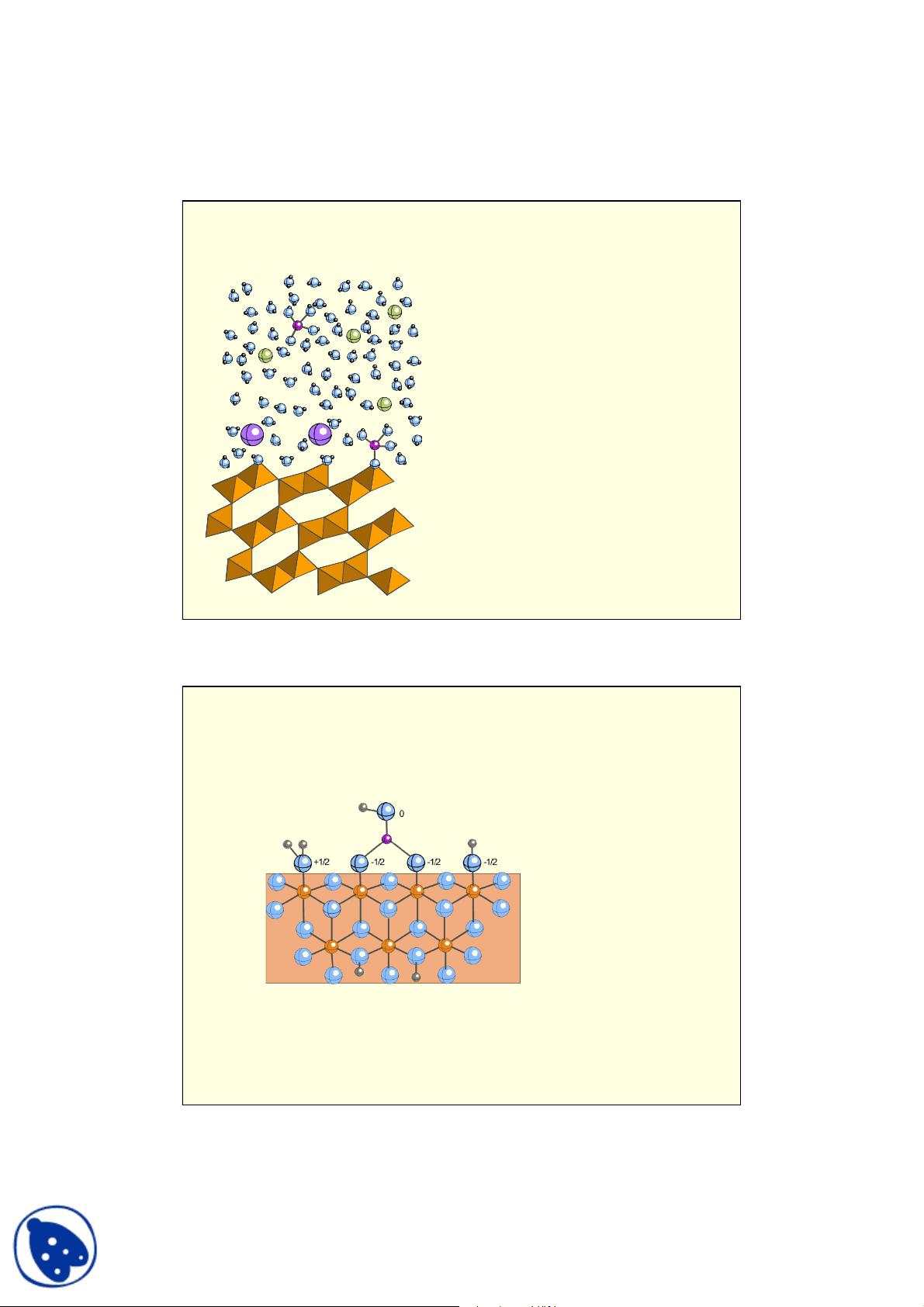
Model for Surface Charge Distribution
The Surface Charge is:
σ 0 = -0.5{>Fe-OH-0.5^ } + 0.5 {>Fe-OH 2 +0.5^ } -1.0{(>FeO) 2 AsOH}
Popular strategy is to assign atomic charges based on
Pauling’s Second Rule.
Page 15
Diffuse Layer Model
0-plane
Solid
Diffuse Layer
Diffuse Layer Model
€
σ 0 = ((−
1 2
){> FeOH−1/2^ }Stot + (
1 2
){> FeOH 2 1/2^ }Stot +
{(> FeOH) 2 Cd+^ }Stot ) /A
€
σ 0 = −σd
8 εε 0 RTI
1/ 2
sinh
zFψ 0
2 RT
Page 17
Basic Stern Model
€
σ 0 = ((−
1 2
){> FeOH−1/2^ }Stot + (
1 2
){> FeOH 2 1/2^ }Stot +
{(> FeOH) 2 Cd+^ }Stot ) /A
€
σ 0 = −σd
σ 0 = C 1 ( ψ 0 −ψd )
σd =
8 εε 0 RTI
1/ 2
sinh
zFψd
2 RT
Extended Stern Model
1-plane
Solid
1 st^ Stern Layer
2 nd^ Stern Layer
Diffuse Layer
Allows for charge distribution in ternary complexes and
oxyanions
0-plane
d-plane
Page 18
Sorption on an amphoteric oxide surface
(including electrostatic effects)
We have two simultaneous equilibria:
>Fe-OH-0.5^ + H+^ = >Fe-OH 2 +0.
>Fe-OH-0.5^ + M2+^ = >Fe-(OH)M+1.
With equilibrium constants
€
K (^) a =
{> FeOH−0.5^ }[H+^ ] {> FeOH 2 +0.5^ }
e−ψ^0 F /RT
K 2 =
{> FeOHM +1.5^ } {> FeOH−0.5^ }[M 2 +^ ]
e−^2 ψ^0 F /RT
Summary: Developing a Surface
Complexation Model
Identify surface sites
and their abundances
pK’s for surface site
protonation
Structures and charges
of surface complexes
Model for surface
electrostatics
Surface Morphology,
BET surface areas
Basic Stern, Diffuse
Layer etc.
Potentiometric
Titrations, MUSIC Model
EXAFS Spectroscopy,
Quantum Chemistry
Fit sorption experiments Sorption Edges
Page 20
Implementation of Surface Complexation
Models in PHREEQC
SURFACE_MASTER_SPECIES! Fes_ Fes_OH-0.5! SURFACE 1! Fes_OH-0.5 1.0e-3 32.7 3.33! -cd_music! -capacitance 1.0 3.0!
SURFACE_SPECIES! Fes_OH-0.5 = Fes_OH-0.5! log_k 0.0! -cd_music 0 0 0 0 0!
Fes_OH-0.5 + H+ = Fes_OH2+0.5! log_k 9.20! -cd_music 1 0 0 0 0!
2Fes_OH-0.5 + Zn+2 = (Fes_OH)2Zn+! log_k 8.5! -cd_music 2 0 0 0 0!
Extended Stern model
Charge distribution
1pK model
Cu +2^ Sorption on FeOOH (Peacock and Sherman, 2004; Moore and Sherman, in prep))
3D: 3 >FeOH-1/2^ + 2Cu2+^ + H 2 O = (>FeOH) 2 (>FeO)Cu 2 (OH) +1/2^ + 2H +
2C: 2 >FeOH-1/2^ + Cu2+^ = (>FeOH) 2 Cu +1/
2E: >Fe(OH) 2 -1^ +Cu +2^ = >FeOH 2 Cu +1^0
1
2
3
4
1 2 3 4 5 6 7 8
Moles Cu x 10
6
pH
0
1
2
3
4
Moles Cu x 10
5
0
1
2
3
4
Moles Cu x 10
4
0.075 wt. % Cu
0.75 wt. % Cu
0.0075 wt. % Cu
2C
2E
2E 2C
2C 3D
Cu
Cu 3.0 Cu
Cu
3D
2C
2E
Page 21
As(V) Sorption on FeOOH (Jonsson and Sherman, in prep.)
0 1 2 3 4 5
Fourier Transform of X(k)k
3
Distance ( )
goethite As/Fe=0.
hematite As/Fe=0.
ferrihydrite (ads) As/Fe=0.
ferrihydrite (cpptd) As/Fe=0.
lepidocrocite As/Fe=0.
ferrihydrite (ads) As/Fe=0.
C2 complex
MS
(Sherman and Randall, 2003)
Only the C2 complex seem
important at low loading and
has a lower internal energy.
As(V) Sorption on FeOOH (Jonsson and Sherman, in prep.)
Charge-distribution in extended Stern model:
Page 23
Availability of 2 C vs 2 E Sites on FeOOH
€
NE
NC
=
K (^) E
K (^) C
N{210}tot
N{101}tot
X (^) FeOH,{210}
X (^) FeOH,{101}
2
Configurational entropy favors 2 C complexes on {101} surface
even in the dilute limit.
2 E sites
2 C sites
2 E on {210} can only accommodate ~0.03 wt. % U
UO 2 ++^ Sorption on FeOOH (Sherman et al., 2008)
2>FeOH -1/2^ + UO 2 ++^ = (>FeOH) 2 UO 2 +
2>FeOH-1/2^ + UO 2 ++^ + H 2 CO 3 = (>FeOH) 2 UO 2 CO 3 -1^ + 2H+
FeOH-1/2^ + UO 2 ++^ + H 2 CO 3 = (>FeO)CO 2 UO 2 1/2^ + H+^ + H 2 O
Page 24
Applications of Surface Complexation
Models to Reactive Transport..
(Beyond the K d formalism)
The Advection-Diffusion Equation:
∂Ci
∂t
= D
Ci
∂x
− v
∂Ci
∂x
Diffusion Advection
Advection = motion of bulk fluid
Page 26
Advection + Surface Complexation
20
18
16
14
12
10
8
6
4
2
0
0 0.2 0.4 0.6 0.8 1 1.2 1.
Depth (cm)
Pore Water U (ppm) Rainwater; pH 5.6, pCO = 3.
1g FeOOH; pCO2 = 3.
2 g Schoepite; pCO2 = 3.
1g FeOOH; pCO2 = 3.
1g FeOOH; pCO2 = 3.
1g FeOOH; pCO2 = 3.
Sorption by FeOOH retards transport
With FeOOH
No FeOOH
Buried DU
Summary"
- The surfaces of Fe and Mn (hydr)oxides are
reactive (as predicted by Pauling’s second rule).
Surface oxygens can complex dissolved ions and
act as Bronsted bases.
- Because surface areas of Fe-Mn oxides are 10-10 2
m 2 /g, they may sorb ~10 -4^ to 10 -3^ moles/gram.
- At pH ~ 8, cations prefer Mn oxides, anions prefer
Fe-oxides.
- Structural incorporation (solid solution) may make
sorption reactions irreversible.