
Engineering Utilities, Summaries of Electrical Circuit Analysis

Comprehensive lecture notes for Engineering Utilities 1 covering water supply, plumbing and sanitary systems, electrical basics, HVAC, fire protection, and communication systems. Includes diagrams, definitions, sample computations, and references to Philippine standards like NPC, PEC, NBCP, and the Fire Code. Ideal for CE/Architecture students and reviewe

Typology: Summaries

2025/2026

Uploaded on 12/04/2025

joseph-l-cutillas
joseph-l-cutillas 🇹🇼

2 documents

1 / 5

Toggle sidebar

This page cannot be seen from the preview

Don't miss anything!

bg1
pf3
pf4
pf5

Partial preview of the text

Download Engineering Utilities and more Summaries Electrical Circuit Analysis in PDF only on Docsity!

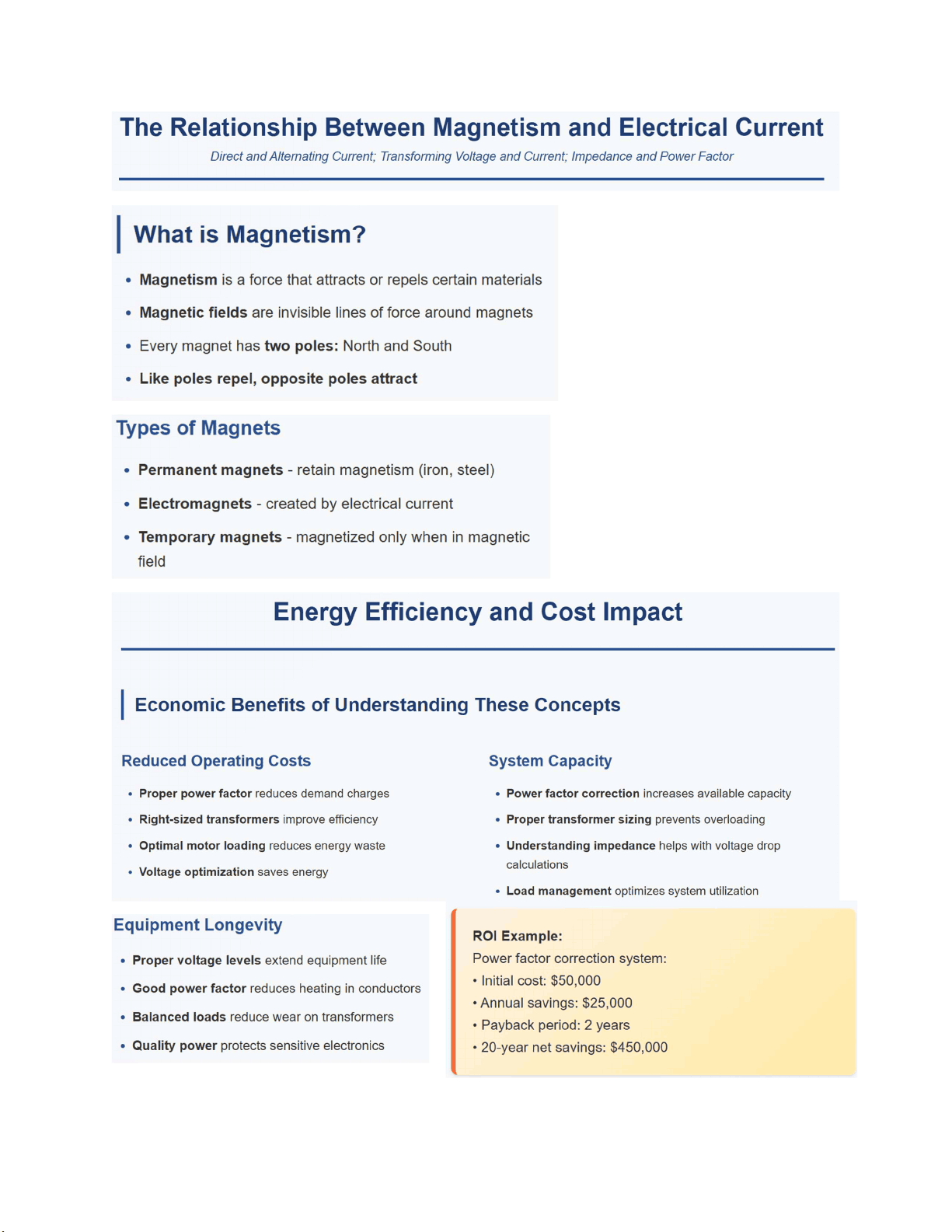
The Relationship Between Magnetism and Electrical Current Direct and Alternating Current; Transforming Voltage and Current; Impedance and Power Factor What is Magnetism? * Magnetism is a force that attracts or repels certain materials ¢ Magnetic fields are invisible lines of force around magnets ¢ Every magnet has two poles: North and South ¢ Like poles repel, opposite poles attract Types of Magnets « Permanent magnets - retain magnetism (iron, steel) « Electromagnets - created by electrical current ¢ Temporary magnets - magnetized only when in magnetic field Energy Efficiency and Cost Impact Economic Benefits of Understanding These Concepts Reduced Operating Costs System Capacity + Proper power factor reduces demand charges + Power factor correction increases available capacity + Right-sized transformers improve efficiency + Proper transformer sizing prevents overloading + Optimal motor loading reduces energy waste + Understanding impedance helps with voltage drop I tic + Voltage optimization saves energy calcdatcos + Load management optimizes system utilization Equipment Longevity ROI Example: * Proper voltage levels extend equipment life Power factor correction sy * Good power factor reduces heating in conductors * Balanced loads reduce wear on transformers + Quality power protects sensitive electronics Utility Rate Structures * Demand charges - based on peak power factor 0.95 orhigher 1.0 No penalty + Energy charges - based on kWh consumption 0.85 - 0.94 1.0-1.1 ‘Small penalty + Power factor penalties - for PF below 0.85 + Time-of-use rates - higher rates during peak hours Gnosis deals) (Miata (realy Below 0.70 1.34 Severe penalty Modern Trends and Future Developments Emerging Technologies Renewable Energy Integration ¢ Solar panel DC output and inverters Smart Grid Integration ¢ Wind turbine AC generation + Advanced metering infrastructure (AMI) ¢ Power quality challenges with renewables + Real-time monitoring and control ¢ Microgrids and islanding capability pmo Deep olice Drogas Electric Vehicle Impact ¢ Grid-interactive buildings ¢ EV charging loads on buildings Energy Storage ¢ Power factor considerations + Battery energy storage systems (BESS) * Vehicle-to-grid (V2G) technology * Power factor correction capabilities + Load management strategies « Peak shaving and load shifting ¢ Grid stabilization services Building Automation Evolution ¢ loT sensors for real-time electrical monitoring ¢ Al-powered optimization of electrical systems ¢ Predictive maintenance using electrical signatures Digital twins for electrical system modeling Future Vision: Buildings will become active participants in the electrical grid, a loads, and providing grid services while minimizing energy costs. Historical Timeline Summary Key Milestones in Electrical History 1831: Faraday discovers electromagnetic induction 1879: Edison invents practical incandescent light bulb 1882: First DC power station (Pearl Street Station, NYC) 1888: Tesla invents AC induction motor and polyphase system 1890- 1892: "War of the Currents" peaks 1893: Westinghouse wins contract to light Chicago World's Fair with AC 1896: Niagara Falls AC power plant begins operation 1900s: AC becomes worldwide standard for power distribution 1950s: First commercial HVDC transmission lines 2000s: DC renaissance in data centers and renewable energy The Lessons from History Technical Innovation Impact on Modern Building Systems * Technical innovation often faces resistance from established * Understanding this history explains why we use AC for power systems but DC for controls + The best technology doesn't always win immediately + Shows importance of standardization in electrical systems + Economic factors ultimately determine adoption + Demonstrates how technological choices affect entire + Old technologies can find new applications (DC comeback) industries + Guides decisions for future electrical system designs Historical Perspective: The fundamental principles discovered by Faraday, Edison, and Tesla over 140 years ago still govern every electrical system in modern buildings. Innovation builds on these foundations rather than replacing them. Summary and Key Takeaways Essential Concepts to Remember + Magnetism and electricity are inseparable - one creates the other through electromagnetic induction + DC flows in one direction, AC alternates direction 60 times per second + Transformers use electromagnetic induction to change voltage levels efficiently + Impedance includes resistance and reactance in AC circuits + Power factor measures electrical efficiency - closer to 1.0 is better + Poor power factor costs money and reduces system capacity Applications in Your Career Technical Applications Business Applications * Motor selection and troubleshooting Utility bill analysis and cost reduction * Transformer sizing and specification + Energy management and demand control « Power quality analysis and improvement * Equipment specification and procurement « Energy efficiency optimization * Maintenance planning and budgeting ¢ Electrical system design and maintenance * Building automation system design The Big Picture Next Steps Apply these concepts to analyze actual building electrical systems and identify opportunities for improvement. Continue learning about advanced topics like three-phase power, motor controls, and smart building technologies.