Download Physics Concepts in Exam Results: Elasticity, Pressure, Density, Buoyancy, Hydrodynamics and more Exams Physics in PDF only on Docsity!
Phy 2053 Announcements
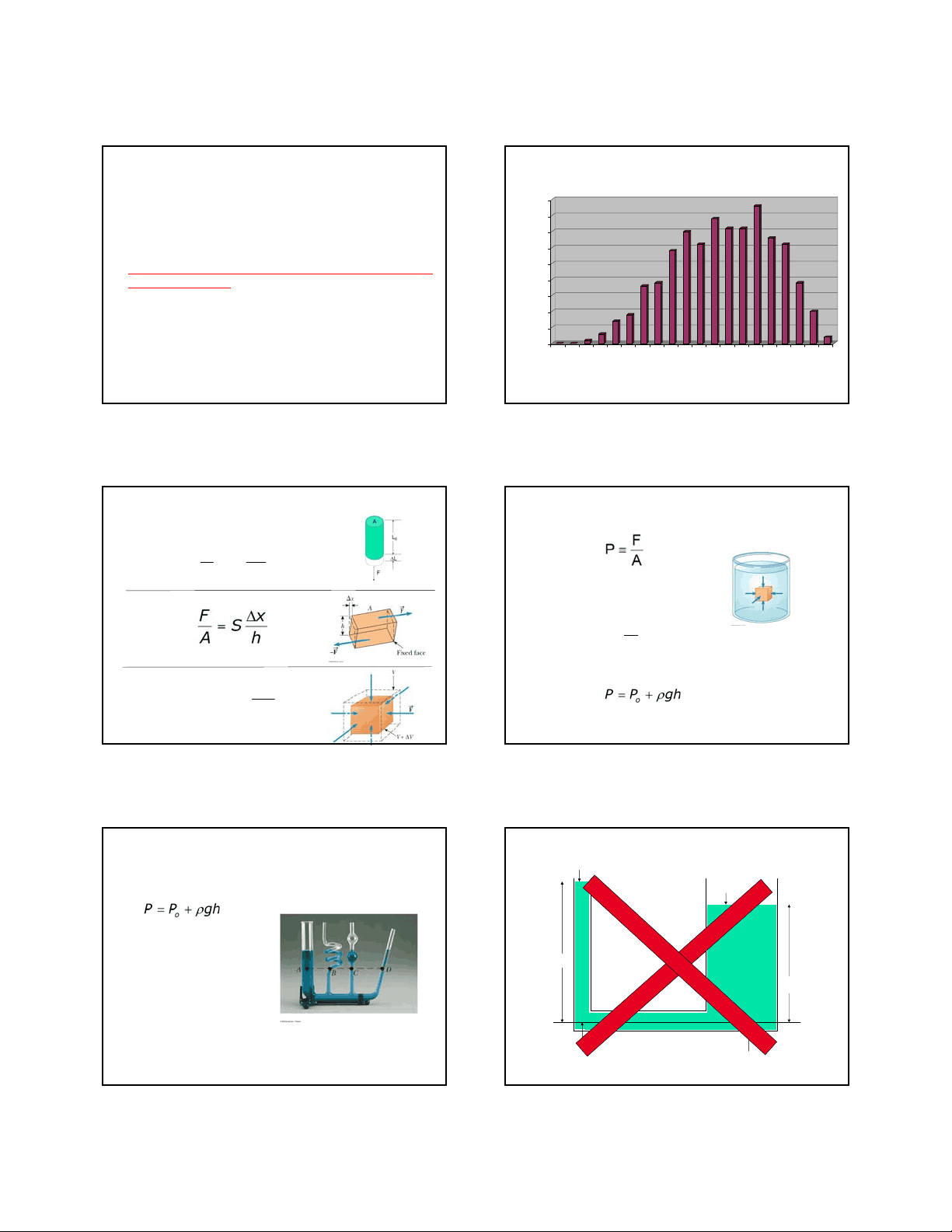
Results from Exam 2 are in Average: 12. Standard deviation: 3.
Grades are available on UF e-Learning web site
Exam 2 solutions have been posted:
http://www.phys.ufl.edu/courses/phy2053/spring09/webpage/ midterm2/index.html
Still waiting to check IDs for a few students; please come by my office during office hours
You have until next Tuesday to look at your test and bubble sheets Come to my office
HW Assignment 9 due this Wednesday, April 8
0
5
10
15
20
25
30
35
40
45
Number
1 2 3 4 5 6 7 8 9 10 11 12 13 14 15 16 17 18 19 20 Grade
Exam 2 Grade Distribution
o
F L
Y
A L
Elastic Moduli
V
P B
V
Young’s Modulus:
Sheer Modulus:
Bulk Modulus:
Pressure and Density
Pressure:
force exerted by a fluid on a submerged object at any point if perpendicular to the surface of the object
Density:
Pressure vs depth
m
V
Pressure and Depth
equation
Po is normal
atmospheric
pressure
1.013 x 10^5 Pa
The pressure does not depend upon the shape of the container
Liquid in a U- tube
P atm
P atm
h 1
h 2
P = Patm + ρgh 1 P = Patm + ρgh 2
Liquid in a U- tube
P (^) atm P (^) atm
h (^1)
h (^2)
P = Patm + ρgh 1 P = Patm + ρgh 2
h 1 = h (^2)
Pressure Measurements:
Barometer
Invented by Torricelli (1608 – 1647) A long closed tube is filled with mercury and inverted in a dish of mercury
Buoyant Force (will it
float?)
The magnitude of the buoyant force always equals the weight of the displaced fluid
The buoyant force is the same for a totally submerged object of any size, shape, or density
fluid fluid fluid B = ρ V g = w
Floating Object
The forces
balance
obj
fluid
fluid
obj
V
V
ρ
ρ
Totally Submerged Object
If the object is less
dense than the fluid,
the object
experiences a net
upward force
If the object is more
dense than the fluid
the net force is
downward
B = ρ fluid Vfluid g = wfluid
Totally Submerged Object
mg = ρ object Vobjectg
For completely submerged object:
V (^) object = V (^) fluid
If ρ object < ρ fluid, mg < B
If ρ object > ρ fluid, mg > B