
Study with the several resources on Docsity
Earn points by helping other students or get them with a premium plan
Prepare for your exams
Study with the several resources on Docsity
Earn points to download
Earn points by helping other students or get them with a premium plan
Learn about fact tables, the primary component of dimensional modeling, which store numerical business performance measurements. Discover how fact tables are joined with dimension tables in a star schema to bring data together. Fact tables are deep in rows but narrow in columns, making up the majority of a dimensional database.
Typology: Exercises
1 / 2
This page cannot be seen from the preview
Don't miss anything!


Fact Table
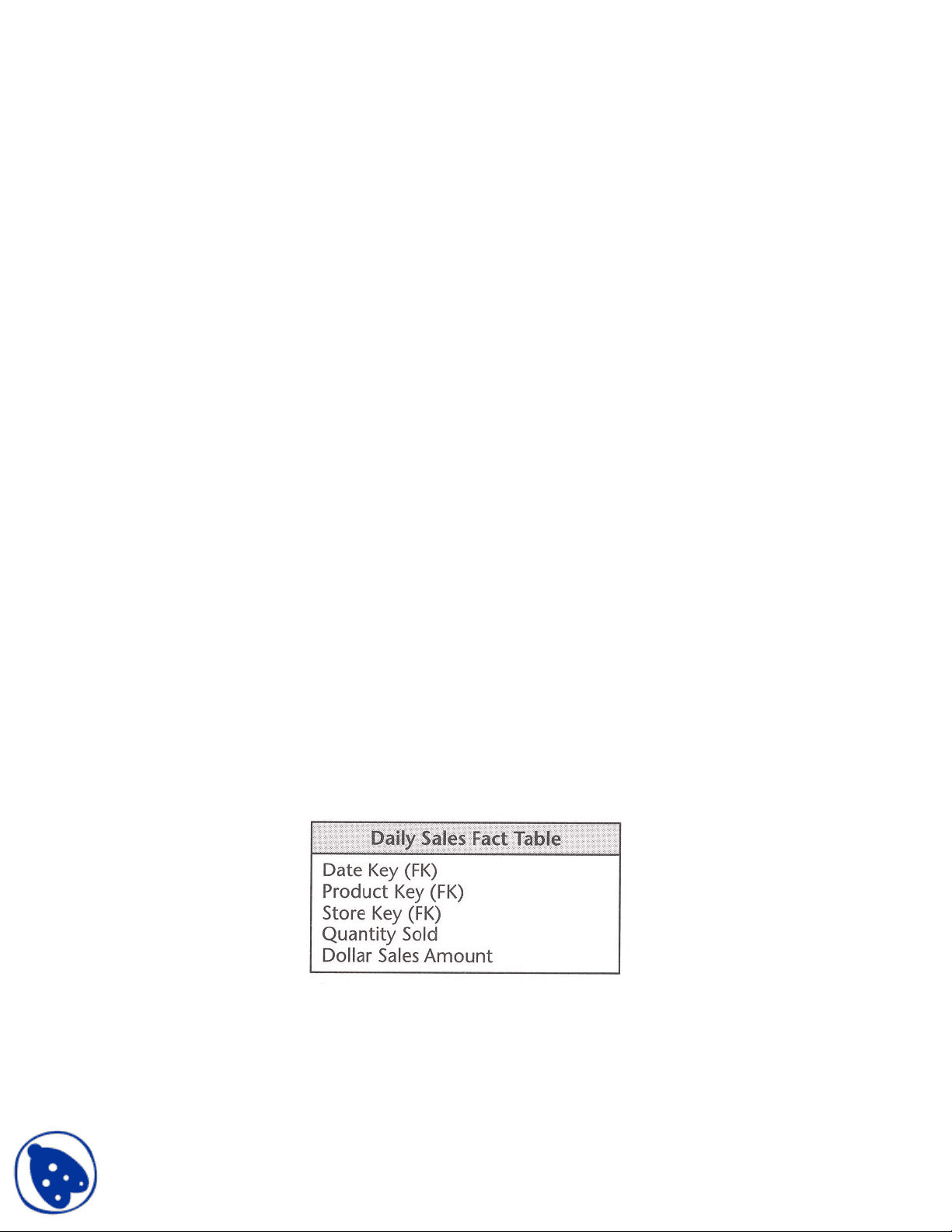
A fact table is the primary table in a dimensional model where the numerical performance measurement of the business are stored. There can be many performance measurements or facts in a fact table.
A row in a fact table corresponds to a measurement. The most useful facts in a fact table are numeric and additive. Fact tables tend to be deep in terms of the number of rows but narrow in terms of the number of columns. Thus, fact tables usually make up 90 percent or more space of a dimensional database.
All fact tables have two or more foreign keys that connect to the dimension tables’ primary keys. When all the keys in the fact table match their respective primary keys correctly in the corresponding dimension tables, we say that the tables satisfy referential integrity. We access the fact table via the dimension tables joined to it.
The fact table itself generally has its primary key made up of a subset of the foreign keys. This key is called a composite or concatenated key. Every fact table in a dimensional model has a composite key, and conversely, every table that has a composite key is a fact table.
Another way to say this is that in a dimensional model, every table that expresses a many-to-many relationship must be a fact table. All other tables are dimension tables.
docsity.com
The Dimensional Model: Star Schema
The model that brings the dimensions and facts together is termed as the dimensional model. In this model, the fact table consisting of numeric measurements is joined to a set of dimension tables filled with descriptive attributes.
In the model, the fact table is at the center and the dimension tables are hung around like a star. Hence, this characteristic structure is often termed as star schema. When a customer id, a product id, and a time period are used to determine which rows are selected from the fact table, this way of collecting the data is called the star schema join.
Dimension
Fact
docsity.com