



PHY2049: Chapter 23 1
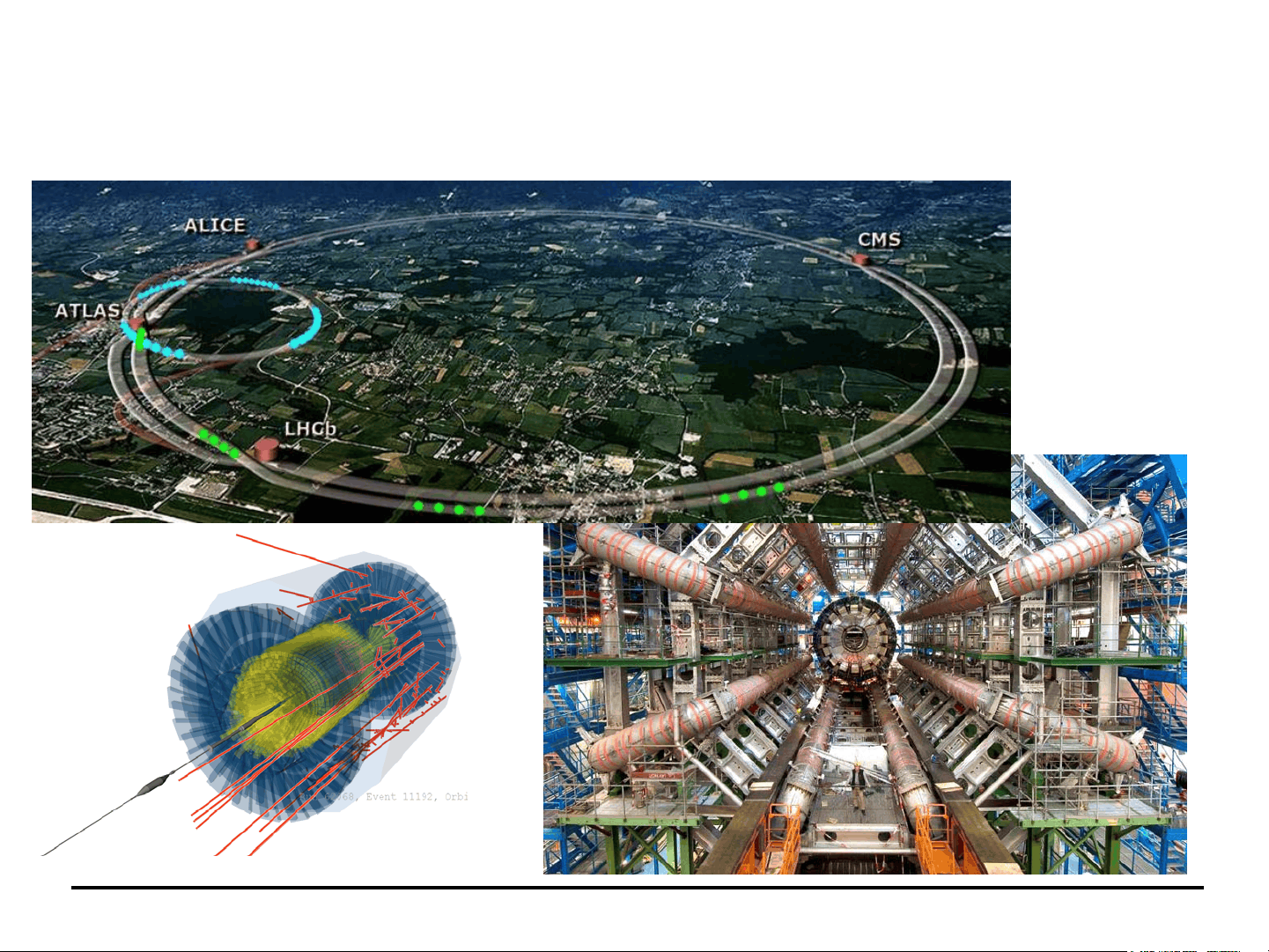
First Beams at LHC!


Study with the several resources on Docsity

Earn points by helping other students or get them with a premium plan

Prepare for your exams
Study with the several resources on Docsity
Earn points to download
Earn points by helping other students or get them with a premium plan
A chapter from a physics textbook focusing on gauss' law and its application to calculate electric fields in various symmetrical charge distributions, including spherical, cylindrical, and rectangular symmetries. It covers topics such as conductors, spherical symmetry, axial symmetry, and rectangular symmetry, providing equations and solutions for different scenarios.
Typology: Study notes
1 / 10

This page cannot be seen from the preview
Don't miss anything!
PHY2049: Chapter 23
PHY2049: Chapter 23
Î
Î
no effect on the total
Remember:
Outward E field, flux > 0 Inward E field,
flux < 0
enc ε^0 q
d S^
∫^
PHY2049: Chapter 23
Use Gauss’ Law to Calculate E Fields Î
Spherical symmetry^
E field vs r inside uniformly charged sphere
Charges on concentric spherical conducting shells Î
Cylindrical symmetry^
E field vs r for line charge
E field vs r inside uniformly charged cylinder Î
Rectangular symmetry^
E field for charged plane
E field between conductors, e.g. capacitors
PHY2049: Chapter 23
ÎInsulator or conductor?
^ Conducting sphere cannot be uniformly charged ÎInside
^ By symmetry, E must be radially symmetric ^ E field has constant mag.,
⊥^
to Gaussian surface
ÎOutside
Gaussian surface
(sphere)
Gauss’ Law
Solve for E
Uniformly Charged Sphere
enc^0
2 ) (^4) (
q ε
rπ E
d S^
∫^
+^ +
+^
+^ +
+^
+^ +
+^ +
+^
+^ +
+^
+^ +
+^ +
+^
+^ +
+^
+^ +
+^ +
+^
+^ +
+^
+^ +
+^ +
+^
+^ +
+^
+^ +
+^ +
+^
+^ +
+^ +
+^
3 4 3 Q Rπ Q ρ = 3 3
3 ) (^4) ( 3
r R Q rπ ρ^
= Q 3 0 2 0
3 3
(^14)
4
/
Qr^ R πε
r πε
R Qr E^
=
=
2 0 (^14)
Q r πε
E^
=
Volume chargedensity
PHY2049: Chapter 23
ÎInfinitely long line, uniformly charged
^ By symmetry, E must be axially symmetric ^ On curved surface, E field has constantmag.,
⊥
to Gaussian surface
^ Through top and bottom surfaces, no
Φ
E
since E is ||
Solve for E
enc^0
0 0 ) 2 (^
q ε
rπ h E
d S^
∫^
Gauss’ Law
hλ
λ r πε E
0 (^12) =^
λ: linear charge density
PHY2049: Chapter 23
ÎInfinitely tall cylinder, uniformly charged
^ By symmetry, E must be axially symmetric ^ On curved surface, E field has constant mag.,^ ⊥
to Gaussian surface ^ Through top and bottom surfaces, no
Φ
sinceE
E is ||
)
(^
(^2) r πh ρ
Solve for E
enc^0
0 0 ) 2 (^
q ε
rπ h E
d S^
∫^
Gaussian surface
(cylindrical) ρ
R r
h
Gauss’ law
rρ ε
E
0 (^12) =
ρ: volumecharge density
PHY2049: Chapter 23
λ πε
E
0 2
Some Comparisons
total^2 r 0
0 σ 2 ε
E^
No distance dependence!
Î
Spherically symmetric charge distribution Î
Uniformly charged, infinitely long (i.e., verylong) line Î
Uniformly charged plane