
Forensics Cheat Sheet, Cheat Sheet of Earth science

Forensics notes for Nebraska Science Olympiad

Typology: Cheat Sheet

2023/2024

Uploaded on 04/09/2025

michael-tophoj
michael-tophoj 🇺🇸

2 documents

1 / 2

Toggle sidebar

This page cannot be seen from the preview

Don't miss anything!

bg1
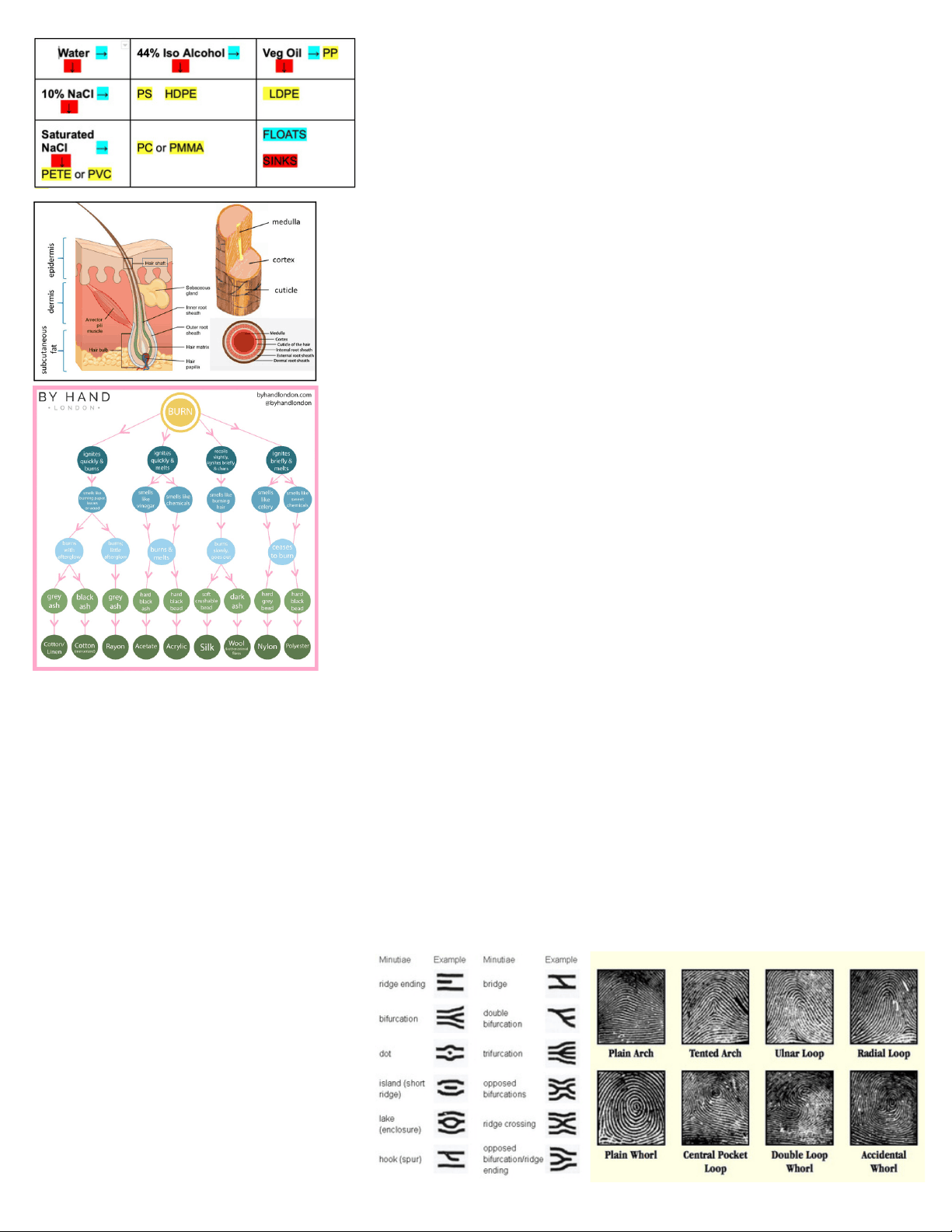
PS- Polyethylene terephthalate, is the most commonthermoplastic polymer resin of the polyester
family and is used in fibres for clothing, containers for liquids and foods, and thermoforming for
manufacturing, and in combination with glass fibre for engineering resins.HDPE- High-Density
Polyethylene is a polyethylene thermoplastic made from petroleum. HDPE is commonly recycled and
made into composite wood or plastic lumber. is a Type 2 plastic commonly used in making containers
for milk, motor oil, shampoos and conditioners, soap bottles, detergents, and bleaches.LDPE-
Low-density polyethylene. This clear or translucent plastic exhibits flexibility, chemical resistance, and
waterproofing capabilities. It is used in the manufacture of a wide range of products, including grocery
bags, plastic wrap and film, and flexible packaging material.PC- commonly used for plastic lenses in
eyewear, medical devices, automotive components, protective gear, greenhouses, Digital Disks (CDs,
DVDs, and Blu-ray), and exterior lighting fixtures.PMMA- often used as a lighter, shatter-resistant
alternative to glass in everything from windows, aquariums and hockey rinks. Therefore, it's hard to fathom that
this easy-to-process, low-cost, versatile material is also used in dentures, bone implants etc.PETE-
polyethylene terephthalate, the chemical name for polyester. PET is a clear, strong, and lightweight plastic that
is widely used for packaging foods and beverages, especially convenience-sized soft drinks, juices and water.
*Forensicscientists can determine a number of thingsfrom analyzing hairs found at crime scenes. The clues
that hairs reveal include what part of the body the hairs came from, the race of the person they came from, if
the hairs shed naturally or were pulled from someone's head, and whether the hairs were colortreated.*
Medullary index(MI): width of medulla/whole hairwidth (if >0.5 then it is animal hair, if <0.33 then it is human
hair) Medulla: the centre-most part of the hair strandAnagen phase- period of growth in the hair cycle,avg
3-5 yearsCuticle- translucent outer layer of thehair shaft consisting of scales that cover the shaft. Cuticular
scales always point from the proximal or root end of the hair to the distal or tip end of the hair.Cortex- the
main body of the hair composed of elongated and fusiform (spindle-shaped) cells. It may contain cortical fusi,
pigment granules, and/or large oval-to-round-shaped structures called ovoid bodies.Root- the part ofthe
hair located under the skin (all previously mentioned components of the follicle are located in the shaft, which
is the part sticking out of the skin) in the tube-like structure known as the follicle. It is where the hair first
begins to grow, the underlying cells forming the protein keratin which comprises the hair.Catagen phase:
intermediate period of hair growth, 3 weeksTelogenphase: final period of hair growth resulting in hairloss,
3 months.Describe the distinguishing factors of humanhair- cuticle pattern resembles that of
unorganized, overlapping roof shingles. Only human hairs can possess fragmented or absent medulla.
Caucasian- Shaft diameter: moderate with little variation,Cross Section: oval, Pigment granules evenly
distributedAfrican-Shaft diameter: fine to moderatewith considerable variation, Cross Section: flattened,
Pigment granules: clumpedAsian- Shaft diameter:moderate with little variation, Cross Section: round,
Pigment granules: large patchy areasRidge- the line-like,raised formations that form the pattern that
forensic scientists use to analyze and identify fingerprints. By all means, they alone with the furrows they
create define the fingerprints. When they form is when a fetus gets his/her fingerprints (more notes on
fingerprint formation are listed below)bifurcation- a point on a fingerprint in which a single ridge divides into
twoisland- formation in which the ridge is shapedlike a dotenclosure- an often elliptically-shaped,
bowl-like furrow surrounded by ridgesloop- the mostcommon basic pattern of the human fingerprint,
formed by several sharply rising elongated-U-shaped ridgeswhorl- one of the basic patterns of the human
fingerprint, formed by several complete circular ridges one inside another arch - one of the basic patterns of
the human fingerprint, formed by several curved ridges one above the other3 types of fingerprints- 1.Latent, 2. visible, 3. impressionlatent- composedof
several chemicals exuded through the pores in the fingertips and are left on virtually every object touched, hard to find if possible at all, to identify a latent fingerprint,
one uses chemical testsvisible- relatively easyto find and photographimpression- still relativelyeasy to find and photographDusting- a method ofcreating a
copy of fingerprint found at a crime scene which can then be taken back to the crime lab for examination. This process centers on adhering the fingerprint oils which
left the ridge imprint to a certain substance (coming in the form of a fine powder, hence the term dusting) which can then be pulled up via specialized tape. This is
usually then attached to a note card or object of that nature so that one is left with a mirror image of the fingerprint.2 types of fingerprint powder- regular and
magnetic powderregular powder- preferable when dustingoff such surfaces as windows, televisions, kitchen counter tops, table tops, painted surfaces, cabinets
and many other surfaces found in residential and commercial settings, and it is quite effective in dustings on apprehended or stolen vehicles on painted surfaces on
the exterior of the vehicle and on glass. It also has the advantage of being available in different colors ranging from black to pink, which makes the fingerprint copy
generally more discernible against any debris that the adhesive tape may peel off the surface as well. When utilizing this type of powder, one should use a fibreglass
brush. Also, it is important to not get too much powder on it at a time, or you risk compromising the fingerprint. Lightly dapple the tip.magnetic powder- best
applied to shiny surfaces, such as plastic containers. When dusting for fingerprints with magnetic powder, crime scene investigators must use a magnetic applicator
which has a magnet. Magnetic powder is applied with a light hand with brushing strokes. Besides being available in the colors of black, white, silver/gray and
biochromatic, magnetic powder is also available in fluorescent magnetic powder colors like red and green. These can be used when dealing with problematic
background fluorescence, and they are best applied with feather duster.Chromatography- based on theprinciple where molecules in a mixture are smeared onto a
solid or surface, and a stable phase (fluid stationary phase)
separates the components of a mixture from each other
while working with the aid of a mobile phase.
Chromatography can be used as an analytical tool, feeding
its output into a detector that reads the contents of the
mixture. It can also be used as a purification tool, separating
the components of a mixture for use in other experiments or
procedures.Spectroscopy- used in physical and analytical
chemistry to detect, determine, or quantify the molecular
and/or structural composition of a sample. Each type of
molecule and atom will reflect, absorb, or emit
electromagnetic radiation in its own characteristic way.
Iodine Fuming- Self-explanatory by its
name. It was one of the earliest methods of fingerprint
development. The iodine reacts with body fats and oils in
prints.Ninhydrin- A chemical method that is usefulfor lifting
latent prints on paper. It reacts with amino acids in prints and
pf2

Partial preview of the text

Download Forensics Cheat Sheet and more Cheat Sheet Earth science in PDF only on Docsity!

PS - Polyethylene terephthalate, is the most commonthermoplastic polymer resin of the polyester family and is used in fibres for clothing, containers for liquids and foods, and thermoforming for manufacturing, and in combination with glass fibre for engineering resins. HDPE - High-Density Polyethylene is a polyethylene thermoplastic made from petroleum. HDPE is commonly recycled and made into composite wood or plastic lumber. is a Type 2 plastic commonly used in making containers for milk, motor oil, shampoos and conditioners, soap bottles, detergents, and bleaches. LDPE - Low-density polyethylene. This clear or translucent plastic exhibits flexibility, chemical resistance, and waterproofing capabilities. It is used in the manufacture of a wide range of products, including grocery bags, plastic wrap and film, and flexible packaging material. PC - commonly used for plastic lenses in eyewear, medical devices, automotive components, protective gear, greenhouses, Digital Disks (CDs, DVDs, and Blu-ray), and exterior lighting fixtures. PMMA - often used as a lighter, shatter-resistant alternative to glass in everything from windows, aquariums and hockey rinks. Therefore, it's hard to fathom that this easy-to-process, low-cost, versatile material is also used in dentures, bone implants etc. PETE - polyethylene terephthalate, the chemical name for polyester. PET is a clear, strong, and lightweight plastic that is widely used for packaging foods and beverages, especially convenience-sized soft drinks, juices and water. Forensic scientists can determine a number of thingsfrom analyzing hairs found at crime scenes. The clues that hairs reveal include what part of the body the hairs came from, the race of the person they came from, if the hairs shed naturally or were pulled from someone's head, and whether the hairs were color treated. Medullary index (MI): width of medulla/whole hairwidth (if >0.5 then it is animal hair, if <0.33 then it is human hair) Medulla: the centre-most part of the hair strand Anagen phase - period of growth in the hair cycle,avg 3-5 years Cuticle - translucent outer layer of thehair shaft consisting of scales that cover the shaft. Cuticular scales always point from the proximal or root end of the hair to the distal or tip end of the hair. Cortex - the main body of the hair composed of elongated and fusiform (spindle-shaped) cells. It may contain cortical fusi, pigment granules, and/or large oval-to-round-shaped structures called ovoid bodies. Root - the part ofthe hair located under the skin (all previously mentioned components of the follicle are located in the shaft, which is the part sticking out of the skin) in the tube-like structure known as the follicle. It is where the hair first begins to grow, the underlying cells forming the protein keratin which comprises the hair. Catagen phase : intermediate period of hair growth, 3 weeks Telogenphase : final period of hair growth resulting in hairloss, 3 months. Describe the distinguishing factors of humanhair - cuticle pattern resembles that of unorganized, overlapping roof shingles. Only human hairs can possess fragmented or absent medulla. Caucasian - Shaft diameter: moderate with little variation,Cross Section: oval, Pigment granules evenly distributed African -Shaft diameter: fine to moderatewith considerable variation, Cross Section: flattened, Pigment granules: clumped Asian - Shaft diameter:moderate with little variation, Cross Section: round, Pigment granules: large patchy areas Ridge - the line-like,raised formations that form the pattern that forensic scientists use to analyze and identify fingerprints. By all means, they alone with the furrows they create define the fingerprints. When they form is when a fetus gets his/her fingerprints (more notes on fingerprint formation are listed below) bifurcation - a point on a fingerprint in which a single ridge divides into two island - formation in which the ridge is shapedlike a dot enclosure - an often elliptically-shaped, bowl-like furrow surrounded by ridges loop - the mostcommon basic pattern of the human fingerprint, formed by several sharply rising elongated-U-shaped ridges whorl - one of the basic patterns of the human fingerprint, formed by several complete circular ridges one inside another arch - one of the basic patterns of the human fingerprint, formed by several curved ridges one above the other 3 types of fingerprints - 1.Latent, 2. visible, 3. impression latent - composedof several chemicals exuded through the pores in the fingertips and are left on virtually every object touched, hard to find if possible at all, to identify a latent fingerprint, one uses chemical tests visible - relatively easyto find and photograph impression - still relativelyeasy to find and photograph Dusting - a method ofcreating a copy of fingerprint found at a crime scene which can then be taken back to the crime lab for examination. This process centers on adhering the fingerprint oils which left the ridge imprint to a certain substance (coming in the form of a fine powder, hence the term dusting) which can then be pulled up via specialized tape. This is usually then attached to a note card or object of that nature so that one is left with a mirror image of the fingerprint. 2 types of fingerprint powder - regular and magnetic powder regular powder - preferable when dustingoff such surfaces as windows, televisions, kitchen counter tops, table tops, painted surfaces, cabinets and many other surfaces found in residential and commercial settings, and it is quite effective in dustings on apprehended or stolen vehicles on painted surfaces on the exterior of the vehicle and on glass. It also has the advantage of being available in different colors ranging from black to pink, which makes the fingerprint copy generally more discernible against any debris that the adhesive tape may peel off the surface as well. When utilizing this type of powder, one should use a fibreglass brush. Also, it is important to not get too much powder on it at a time, or you risk compromising the fingerprint. Lightly dapple the tip. magnetic powder - best applied to shiny surfaces, such as plastic containers. When dusting for fingerprints with magnetic powder, crime scene investigators must use a magnetic applicator which has a magnet. Magnetic powder is applied with a light hand with brushing strokes. Besides being available in the colors of black, white, silver/gray and biochromatic, magnetic powder is also available in fluorescent magnetic powder colors like red and green. These can be used when dealing with problematic background fluorescence, and they are best applied with feather duster. Chromatography - based on theprinciple where molecules in a mixture are smeared onto a solid or surface, and a stable phase (fluid stationary phase) separates the components of a mixture from each other while working with the aid of a mobile phase. Chromatography can be used as an analytical tool, feeding its output into a detector that reads the contents of the mixture. It can also be used as a purification tool, separating the components of a mixture for use in other experiments or procedures. Spectroscopy - used in physical and analytical chemistry to detect, determine, or quantify the molecular and/or structural composition of a sample. Each type of molecule and atom will reflect, absorb, or emit electromagnetic radiation in its own characteristic way. Iodine Fuming - Self-explanatory by its name. It was one of the earliest methods of fingerprint development. The iodine reacts with body fats and oils in prints. Ninhydrin - A chemical method that is usefulfor lifting latent prints on paper. It reacts with amino acids in prints and

The Fehling's test allows us to detect the presenceof reducing sugars. The Benedict's test allows us to detect the presence ofsugars with a free aldehyde or ketone group. All simple, linear monosaccharides are reducing sugars. All disaccharides have exposed carbonyl groups and are also reducing sugars. generally tends to result in the latent print pattern being a purple color. Cyanoacrylate (Superglue) Fuming - Also self-explanatory by its name. It also reacts with moisture in the air as well as reacting with substances in the prints, forming sticky white material along ridges. Good for nonporous surfaces. Small Particle Reagent (SPR) - Not as commonas the other methods used, but still important. SPR is used for wet surfaces and reacts with the lipids present in fingerprints. How to Perform a Chromatogram on a Pen:

  1. Take a wide rectangular piece of filter paper and use a pencil to draw a line about 1.5 cm from the bottom edge of 1 long side.
  2. Place small dots of each of the known materials you are to test spaced about 1 cm apart along the line you just drew. Be sure to label what the dots are on the paper ABOVE the dot.
  3. Roll the paper up like a cylinder & staple the ends together.
  4. Put about 1 cm of water in a Petrie dish.
  5. Set your chromatography paper in the dish with the dot side down. Be sure the water level in the Petrie dish does not touch any of the dots on the line you made.
  6. While that chromatogram is developing do the same thing over for the knowns of another set of materials.
  7. Take 2 strips of chromatogram paper and make a line about 1.5 cm from the bottom with a pencil on each.
  8. Bring your prepared pieces of chromatogram paper to the instructor who will place a dot on the papers as your unknowns.
  9. Hang the papers in a beaker by placing a wooden stick through the hole in the top & resting the wooden stick on the lip of the beaker.
  10. Use your wash bottle to put enough water in the beaker so that the bottom of the chromatography paper just is in the water, but not so much that the dots are in the water. Be sure that you do not get any water on the chromatography paper as you are putting it in.
  11. The chromatograms are done when the water level gets up to about 1.5 cm from the top.
  12. Take the chromatograms out and spread them on a paper towel to dry.
  13. Which of the knowns do your "crime scene" chromatograms match up to? GLASS: The Rule to Remember - If the glass's refractiveindex (a value calculated from the ratio of the speed of light in a vacuum to that in a second medium of greater density) is the same or close to that of a liquid, then the piece of glass will not be visible in that liquid (use exact same liquids that are used for plastics) Fractures - Cracks end at existing cracks, A smallforce forms circular cracks, Radial cracks and conchoidal cracks make right angles but face different ways. When dealing with fractures, remember the 3Rs of glass fracture: Radial cracks at Right angles on the Reverse side of impact.A force very close to the glass before impact, such as a gunshot or a rock, will completely shatter the glass DNA - stands for deoxyribonucleic acid,and is composed of four nitrogenous bases: adenine, cytosine, thymine, and guanine. The base unit of DNA is known as a nucleotide, and is composed of a deoxyribose sugar, a phosphate group, and one of these four bases. These nucleotides link up, forming long strands of DNA. DNA is a double helix, made up of two strands that twist together. Because each DNA molecule is made up of two strands, the nitrogenous bases must pair together--adenine pairs with thymine, and guanine pairs with cytosine. DNA fingerprints are created through a process known as gel electrophoresis. DNA molecules are placed into a box containing a buffer solution and a gel (typically agarose), as well as positive and negative electrodes. DNA is placed into wells in the gel, and the current is turned on. Because the DNA is negatively charged, it will migrate through the gel towards the positive electrode. Shorter DNA fragments travel further away from the wells through a process known as sieving. The agarose gel is a matrix, and it is much easier for the short fragments to move through the pores in the gel. Long DNA fragments will get caught and tangled, and stop moving as a result. BLOOD SPLATTER - Angle of Impact: The angle at which a spatterhits a surface. The formula for it is: