


Lecture No. 27
7.4 Fractional Knapsack Problem
Earlier we saw the 0-1 knapsack problem. A knapsack can only carry W total weight.
There are n items; the ith item is worth vi and weighs wi. Items can either be put in the
knapsack or not. The goal was to maximize the value of items without exceeding the total
weight limit of W. In contrast, in the fractional knapsack problem, the setup is exactly the
same. But, one is allowed to take fraction of an item for a fraction of the weight and
fraction of value. The 0-1 knapsack problem is hard to solve. However, there is a simple
and efficient greedy algorithm for the fractional knapsack problem.
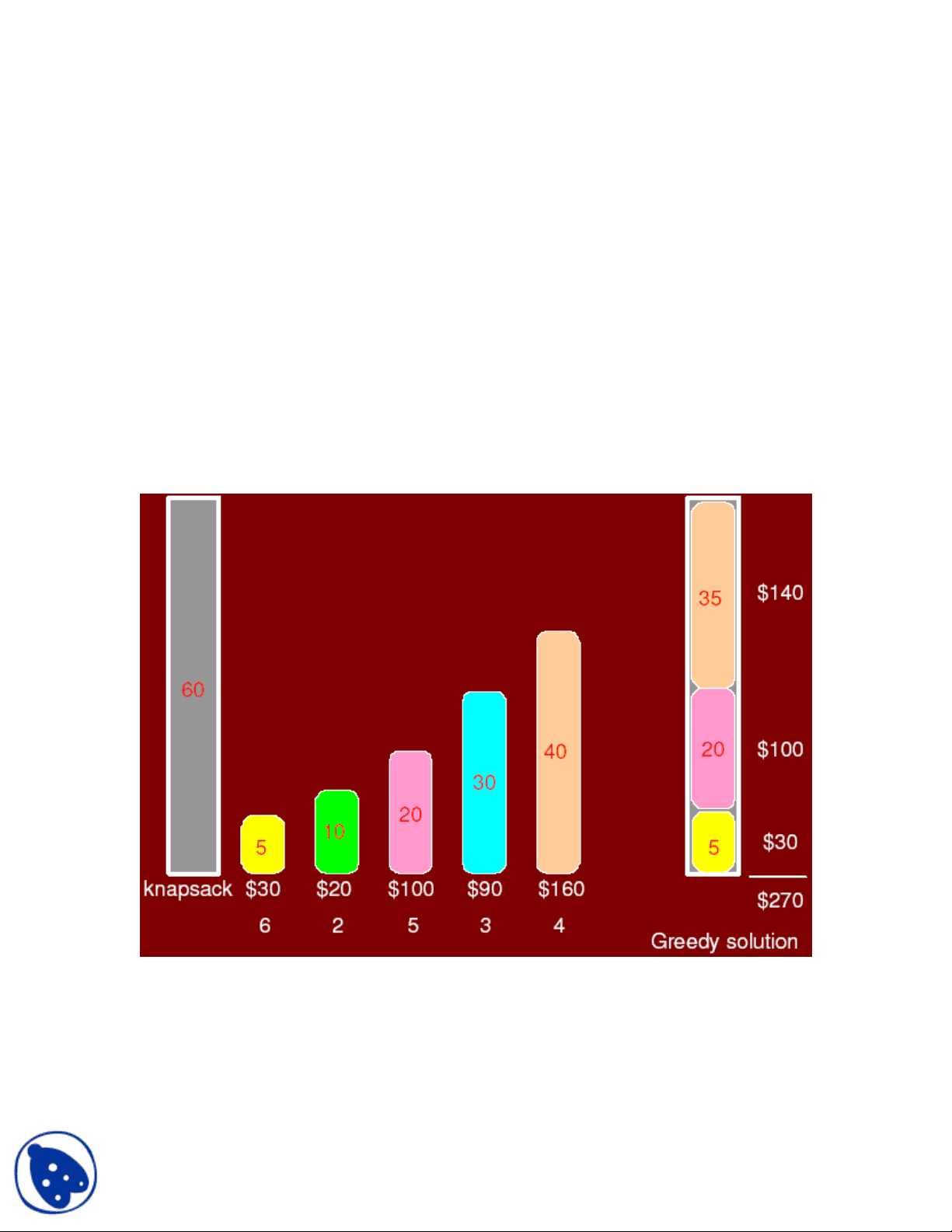
Let ρi = vi/wi denote the value per unit weight ratio for item i. Sort the items in decreasing
order of ρi. Add items in decreasing order of ρi. If the item fits, we take it all. At some
point there is an item that does not fit in the remaining space. We take as much of this
item as possible thus filling the knapsack completely.
Figure 7.8: Greedy solution to the fractional knapsack problem
It is easy to see that the greedy algorithm is optimal for the fractional knapsack problem.
Given a room with sacks of gold, silver and bronze, one (thief?) would probably take as
much gold as possible. Then take as much silver as possible and finally as much bronze
as possible. It would never benefit to take a little less gold so that one could replace it
with an equal weight of bronze.
Docsity.com


