Download Geometric Optics Lab Manual: Reflection, Refraction, and Lens Properties and more Lecture notes Optics in PDF only on Docsity!
Name ___________________________________________ Date _____________ Time to Complete
____h ____m
Partner ___________________________________________ Course/ Section
______/_______ Grade ___________
Geometric Optics
Introduction With this experiment we begin the study of light and its interaction with various optical components. In this experiment we shall study the limit where the wave nature of light can be neglected and we can consider a train of light waves to be a straight line, or ray. Wave effects are usually unimportant when the size of the optical component is much larger than the wavelength of the light which is interacting with it. Situations where the wave nature of light must be taken into account will be studied in a later experiment.
1. Reflection and refraction
Introduction The index of refraction of an optical medium is defined as the ratio of the speed of light in a vacuum, c , to the speed of light in the optical medium, v :
v
c n = (1)
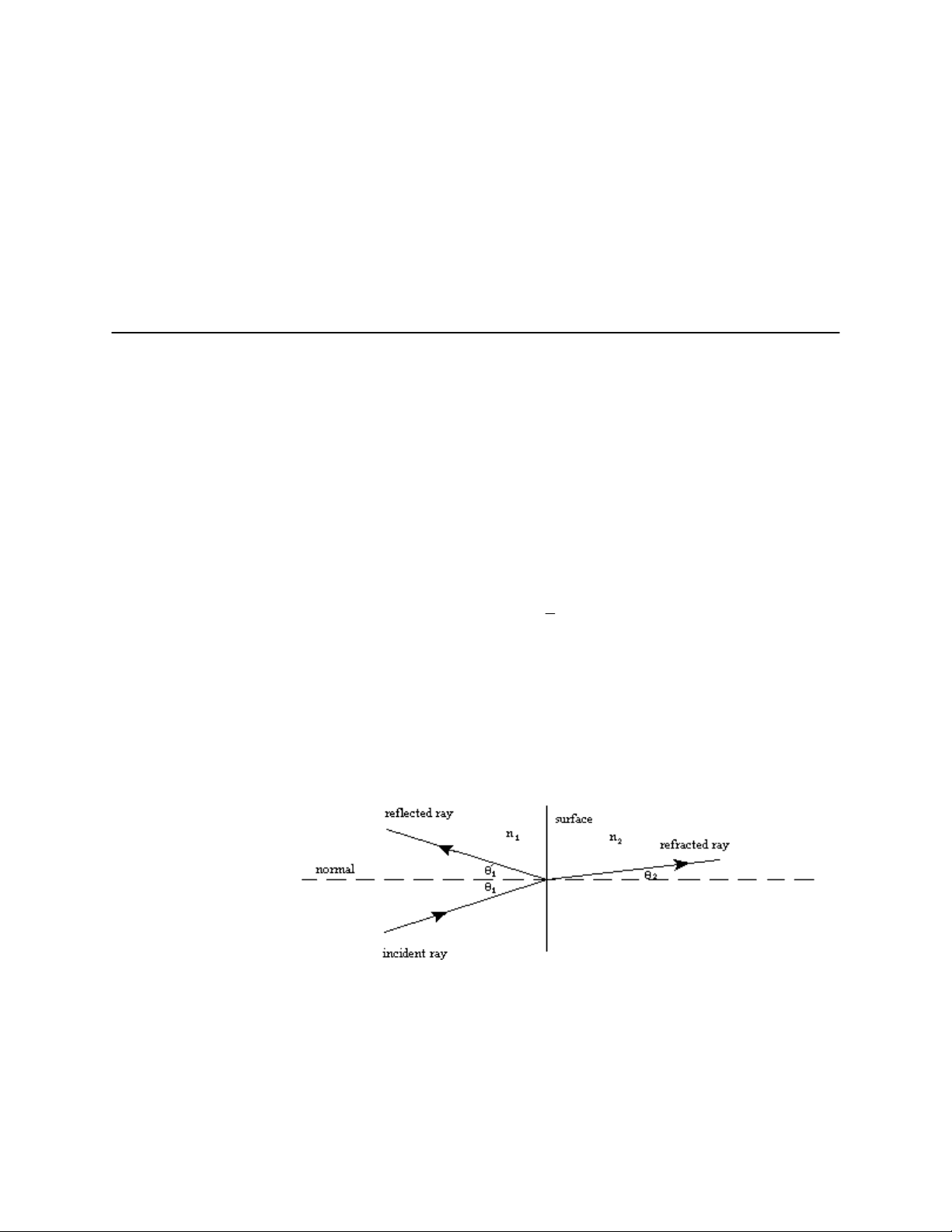
In general, the speed of light in an optical medium depends on the wavelength of the light. Therefore, the index of refraction will also depend on the wavelength. This dependence of index of refraction on wavelength, called dispersion, explains how a prism is able to spread a beam of white light into its component colors. Figure 1 shows a light ray, in an optical medium having index of refraction n 1, incident from the left onto an interface separating the first optical medium from a second optical medium having index of refraction n 2.
Figure 1 : Reflection and refraction at a surface
As the figure shows, an incident ray of light will, in general, split into two parts as it hits the surface separating the two media. One part, the reflected ray, will remain in the first medium, and will make an angle, measured relative to the normal to the surface, that equals the angle the incident ray made with the normal. Expressed mathematically, the Law of Reflection says:
The second part, the refracted, or transmitted, ray, proceeds on into the second medium.
This ray makes an angle, θ 2 , measured relative to the normal line in the second medium,
which is determined by the Law of Refraction, also known as Snell’s Law. Snell’s Law states that:
n 1 sin θ 1 = n 2 sin θ 2 (3)
Figure 1 above represents a situation where n 2 > n 1, resulting in θ 2 being smaller than θ 1. If n 2 < n 1 the situation is reversed and θ 2 becomes greater than θ 1. This would be the case, for example, if a ray of light already in an optical medium such as glass or transparent plastic was exiting back into an optical medium such as air. Figure 2 depicts this situation.
Figure 2 : Refraction where n 2 < n 1
Note that this means as θ 1 increases, θ 2 will eventually approach 90 o. But when θ 2 = 90 o it means that no refracted ray goes into the second medium. Rather, the incident ray is completely reflected back into the first medium. This phenomenon is called total internal reflection. Clearly this can happen only when a ray is incident from a medium of higher index of refraction into a medium of lower index of refraction. Referring to Equation 3 , we see that total internal reflection first occurs when sin θ 2 = 1. When this happens, θ 1 is said to be at its critical value, θ crit. This critical value of θ 1 can therefore be found by setting sin θ 2 = 1 in Equation 3 and solving for sin θ 1. Remembering that θ 1 is now θ crit, the resulting equation is:
1
2 sin (^) crit = n
n
a. Reflection at an n 1 < n 2 interface
Introduction You will begin your investigations by testing the Law of Reflection expressed in Equation 2.
Procedure y Attach the optical table to the optics bench and place the semicircular plastic lens on the optical table. The center of the flat face of the lens should be aligned with the line on the table labeled “component”, and the normal line should intersect the center of the flat face as shown in Figure 3. y Attach the light source to the optics bench and orient the light source so that a single ray of white light leaves the source and shines along the normal line on the optical table. The system should be aligned so that this incident ray (A) strikes the center of the flat face of the semicircular lens. The angle of incidence ( θ 1) can then be varied by rotating the optical table. Note that the refracted ray (C) should not change direction as it exits the circular face of the lens. Explain why this is the case.
b. Refraction at an n 1 < n 2 interface
Introduction In this section you will use Snell’s Law, Equation 3 , and your data from part a , to determine the index of refraction of the plastic from which your lens is made. Proceed as follows:
Procedure y For each angle of incidence, calculate sin θ 1 and sin θ 2 and record these values in Table 1. y For each angle of incidence, use these values, and Equation 3 , to calculate n 2. Assume that n 1, the index of refraction of air, is 1.00. Record these values in Table 1. y Calculate and report the average and standard deviation of your results. The average of all your calculated values represents the most reliable value for your measurement of index of refraction, and the standard deviation is a measure of the uncertainty in your average value.
Average n = __________________
Standard Deviation of n = ____________________ (Max n – Min n )
Conclusion According to the manufacturer, the index of refraction of the plastic from which the hemispherical lens is made is 1.50. Does your average value agree with this value to within the standard deviation of your measurements? If not, redo this portion of the experiment, taking greater care with your measurements.
Using Snell’s Law and geometry, show mathematically why angle Z equals angle X in the diagram below.
c. Refraction at an n 1 > n 2 interface
Introduction In this section you will test Snell’s Law when light crosses an interface into a medium with a lower index of refraction.
Procedure y Arrange the apparatus as shown in Figure 4. Note how the semicircular plastic lens has been rotated 180°.
Figure 4 : Apparatus Alignment
y Be certain that you arrange your apparatus so that the incident ray (A) undergoes no deviation at the cylindrical surface of the lens, and so that the incident ray inside the lens hits the flat surface at its center. You are now seeing refraction at the flat surface as the ray passes into a medium (air) having a lower index of refraction than the plastic, so the refracted ray (C) is bent away from the normal as it passes from the plastic into the air. y Repeat the procedure of parts a and b , and make a second determination of the index of refraction of the plastic. Record your data in Table 2. Note that at some value of the angle of incidence, the refracted ray will disappear. Do not continue your measurements beyond this angle.
Incident Angle
Reflected Angle
Refracted Angle
θ 2 Sin θ 1 Sin θ 2
Index of Refraction n
Table 2
2. Image formation by lenses
Introduction From the point of view of optics, an object is a source of light rays. These rays may exist because the object itself emits them (such as, for example, light bulbs, stars, or the sun) or because the object reflects light from a source other than itself. Most objects (for example people, trees, rocks, etc .) fall into this second category. In either case, under certain conditions, a lens can form an image from the light rays coming from the object. The lens bends, or refracts, the light rays, causing them to interact in such a way as to form the image of the object from which they came. Careful measurements of the distance between the object and the lens (the object distance, (p) ) and the distance between the lens and the image (the image distance, (i) ) can be used to determine the focal length, (f) of the lens. The focal length is a measure of the imaging power of the lens. In this part of the experiment we will study how a lens produces an image. A simple way to understand how a lens works is to follow a procedure called ray tracing. A ray is an imaginary straight line that traces the path of the light. By following the paths of two or three specially selected rays coming from the same point on the object, it is possible to construct a diagram which visually depicts the creation of the image point of that point on the object. As they pass through the lens, the rays will be refracted at both the front and rear surfaces of the lens. After passing through the lens, the rays will, in general, intersect at some point in space. This point is the image point we are looking for. If the lens is not too thick, it is possible to simplify the ray tracing process by assuming that the ray changes direction not at the surfaces of the lens, but rather at a plane through the middle of the lens. If the lens is sufficiently thin (such as the lenses we will be using in the lab), this approximation does not introduce any significant errors. Your textbook gives a discussion of ray tracing, along with several examples. You might want to refer to this information as you work through this section. Be sure that you clearly understand how to construct accurate ray diagrams for both convex (positive) and concave (negative) lenses for all of the categories of images these lenses are capable of producing. For thin lenses, object distance, p , image distance, i, and focal length, f , are related by a simple equation:
p i f
The ratio of the height of the image, h (^) I , to the height of the object, h (^) O , is called the transverse magnification , m. It can be calculated from:
p
i m h
h O
I = =-
You will now determine the focal length of a positive lens by two different methods. Then you will use the measured focal length to predict the position the image distance in a variety of scenarios. In making these measurements you will also become familiar with the characteristics of the image produced in each case.
a. Measuring the focal length of a convex lens – Method 1
Introduction If the object is far from the lens, the value of 1 /p becomes so small that 1/ i approximately equals 1/ f. Or, in other words, i approximately equals f. The image produced will, in general, be quite small and will be located approximately at the focal point of the lens.
Procedure y Remove the light source table from the optics bench and mount the lens and viewscreen on the optical bench. y Orient the bench so that the image of a distant object, a lightbulb at the far end of the lab, for example, appears on the screen. y Adjust the location of the screen until the image is sharp and clear. Measure and record the distance between the lens and the screen. This image distance approximately equals the lens’s focal length.
Approximate focal length = _________________
y Draw a ray diagram depicting how this image is formed on the screen. Use a ruler.
____________________________________________________________________
b. Measuring the focal length of a convex lens – Method 2
Introduction When the object distance is twice the focal length of the lens, Equation 5 can be solved to show that the image distance is also twice the focal length. The transverse magnification is then -1. This means that the image is the same size as the object, but is inverted.
Procedure y Use Equation 5 to show that if p = 2f then i = 2f also.
c. Predicting the image distance
Introduction For an arbitrarily chosen object distance, and a lens of known focal length, Equation 5 can be used to predict the location of the image. Your results from Method 2 should give you an accurate and reliable value for the focal length of your lens. There are three possible ranges in which the object distance can fall: p > 2f, f < p < 2f , and p < f. For each of these ranges, do the following:
Procedure y Choose an object distance and use Equation 5 to calculate a predicted value for the corresponding image distance. y Setup your optics bench using your chosen value of object distance and your calculated value of image distance and see whether you do indeed get an image at the predicted location. If so, measure and record your experimental values of p and i and compare the predicted and experimental values of the image distance. y Draw an accurate ray diagram depicting the formation of the image in each case.
Case 1 : p > 2 f
Object distance = _________________
Predicted image distance = _________________
Measured image distance = ___________________
Ray diagram:
____________________________________________________________________
Case 2 : f < p < 2 f
Object distance = _________________
Predicted image distance = _________________
Measured image distance = ___________________
Ray diagram:
____________________________________________________________________
Case 3 : p < f
Object distance = _________________
Predicted image distance = _________________
Measured image distance = ___________________
Ray diagram:
____________________________________________________________________