Download Geomorphology - Geography - Lecture Slides and more Slides Geology in PDF only on Docsity!
Geomorphology/Weathering/
Erosion/Rivers (2)
Geomorphology is the science of landforms - their origin, evolution, form and spatial distribution. We deal with geomorphology in four sections:
- Intro. to landscape evolution (basic concepts)
- Weathering
- Mass-wasting (briefly)
- Erosional processes and products: a) rivers (fluvial)—today b) wind (aeolian)—next week c) ice (glacial)—next week d) waves (coastal)—in 2 weeks, briefly
Introduction to landscape evolution
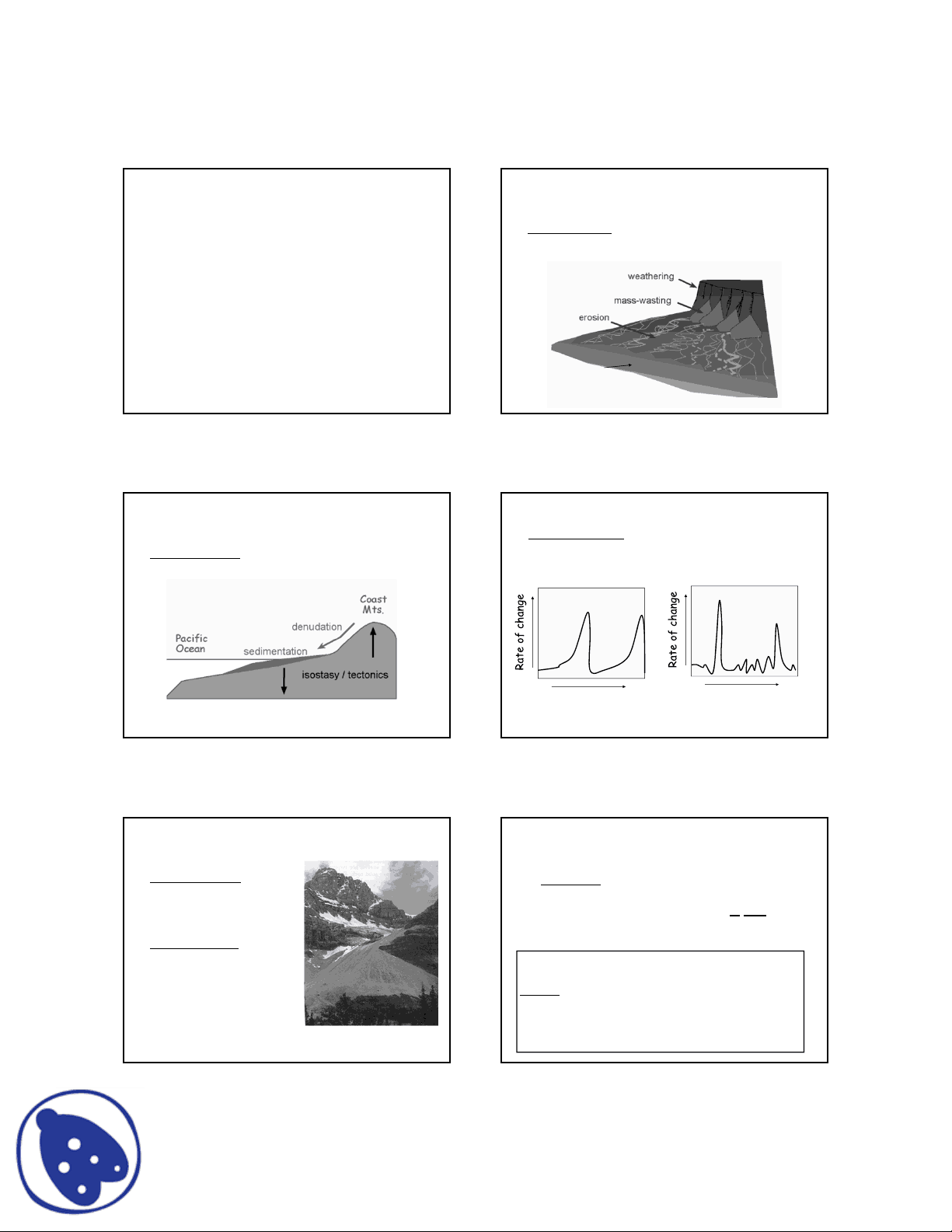
Basic concepts I: denudation = wearing down of the landscape; products re-deposited elsewhere
deposition
Introduction to landscape evolution
Basic concepts II: dynamic (not static) equilibrium
Introduction to landscape evolution Basic concepts III: geomorphic thresholds* (*some start changes, some show change simultaneously)
Time
Time
e.g. rockslides e.g. cliff erosion in storms
Introduction to landscape evolution
Basic concepts IV: the landscape reflects the interaction between local geology and climate, and
Basic concepts V: landscape has memory; it may record prior climatic conditions and geomorphic processes
e.g. intensive frost weathering in a previously glaciated landscape, Lake Louise, Alberta
Weathering
Definition: breakdown of rock and mineral material by physical and chemical means, without transportation; i.e. in situ
Themes:
Physical weathering processes Chemical weathering processes The role of climate Rates of weathering Weathering products: regolith
Physical (mechanical) weathering
Def’n: Disintegration without chemical alteration; Two varieties:
-->Unloading (exfoliation/splitting/spalling),
- rock splits along zones of weakness due to pressure release, and
Crystal growth (freeze-thaw/salt weathering),
- rock splits as a result of growth of crystals in zones of weakness
Exfoliation
Slate tombstone
split as a result of
pressure release
Exfoliation: granite
batholiths in Yosemite
N.P., California
Physical (mechanical) weathering
Def: disintegration without chemical alteration; Two varieties:
Unloading (exfoliation/splitting/spalling),
- rock splits along zones of weakness due to pressure release, and
Crystal growth (freeze-thaw/salt weathering),
- rock splits as a result of growth of crystals in zones of weakness
Crystal growth (note)
niche
- Hydrolysis & 2. Carbonation
Interactions with minerals, e.g.: olivine MgSiO 4 + H 2 CO 3 = Mg(HCO 3 ) 2 +H 4 SiO 4
- entirely dissolves feldspar KAlSi 3 O 8 + [H+^ /OH-^ **] = HAlSi 3 O 8 + KOH + Al 2 O 3 .3H 2 O+H 2 SiO 3
- produces “clay” minerals quartz SiO 2 + [H+**^ /OH-^ **] = H 4 SiO 4 + SiO 2
- partially dissolves (leaving ‘quartz sand’)
- H 2 O H+**^ + OH-^ **(ionization)
- H 2 O + CO 2 = H 2 CO 3 (carbonic acid)**
Rapid chemical weathering
of basalt, Hawaii
Chemical
weathering
CaCO 3 + H 2 CO 3 = Ca(HCO 3 ) (^2)
= complete dissolution
Spheroidal weathering
of granites
(joint corners weather
most rapidly)
Karst formation in carbonate bedrock: example of hydrolysis/ carbonation weathering
CaCO 3 + H 2 CO 3 = Ca(HCO 3 ) (^2)
Karst
topography
Limestone
pavement,
Co. Clare,
Ireland
Sinkholes in limestone,
Roswell, NM
Limestone
solution and re-deposition
Carlsbad Caverns, NM
Weathering regimes
Regolith and the “weathering front”
Intense chemical weathering = deep regolith in tropical environments