Download Moment of Inertia and Rotational Motion and more Study notes Physics in PDF only on Docsity!
Rigid body
A rigid body is an assemblage of a large number of material particles, which do not change their mutual
distances under any circumstance or in other words, the body is not deformed under any circumstance.
Actual material bodies are never perfectly rigid and are deformed under the action of external forces. When
these deformations are small enough not to be considered during the course of motion, the body is assumed
to be a rigid body. Hence, all solid objects such as stone, ball, vehicles etc are considered as rigid bodies while
analyzing their translational as well as rotational motion.
Rotational motion of a rigid body
Any kind of motion is identified by change in position or change in orientation or change in both. If a body
changes its orientation during its motion it said to be in rotational motion.
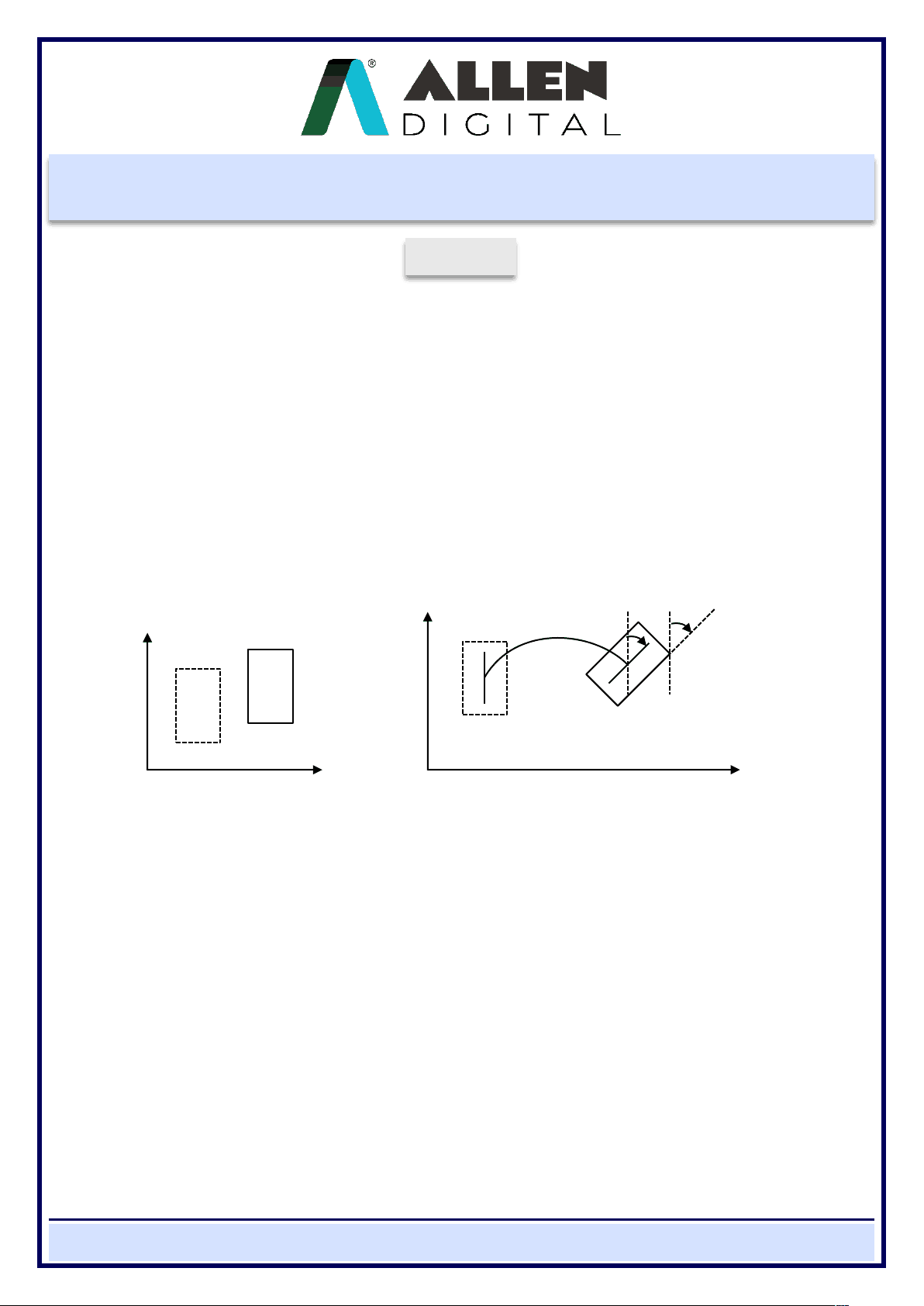
In the following figures, a rectangular plate is shown moving in the x-y plane. The point C is its centre of mass.
In the first case it does not change its orientation, therefore is in pure translation motion. In the second case it
changes its orientation during its motion. It is a combination of translational and rotational motion.
Rotation i.e. change in orientation is identified by the angle through which a linear dimension or a straight line
drawn on the body turns. In the figure this angle is shown by .
Types of motions involving rotation
Motion of body involving rotation can be classified into following three categories.
I Rotation about a fixed axis.
II Rotation about an axis in translation.
III Rotation about an axis in rotation
Rotation about a fixed axis
Rotation of ceiling fan, opening and closing of doors and rotation of needles of a wall clock etc. come into this
category.
When a ceiling fan rotates, the vertical rod supporting it remains stationary and all the particles on the fan move
on circular paths. Circular path of a particle P on one of its blades is shown by dotted circle. Centres of circular
paths followed by every particle on the central line through the rod. This central line is known as the axis of
rotation and is shown by a dashed line. All the particles on the axis of rotation are at rest, therefore the axis is
stationary and the fan is in rotation about this fixed axis.
y
O
Pure Translation
x
t
•C
•C
t+t
y
O
x
Combination of translation and rotation
t
A
B
• C
t+t
B
C
A
Original
orientation
New
orientation
Kinematics of Rotational Motion
Part - 01
Rotational Motion Part- 01
A door rotates about a vertical line that passes through its hinges. This vertical line is the axis of rotation. In the
figure, the axis of rotation is shown by dashed line.
Axis of rotation
An imaginary line perpendicular to the plane of circular paths of particles of a rigid body in rotation and
containing the centres of all these circular paths is known as axis of rotation.
It is not necessary that the axis of rotation should pass through the body. Consider a system shown in the figure,
where a block is fixed on a rotating disc. The axis of rotation passes through the center of the disc but not
through the block.
Important observations
Let us consider a rigid body of arbitrary shape rotating about a fixed axis PQ passing through the body. Two of
its particles A and B are shown moving on their circular paths.
All its particles, not lying on the axis of rotation, move along circular paths with centres on the axis or rotation.
All these circular paths are in parallel planes that are perpendicular to the axis of rotation.
All the particles of the body undergo same angular displacement in the same time interval, therefore all of them
move with the same angular velocity and angular acceleration.
Particles moving on circular paths of different radii move with different speeds and different magnitudes of
linear acceleration. Furthermore, no two particles in the same plane perpendicular to the axis of rotation have
same velocity and acceleration vectors.
Ceiling Fan
Axis of rotation
P
Door
Axis of rotation
Axis of rotation
r
P
A
B
Axis of rotation
Q
Rotational Motion Part- 01
Illustration 1.
In Rotational motion of a rigid body, all particles move with
(1) same linear and angular velocity
(2) same linear and different angular velocity.
(3) with different linear velocities & same angular velocities
(4) with different linear velocity & different angular velocities.
Solution. (3)
In rotational motion of the rigid body all particles cover the same angular displacements in a particular
interval. So angular velocity of all the particle will be same. But linear velocity is also dependent on the
distance of particles from the axis of rotation so linear velocity will be different for all particles as the distances
are different for all the particles.
Illustration 2.
On account of the rotation of earth about its axis –
(1) the linear velocity of objects at equator is greater than that at other places
(2) the angular velocity of objects at equator is more than that of objects at poles
(3) the linear velocity of objects at all places on the earth is equal, but angular velocity is different
(4) the angular velocity and linear velocity are uniform at all places
Solution. (1)
v = r
Where r is the distance of the particle from the axis and is the angular velocity of the each which will be same
for all the particles
VE greater than that at any other places as r will be highest at equator
Kinematics of Rotational Motion
Time period (T) : Time taken by the particle to complete one rotation.
frequency (f) : No. of cycles completed by a particle per second is know as frequency
rpm = rotations per minute(N)
N
f 60
Angular Displacement ( )
- When a particle moves in a curved path, the change in the angle traced by its position vector about a fixed point
is known as angular displacement.
- Unit : radian
- Dimension : M
0 L
0 T
0 i.e. dimensionless.
- Elementary (small) angular displacement is a vector whereas other (large) angular displacements is a scalar.
Rotational Motion Part- 01
Angular Velocity ( )
- The angular displacement per unit time is defined as angular velocity.
t
where is the angular displacement during the time interval t.
- Instantaneous angular velocity t 0
d Lim → t dt
. Average angular velocity
2 1 av 2 1 t t t
- Unit : rad/s
- Dimensions : [M 0 L 0 T - 1 ], which is same as that of frequency.
- Instantaneous angular velocity is a vector quantity, whose direction is normal to the rotational plane and its
direction is given by right hand screw rule.
- If be the angular velocity, v the linear velocity and r the radius of path, we have the following relation.
v = r
- If n be the frequency then = 2n, If T be the time period then = 2/T.
- The angular velocity of a rotating rigid body can be either positive or negative, depending on whether it is
rotating in the direction of increasing (anticlockwise) or decreasing (clockwise).
- The magnitude of angular velocity is called the angular speed which is also represented by .
Angular Acceleration ( )
- The rate of change of angular velocity is defined as angular acceleration
d
dt
- Suppose a particle has angular velocity 1
2 at time t 1 and t 2 respectively
then average angular acceleration,
2 1
2 1 t t
- It is a vector quantity, whose direction is along the change in direction of angular velocity.
- Unit : rad/s 2
- Dimensions : M
0 L
0 T
- 2
- Relation between angular acceleration and tangential acceleration atis t
a = r
- Radial or normal acceleration : r
a = v. Its direction is along the radius.
- Net acceleration : t r a = a + a = r + v
Comparison of Linear Motion and Rotational Motion
Linear Motion Rotational Motion
(i) If acceleration is 0, (i) If angular acceleration is 0,
v = constant and s = vt = constant and = t
(ii) If acceleration a = constant, then (ii) If angular acceleration = constant, then
(a)
(u v)
s t
= (a)
0
t
(b)
v u
a
t
= (b)
0
t
(c) v = u + at (c) = 0 + t
(d) s = ut +
at 2 (d) = 0 t +
t 2
(e) v
2 = u
2
2 = 0
2
(f) th n
S = u +
a
(2n 1)
− (f) th
n
= 0 + (2n 1)
Rotational Motion Part- 01
Illustration 6.
A particle starts rotating from rest according to the formula =
3 2
3t t
− radian. Calculate –
(a) the angular velocity at the end of 5 seconds.
(b) angular acceleration at the end of 5 seconds.
Solution.
(a) Angular velocity
3 2 2
d d 3t t 3 2 1 9t 2t
3t 2t
dt dt 20 3 20 3 20 3
^ ^
Angular velocity at the end of 5 seconds
× 5 × 5 –
× 5 =
− = 11.25 – 3.33 = 7.92 rad/s.
(b) Angular acceleration : =
2
d d 9t 2t 9
dt dt 20 3 20
× 2t –
2 9t 2
Angular acceleration at the end of 5 seconds : =
= 4.5 – 0.67 = 3.83 rad/s
2 .
Illustration 7.
A wheel of perimeter 220 cm rolls on a levelled road at a speed of 9 km/h. How many revolutions does the
wheel make per second?
Solution.
Frequency n =
v
2 r
rev/s = 1.136 rev/s.
Moment of Inertia
- The measure of the property by virtue of which a body revolving about an axis opposes any change in state of
its rotational motion is known as moment of inertia.
- The moment of inertia of a particle with respect to an axis of rotation is equal to the product of its mass and the
square of its distance from the rotational axis.
I = mr
2 , r = perpendicular distance from the axis of rotation
- Moment of inertia of a system of particles
2 2 2 1 1 2 2 3 3 I = m r + m r + m r +..... =
2
^ mr
- Moment of inertia depends on : (a) mass of the body
(b) mass distribution of the body
(c) position of axis of rotation
- Moment of inertia does not depend on :-
(a) angular velocity (b) angular acceleration (c) torque (d) angular momentum
Unit : SI : kg–m
2 , CGS : g–cm
2
Dimension : [M
1 L
2 T
0 ]
- As the distance of mass increases from the rotational axis, the moment of inertia increases.
axis
m
r
axis
r 2
m 2
r (^1) m 1
Discrete
body
r 3
m 3
Moment of Inertia for Discrete System of Particles
Part - 02
Rotational Motion Part- 02
Illustration 4.
Point masses of 1,2,3 and 10 kg are lying at the points (0, 0), (2m, 0) (0, 3m) and (–2m, – 2m) respectively in x-y
plane. Find the moment of inertia of this system about y–axis. (in kg-m
2 ).
Solution.
I = 1 × (0)
2
- 2×(2) 2 +3×(0) 2 +10×(2) 2
= 48kg-m
2
Illustration 5.
Four bodies of masses 5 kg, 2 kg, 3 kg, and 4 kg are respectively placed at positions (0,0), (2,0), (0, 3) and (–2, – 2).
Calculate the moment of inertia of the system of bodies about x– axis, y–axis respectively.
Solution.
Ix = 3 × (3) 2
Iy = 2 × (2) 2
Illustration 6.
Two particles of masses 2kg and 8kg are tied at two ends of a massless rod of length 20m. Then Find MOI of
system about axis passing through COM and perpendicular to the line joining particles.
Solution.
r 1 =
2
1 2
m r
m +m
= 16m
r 2 =
1
1 2
m r
m +m
= 4m
I = m 1 r 1 2
- m 2 r 2 2 = 2 × (16) 2
- 8 × (4) 2 = 640 kg-m 2
(0,3) 3kg
X
1kg 2kg
10kg
Y
3kg (0,3)
X' X
(0,0) (^) 5kg 2kg
4kg
(–2,2)
I =?
20m
8kg 2kg
COM
Rotational Motion Part- 02
Illustration 7.
Three Point masses are located at corners of an equilateral triangle of side 4m. Masses are of 1kg, 2kg and 3kg
respectively and are kept as shown in the figure. Calculate the MOI of system about an axis AB?
Solution.
IAB = m 1 r 1
2
2
2
IAB = 1 × 0
2
2 a 3
+ 3 × 0
2
IAB = 2 ×
2 4 3
= 24 kg-m
2
A
B
1kg
2kg
3kg
Rotational Motion Part- 03
M
dm dx L
2
dI = dm (xsin )
M 2 2
dI dx x sin L
L 2 2
0
M
I dl sin x dx L
L 3 2
0
M x I sin L 3
2 ML 2 I sin 3
Moment of inertia of ring
Moment of inertia of ring about an axis perpendicular to its plane and passing through the centre = MR 2
dI = dmR
2
I = dI = dmR
2
I = R
2 dm
= R
2 × M
I = MR
2
Moment of inertia of Disc
About an axis passing through the centre and perpendicular to its plane =
dA = 2x × dx
x sin
x
M,L
R
M,R
dm
M,R
dx
Ring (dm)
dx
2 x
x
Rotational Motion Part- 03
2
M
dm dA R
2 2
M 2M
dm 2 xdx x dx R R
R 3
0 2
2M
I dI x dx R
R 4 4
2 2 0
2m x 2M R I 0 R 4 R^4
I MR
Moment of Inertia of Hollow cylinder
Moment of Inertia of Hollow cylinder about its geometrical axis which is parallel to its length = MR
2
Moment of inertia of Solid cylinder
Moment of inertia of Solid cylinder about its geometrical axis, which is parallel to its length =
2 MR
Moment of inertia of rectangular plate
About an axis that lies in the plane of plate and parallel to shorter sides
2 M L I 100 100 3
2 ML I 3
R
M
M
R
b
L
M
M/
Rotational Motion Part- 03
Moment of inertia of Solid sphere
Moment of inertia of Solid sphere about its diametric axis =
MR
Moment of inertia of Hollow sphere
Moment of inertia of Hollow sphere about its diametric axis =
MR
Illustration 1.
MOI of Ring about an axis perpendicular to the plane and passes through the centre is
Solution.
= MR
2
Illustration 2.
MOI of Disc about an axis passing through the centre and perpendicular to the plane is :
Solution.
2 MR I 2
M
R
R
M
M,R
M,R
R
Rotational Motion Part- 03
Illustration 3.
MOI of Ring and MOI of disc about an axis passing through centre and perpendicular to its plane are same?
What will be the ratio of there radii?
Solution.
ring Disc
I =I
2 2 2 1
MR
MR
2 1 2 2
R 1
R 2
1
2
R 1
R 2
i.e. R 1 : R 2 = 1 :^2
Illustration 4.
Two rings have their moments of inertia in the ratio 4 : 1 and their diameters are in the ratio 4 : 1. Find the ratio
of their masses.
Solution.
Moment of inertia of ring = mr 2
1 = m 1 r 1
2
2 = m 2 r 2
2
2 1 1 1 2 2 2 2
I m r
I m r
(^2 ) 2
d m I 2
I (^) d m 2
1
2
I 4
I 1
2 1 1
2 2 2
4 m d
m d
2
1 1
2 2
4 m d
1 m d
1 2
2
m 4 (4) m
1
2
m 1
m 4
Rotational Motion Part- 03
Illustration 8.
A solid sphere and a hollow sphere of the same mass have the same M.I. about their respective geometrical axis.
The ratio of their radii will be -
Solution. ( 3 )
given Isolid sphere = Ihollow sphere
2 2 1 2
Mr Mr 5 3
2 1 2 2
r 5
r 3
1
2
r 5 : 3 r
Illustration 9.
A solid cylinder of mass 20kg has length 1 m and radius 0.2 m. Then its moment of inertia (in kg-m 2 ) about its
geometrical axis is :
(1) 0.8 kg-m 2 (2) 0.4 kg-m 2 (3) 0.2 kg-m 2 (4) 20.2 kg-m 2
Solution. ( 2 )
2 MR I 2
2 20 (0.2)
= 0.4 kg-m 2
Illustration 10.
A solid sphere is shown in the figure. What will be the MOI of solid sphere about the diametric axis if the mass
becomes 4 times and radius 10 times.
(1) 160MR
2 (2) 180MR
2 (3) 200MR
2 (4) 220MR
2
Solution. ( 1 )
I MR
Since M' = 4M and R' = 10R
I' M'R'
I'
= × 4M × (10R)
2
I'
= × 4M × 100 R
2
' = 400 or 160MR 2
M
R
Rotational Motion Part- 03
Illustration 11.
What will be the MOI of disc about an axis passing through centre an perpendicular to the plane if mass of disc
becomes 2 times and radius 2 times
(1) 3MR
2 (2) 4MR 2 (3) 8MR 2 (4) 10MR 2
Solution. (2)
2 MR I 2
M' = 2M
R' = 2R
2 M'R' I' 2
2 (2M) (2R)
2 2M 4R
2 MR 8 2
' = 4MR
2
Illustration 12.
A Rod of Mass M = 20kg and length 2m has been taken. What will be its MOI about an axis passing through
COM and perpendicular to its length.
kg-m 2 (2)
kg-m 2 (3)
kg-m 2 (4) 9 kg-m 2
Solution. (1)
2 ML I 12
Here M = 20kg and L = 2m,
2 20 (2) I 12
I
= kg-m
2
Illustration 13.
A Rod of mass M and length L 1 about an axis passing through its end and perpendicular to its length and
rectangular plate of mass M & length L 2 about an axis that lies in the plane of plate and parallel to shorter sides
have same moment of inertia. The Ratio of their length's will be
Solution. (3)
2 1 1
ML
I
2 2 2
ML
I
1 = 2 (given)
2 2 ML 1 ML 2
1
2
L 1
L 1
L 1 : L 2 = 1 : 1