
Study with the several resources on Docsity
Earn points by helping other students or get them with a premium plan
Prepare for your exams
Study with the several resources on Docsity
Earn points to download
Earn points by helping other students or get them with a premium plan
An in-depth analysis of newton's law of universal gravitation and its application to satellite motion. It covers the concepts of gravitational force, potential energy, and conservation of energy. Additionally, it explains kepler's laws of planetary motion derived from the conservation of angular momentum.
Typology: Lecture notes
1 / 3
This page cannot be seen from the preview
Don't miss anything!


Summary of Lecture 21 – GRAVITY
1 2 (^1 2 )
masses and is and is directed along the line joining the two bodies.
Putting in a constan
m m m m F r
1 2 2
21 2 1
12 1 2 12 21
t of proportionality,. Now let's be a bit careful of the
direction of the force. Looking at the diagram below, Force on by ,
Force on by ,. By New
m m F G r
F m m
F m m F F F
ton's Third Law, F 12 (^) = − F 21.
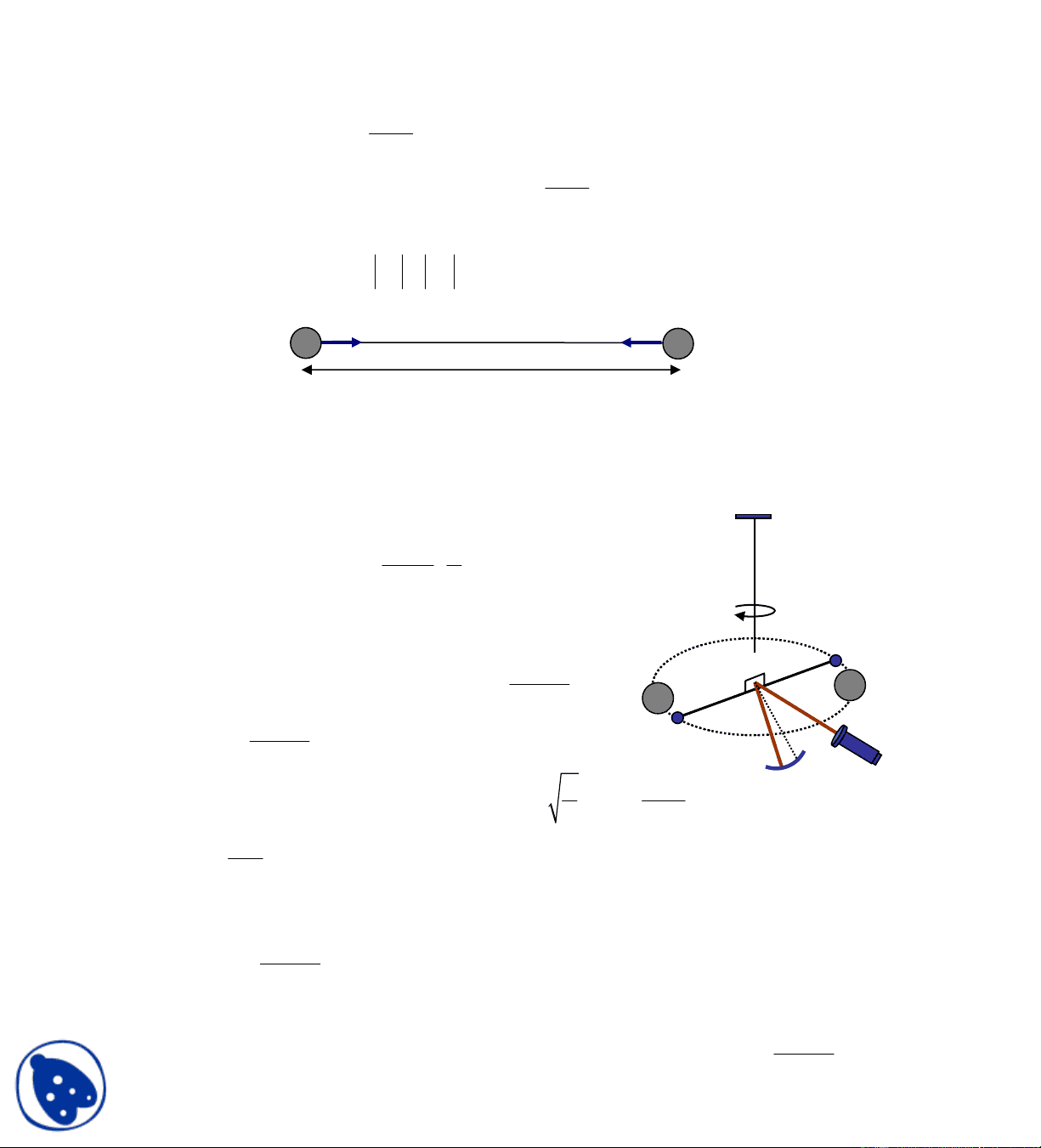
needs a very sensitive experiment. An early experiment to
find involved suspending two masses and measuring the
attrac
2
tive force. From the figure you can see that the
is gravitational torque is 2. A thread provides 2
the restoring torque. The deflection can be measured
by observing th
GmM L
r
κθ θ
2
2
e beam of the light reflected from the small
mirror. In equilibrium the torques balance,.
Hence. How to find? It can be found from
observing the period of free o
GmML
r
r G GmML
κθ
κθ κ
2
2
2 11 2 2
scillations, 2
with. The modern value is 6.67259 10. / 2
mL I G N m kg
π π κ κ
−
E 2 E E E
centre is , where 6400 is the radius of the Earth and is the mass.
The material does n
GmM F R km M R
E 2 E
ot matter - iron, wood, leather, etc. all feel the force in proportion to
their masses. If the body can fall freely, then it will accelerate. So,.
GmM F mg R
m 1 m 2
r
mirror
scale
Quartz fiber
θ
2
2 24
We measure g, the acceleration due to gravity, as 9.8m/s. From this we can immediately
deduce the Earth's mass: 5.97 10. What a remarkable achievement!
We can do still more: th
E E
gR M kg G
3 21 3 E E
E^3 E E
e volume of the Earth 1.08 10. Hence the] 3
density of the Earth 5462kg. So this is 5.462 times greater than the
density of water and tells us that the earth must be quit
V R m
m M
π
ρ
−
e dense inside.
mass from infinity to a given point R, and equals ( ).
Proof: Conservation of
V r R
gravitational potential
0
( )
2
energy says, ( )
Integrate both sides: 0 ( ) , ( )
V R R
R R
dV Fdr dV drF r
dr GM V R GM GM V R r r R
∞
∞ ∞
1
raise
a body of mass to a height above the Earth's surface.
Now suppose that the distance is much smalle
E E E E
m h
U GMm GMm GMm h R R R h h R
h
1
r than the Earth's radius. So, for ,
1 / 1 /. So we find 1 1 /.
E
E E E E
h R
h R h R U GMm h R m h mgh R
find the minimum velocity needed for a body to escape the Earth' gravity. Far away from
the Earth, the potential energy is zero, and the smallest value for the kinetic energy is
2
e e
e
that gives v 0 0. From 2
this, v 2. Putting in some numbers we find that for the Earth v 11.2 km/s
and for the Sun v 618km/s. For a Black Hole, the escap
r R r^ e E
E E
GMm KE PE KE PE m R
gR R
= =∞
= e velocity is so high that nothing
can escape, even if it could move with the speed of light! (Nevertheless, Black Holes can be
observed because when matter falls into them, a certain kind of radiation is emitted.)