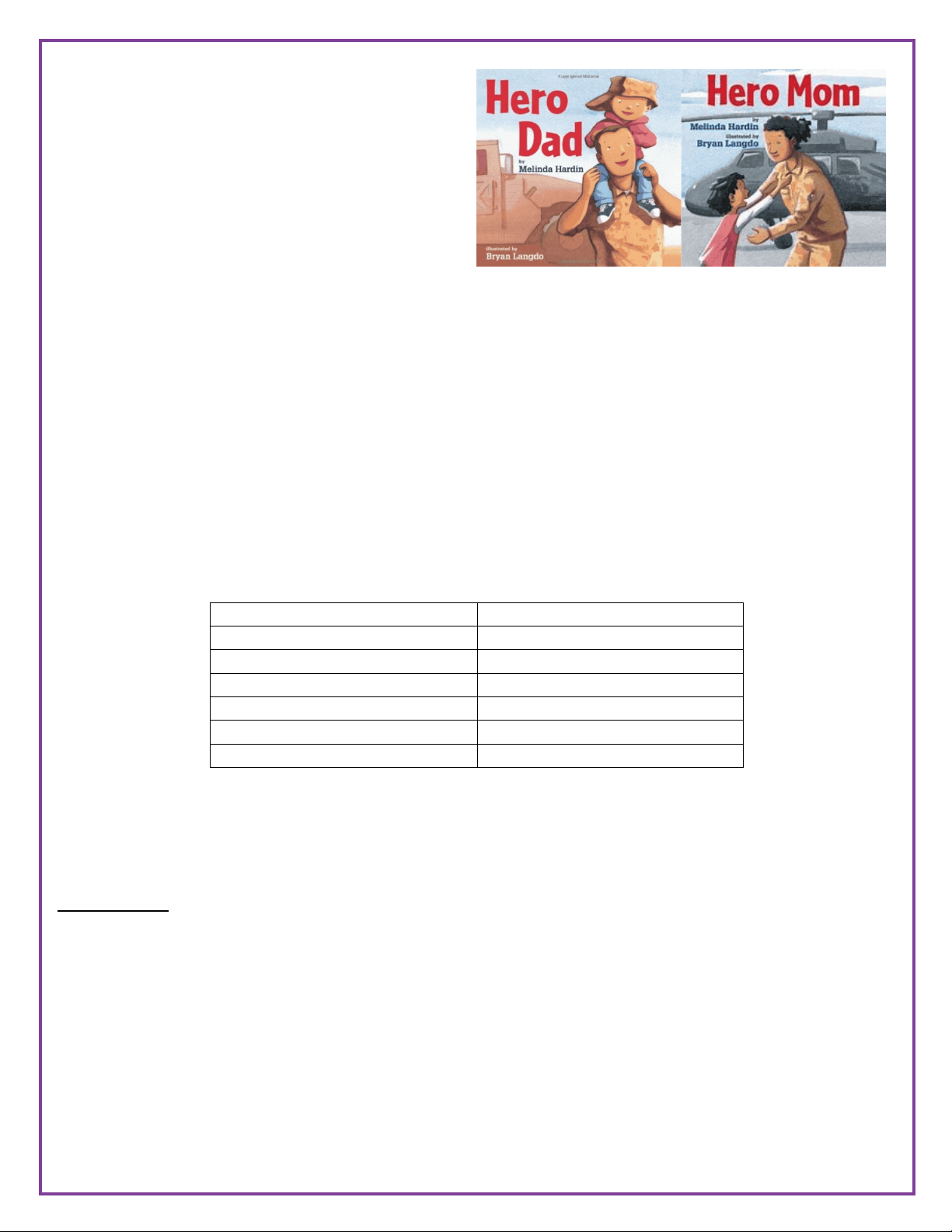
Hero Dad and Hero Mom, Schemes and Mind Maps of English Language

by Melinda Hardin. Hero Dad is about a little boy whose dad is a soldier. Hero Mom is about several children who have moms that are soldiers.

Typology: Schemes and Mind Maps

2022/2023

Uploaded on 03/01/2023

astarloa
astarloa 🇺🇸

4.2

(12)

298 documents

1 / 3

Toggle sidebar

This page cannot be seen from the preview

Don't miss anything!

bg1
Hero Dad and Hero Mom
by Melinda Hardin
Hero Dad is about a little boy whose dad is a soldier.
Hero Mom is about several children who have moms
that are soldiers. The children in these books talk
about the many things their caregiver does that
makes them a superhero. Even though the children
know their caregiver is not a typical superhero with
traditional super powers, they still consider them to be their superhero.
Discussion and Questions:
Ask the children to name their favorite superhero. If the child is very young or nonverbal, show
pictures of common superheroes and encourage the child to point to their favorite picture.
Ask the child, “What does it mean to be a hero?” If the child has trouble answering, ask questions such
as, “Is a hero someone who helps or hurts others?” or “Does a hero do easy or difficult things?”
Tell the children that a hero is someone who is brave, works hard, and helps other people. Explain that
heroes are not always the characters seen on TV and in books. Point to the pictures of the
superheroes in a book or environment and explain that these are not the only superheroes to be
celebrated.
Talk about the words in the story that the child may not know. Ask them what a word means.
Demonstrate reflective listening by repeating their answer.
Some vocabulary words that may be discussed in two books are below:
Hero Dad
Hero Mom
Night vision
Command
Camouflage
Dangerous
Tank
Leap
Invisible
Transform
Cloak
Tank
Platoon
Battalion
For very young children, ask where questions (i.e., where in the tank, where is the cloak). This allows
children with limited language to point and engage in the discussion. If the child is unable to answer,
help them point to the picture and model naming the object.
Activities:
Ages Birth to 5:
Hero in Me
Remind children that they can be a hero too.
Discuss the characters of a hero with the children. For very young or non-verbal children, list
several ways they are like a hero (brave, strong, etc.)
Take a picture of the each child in a “hero pose.”
For example, the child may flex their muscles or use a prop.
If possible, give children the option to wear a piece of their military caregivers uniform for
pictures (i.e., a military hat).
Write “I’m A Hero Because…” at the top of a piece of card stock, and help each child glue the
picture to the cardstock under the words.
Write the child’s answer to the hero question under the picture, if they were able to answer.
pf3

Partial preview of the text

Download Hero Dad and Hero Mom and more Schemes and Mind Maps English Language in PDF only on Docsity!

Hero Dad and Hero Mom

by Melinda Hardin Hero Dad is about a little boy whose dad is a soldier. Hero Mom is about several children who have moms that are soldiers. The children in these books talk about the many things their caregiver does that makes them a superhero. Even though the children know their caregiver is not a typical superhero with traditional super powers, they still consider them to be their superhero.

Discussion and Questions:

  • Ask the children to name their favorite superhero. If the child is very young or nonverbal, show pictures of common superheroes and encourage the child to point to their favorite picture.
  • Ask the child, “What does it mean to be a hero?” If the child has trouble answering, ask questions such as, “Is a hero someone who helps or hurts others?” or “Does a hero do easy or difficult things?”
  • Tell the children that a hero is someone who is brave, works hard, and helps other people. Explain that heroes are not always the characters seen on TV and in books. Point to the pictures of the superheroes in a book or environment and explain that these are not the only superheroes to be celebrated.
  • Talk about the words in the story that the child may not know. Ask them what a word means. Demonstrate reflective listening by repeating their answer. Some vocabulary words that may be discussed in two books are below: Hero Dad Hero Mom Night vision Command Camouflage Dangerous Tank Leap Invisible Transform Cloak Tank Platoon Battalion
  • For very young children, ask where questions (i.e., where in the tank, where is the cloak). This allows children with limited language to point and engage in the discussion. If the child is unable to answer, help them point to the picture and model naming the object.

Activities:

Ages Birth to 5:

  • Hero in Me
    • Remind children that they can be a hero too.
    • Discuss the characters of a hero with the children. For very young or non-verbal children, list several ways they are like a hero (brave, strong, etc.)
    • Take a picture of the each child in a “hero pose.”
      • For example, the child may flex their muscles or use a prop.
      • If possible, give children the option to wear a piece of their military caregivers uniform for pictures (i.e., a military hat).
    • Write “I’m A Hero Because…” at the top of a piece of card stock, and help each child glue the picture to the cardstock under the words.
    • Write the child’s answer to the hero question under the picture, if they were able to answer.
  • If the child is too young to answer, the activity can be altered by writing “Little Hero” above the picture of the child.
  • The cardstock could be framed or hung on the wall.
  • Hero Bean Bag Toss
  • Print off pictures of several items related to super heroes and items related to the military (i.e., rocket-propelled boots/combat boots, super-powered car/tank, cape/uniform).
  • Tape the group of pictures, in no particular order, to the floor in a straight line.
  • Put a starting line a few feet away from the pictures on the floor.
  • If several children are playing, have them line up behind the line.
  • This game can be played in a group or individual settings with siblings and other family members.
  • Remind the children of the difference between a superhero and a military hero using pictures.
  • Explain to the children everyone will get a turn to toss a bean bag on the pictures on the floor.
  • First, model for the children how to toss the bean bag.
  • Before each child’s turn, give them a prompt of “Superhero” or “Military Hero.”
  • If they need help locating a superhero or military hero item, stand behind the picture and encourage the child to throw the bean bag right in front of you.
  • For younger children, have them walk over to the pictures and place the bean bag on top of the pictures with assistance from an adult. Ages 3-5:
  • Superheros and Military Heroes
  • Create a poster board with pictures of common superheroes on one side and pictures of military members on the other side. Use this to discuss similarities and differences between superheroes and military heroes.
  • On several pages in the books the children talk about what their caregivers do that is not quite like a superhero. For example, Hero Dad says, “He doesn’t wear rocket-propelled boots—he wears Army boots.” Ask the child to decide if the line in the book applies to a superhero or a military member while pointing to each category on the poster.
  • For example - Who wears Army boots? Superheroes? Or military members? If needed, encourage the child to point to their answer on the poster.
  • Some of the lines in the book apply to both a superhero and a military member. For example, Hero Mom reads, “My mom doesn’t fly in to save the day—well, sometimes she does.” Point out to the children that both superheroes and military members can save the day.
  • What Does a Hero Do? The children in these two stories understand their military caregiver’s job. They were able to describe the clothes they wear and some of the skills they use at work. This activity is designed to help the child understand the military caregiver’s job and how it makes them a hero.
  • If the military caregiver is home, invite them to participate in the activity. If they are deployed, ask the caregiver at home to describe their partner’s duties as well as they can.
  • Find and makes copies of pictures of the active duty caregiver in their uniform and doing anything related to their military job. If the family does not have pictures of the military caregiver working, find pictures of similar jobs on the internet, books, or magazines.
  • For example, if the military caregiver is a pilot, find pictures of a similar aircraft, a pilot, and the uniform they would wear.
  • Explain to the child that the caregiver is a hero, like the moms and dads in the two books.
  • On the top of a poster board write, “What Does a Hero Do?”