Download Homework Practice Problems on Advanced Calculus II | MATH 410 and more Assignments Mathematics in PDF only on Docsity!
Math 410, Spring 2009
Homework Problems (updated 2/19/09)
In the 6th century, the Indian mathematician Aryabhata wrote that “Half the circumference multiplied by half the diameter is the area of a circle.”
Problem #1 Is Aryabhata’s statement correct? Why or why not?
The quotation above doesn’t say anything about the actual numerical value of π. However, Aryabhata also gave the following rule.
Add four to one hundred, multiply by eight and then add sixty-two thousand. The result is approximately the circumference of a circle of diameter twenty thousand. By this rule the relation of the circumference to diameter is given.
Problem #2 What numerical value of π is implicit in Aryabhata’s formula?
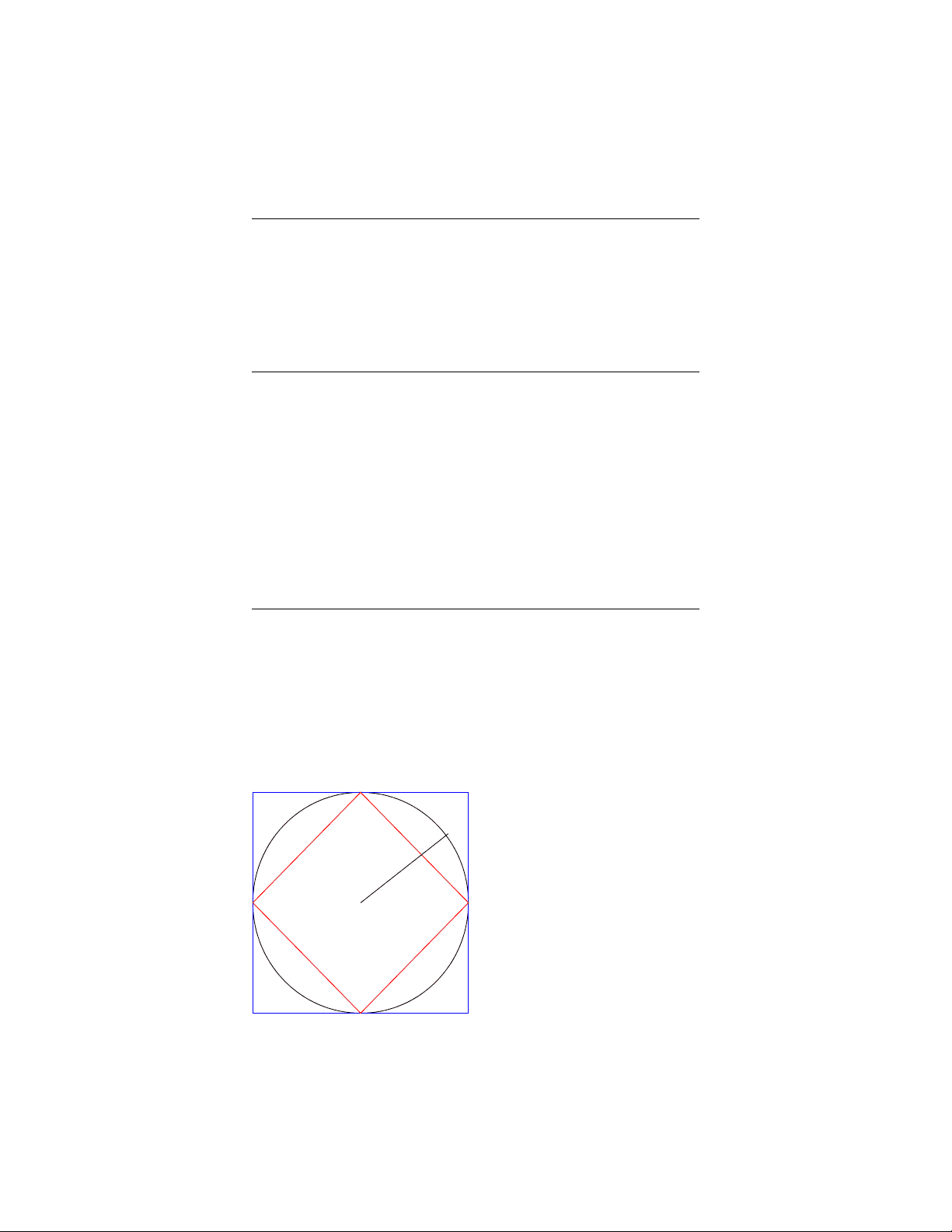
In class, we (briefly) discussed Archimedes’ method for estimating the value of π. What his method boils down to is this: if you inscribe a regular polygon inside a circle, then its perimeter — let’s call it B — will be a lower bound for the circumference of the circle. Likewise, if you circumscribe a regular polygon around a circle, then its perimeter A will be an upper bound for the circumference. That is,
A < circumference < B.
The more sides that P has, the closer these estimates will be (and, of course, the harder to compute).
perimeter of little square: B
perimeter of big square: A
r
Problem #3 Figure out the formulas for A and B, in terms of r, when the regular polygon is a square (as in the above figure).
For extra credit, figure out the values of A and B for other polygons (or even, if you want, for a general polygon).
Problem #4 Give a proof that
3 is irrational. (If you understand the Pythagorean proof that of the irrationality of
2, you’ll be able to modify it to deal with the case of
Problem #5 The year is 500 BCE. You are a Greek mathematician, currently working for the Egyptian government as a consultant. You’ve been asked to determine the distance from a lighthouse, which stands on a rock in the sea, to the mainland (see figure).
Shoreline
Lighthouse
Distance to be determined
Explain to your Egyptian employers how you’re going to carry out the project, and why your method works. You can use your compass, and you can measure as many line segments as you need, as long as they are all between points on land (the slaves who are going to carry out the measurements can’t swim). Hint: You actually need to measure only one line segment, as long as you choose the points carefully.
Problem #8 This problem concerns Euclid’s proof of the theorem that there are infinitely many prime numbers (see the class notes for February 11).
Suppose that Euclid had defined x = p 1 p 2... pn + 2 instead of x = p 1 p 2... pn + 1. Would the argument still be valid?
(Important note: I am not asking you to say whether Euclid’s theorem is still true, but whether this alternate proof would be logically correct. If you try to prove a theorem and your proof is incorrect, it doesn’t automatically mean that the theorem is false.)
It was pointed out in class that you can test whether a number n is divisible by 3 by adding up its digits. For example, if you add up the digits of n = 72465702, you get 7 + 2 + 4 + 6 + 5 + 7 + 0 + 2 = 33. Since 33 is a multiple of 3, so is 72465702. The same test works for divisibility by 9 — since 33 is not a multiple of 9, neither is 72465702.
Here’s something else you might try doing to a number n: look at the alternating sum of the digits. That is, add up the digits, but put a minus sign on every other digit. For example,
n = 72465702 becomes 7 − 2 + 4 − 6 + 5 − 7 + 0 − 2 = 5.
(Of course, it’s possible to get zero or a negative number in this way, but so what?)
Miracle of miracles! This procedure really is a test for divisibility by some number d. Your job is to figure out what d is.
Problem #9 (i) Suppose that you apply this test to all positive numbers n from 1 to 100. (Don’t actually do it — just think about what would happen.) What are all the values of n for which the alternating sum of digits is 0?
(ii) Based on your answer to (i), make a conjecture about the value of d.
(iii) Test your conjecture on these numbers: 2009, 3124, 4567, 8481, 218702088. (That is, for each of those numbers, form the alternating sum and say what your conjecture implies about whether it is divisible by d or not. Then check your answer by actually dividing the number by d — it is OK to use a calculator for this step.)
Problem #10 Verify that Archimedes’ trisection of the angle (described in the class notes for 2/18/09) is correct.
Problem #11 Here is a Euclidean construction that comes close to being a trisection, but doesn’t quite work. (Many people have discovered this construction and thought that it worked. In fact, lots and lots of people throughout history have insisted wrongly that they were able to solve the classical trisection problem, by this or other Euclidean constructions.)
- Let ∠AOB be the angle to be trisected.
- Construct circles of radii 2, 3, and 4 centered at O. Call them C 2 , C 3 and C 4 respectively.
- Bisect ∠BOA with a line ℓ. Let C be the point where line ℓ meets C 2.
- Bisect ∠COB with a line m. Let D be the point where line m meets C 4.
- Draw the segment CD. Let T be the point where CD meets C 3.
- Construct ∠T OB. (This is supposed to be the trisection of ∠AOB.)
Carry out this construction in Sketchpad. (You don’t have to send me the sketch.)
a. By moving A around, tell me the value of m∠T OB for each of these values of ∠AOB: 30 ◦, 90◦, 144◦, 6◦, 180◦.
b. Tell me how the value of ∠AOB (i.e., small, medium or large) affects the accuracy of the construction.
Problem #12 (Extra credit) Prove that
n is constructible for every odd positive integer n.
Problem #14 (Adapted from Burton, pp. 300–301) The Persian Omar Khayyam (c. 1050–1130 CE), best known as a poet, was also an outstanding mathematician. Several centuries before del Ferro (and/or Tartaglia and/or Cardano) solved the cubic equation algebraically, Khayyam came up with a geometric solution. His solution is non-Euclidean because it involves a parabola, but it’s not hard to see that it works.
Khayyam considered the equation z^3 + a^2 z = b
where a and b are positive real numbers. His solution is as follows (in modern coordinate notation):
- Construct the parabola with equation x^2 = ay (shown in blue below).
- Construct a semicircle with diameter AC = b/a^2 on the x-axis (shown in red below).
- Let P be the point where the parabola meets the semicircle. Drop a perpendicular from P to the x-axis to find the point Q.
- Let z be the length of segment AQ.
C
P
A Q
ay = x^2
Verify that Khayyam’s construction of z is correct, by the following steps.
a. Prove that z^2 = a · P Q.
b. Prove that z P Q
P Q
QC
(Hint: Use similar triangles and a theorem or two from Euclidean geometry.)
c. Use (b) to write (P Q)^2 in terms of a, b and z.
d. (Before going on, take a step back and remind yourself of what Khayyam was trying to do!) Combine the equations from parts (a) and (c) to complete your verification that Khayyam’s construction is correct.
Problem #15 Recall the theorem about when a graph G has an Euler circuit or or Euler path:
- If G has no vertices of odd degree, then it has an Euler circuit.
- If G has two vertices of odd degree, then it has an Euler path but no Euler circuit.
- If G has four or more vertices of odd degree, then it has neither an Euler circuit nor an Euler path.
Obviously there are some missing cases — what if G has one or three vertices of odd degree? In this problem, you’ll convince yourself that those cases can’t actually happen.
(a) For each of the four graphs G 1 , G 2 , G 3 , G 4 below: (i) find the degree of each vertex; (ii) add up the degrees of all the vertices; (iii) count the edges.
(Suggestion: Keep track of the answers to (ii) and (iii) in a table.)
G 1 G 2 G 3 G 4
(b) What do you notice? Based on the numbers you’ve written down, make a conjecture about what happens in an arbitrary graph (and, for extra credit, explain why your conjecture is true).
(c) What does your conjecture imply about the number of odd-degree vertices in any graph?
Problem #16 Is it possible to draw a map with ten countries — let’s call them Algeria, Australia, Belarus, Bulgaria, Congo, Cyprus, Namibia, Nepal, Pakistan, Portugal — so that each country is contiguous, and every two countries without the same first letter share a common border? (For example, Belarus borders Pakistan, but Congo does not border Cyprus.) Either draw such a map, or explain why it is impossible to do so.
References
[1] David M. Burton, Burton’s History of Mathematics: An Introduction, 3rd edn., Wm. C. Brown Pub- lishers, 1995.
[2] Underwood Dudley, Mathematical Cranks, Mathematical Association of America, 1992.
[3] John J. O’Connor and Edmund F. Robertson, The MacTutor History of Mathematics Archive. Home- page: http://www-groups.dcs.st-and.ac.uk/ history/index.html.
[4] John Stillwell, Mathematics and its History, Springer, New York, 1989.