


MGT101
LECTURE – 25
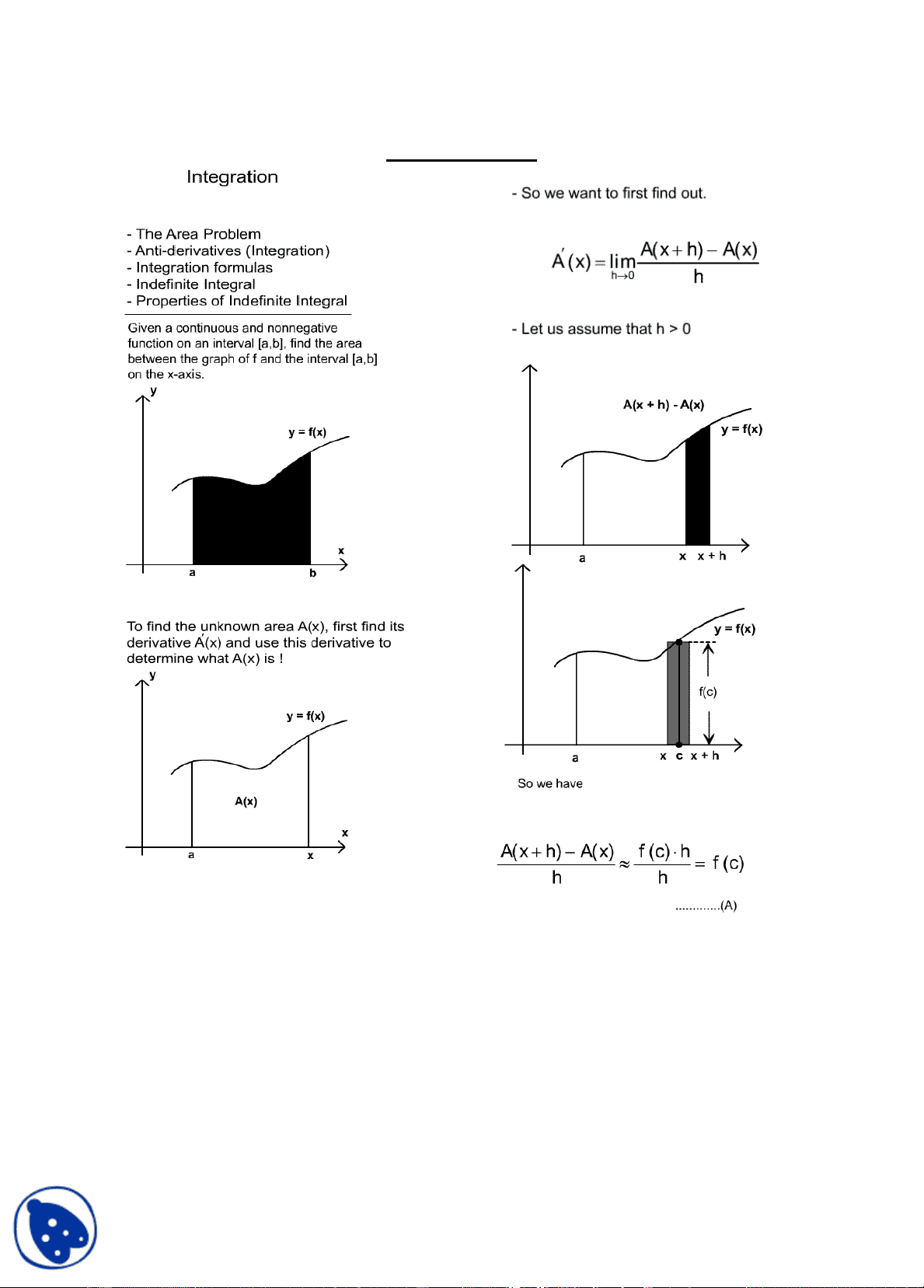
Here the dark region is area under the curve
y=f(x) in the interval [a,b].
docsity.com


Study with the several resources on Docsity

Earn points by helping other students or get them with a premium plan

Prepare for your exams
Study with the several resources on Docsity
Earn points to download
Earn points by helping other students or get them with a premium plan
An introduction to the concept of integration and antidifferentiation. It explains how to find the area under a curve by finding a function whose derivative is the given function. The document also includes examples and basic integration formulas.
Typology: Exercises
1 / 4

This page cannot be seen from the preview
Don't miss anything!
Here the dark region is area under the curve y=f(x) in the interval [a,b].
Here to find the area under the curve, we have to find a function A(x) whose derivative is f(x). i.e. This process of finding A(x) is called antidifferentiation problem. By simple guessing we see that If we agree that the area above a singe point Should be taken as zero, then on putting A(0) = 0 , And x=0, we get C=0. So we can write
If we differentiate an antiderivative of f(x) , we obtain f(x) back again. Thus Part (b) and (c) of theorem 5.2.3 can be extend to more than two Functions, which in combination with part (a) results in the following General formula: