Download Binary Search Trees: Implementing Maps as Trees and more Lecture notes Programming Abstractions in PDF only on Docsity!
Admin
Today’s topics
• Binary search trees, implementing Map as tree
Reading
• Ch 13
Lecture
Map as Vector
!!!!! Unsorted Sorted Map() O(1) O(1) ~Map() O(1) O(1) add() O(N) O(N) getValue() O(N) O(logN) Overhead per entry none none
A different strategy
Sorting the Vector
• Provides fast lookup, but still slow to insert (because of shuffling)
Does a linked list help?
• Easy to insert, once at a position
• But hard to find position to insert...
• Will rearranging pointers help?
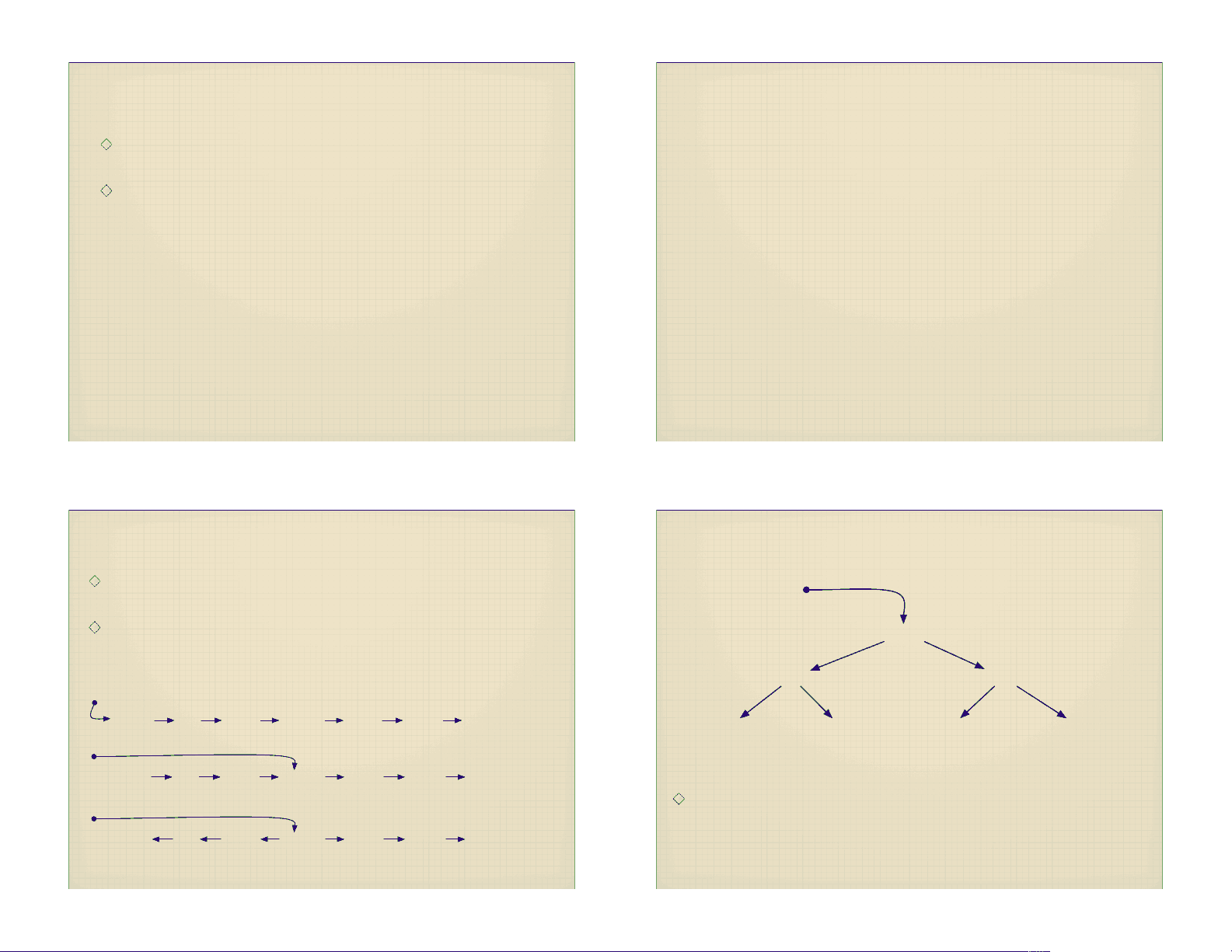
Bashful Doc Dopey Grumpy Happy Sleepy Sneezy Bashful Doc Dopey Grumpy Happy Sleepy Sneezy Bashful Doc Dopey Grumpy Happy Sleepy Sneezy
Voila... a binary search tree!
Tree terminology
• Node, tree, subtree, parent, child, root, leaf
Bashful Doc Dopey Grumpy Happy Sleepy Sneezy
Trees in general Rules for all trees
- Recursive branching structure
- Single root node
- Every node reachable from root by unique path Examples
- Game tree
- Family tree
- Filesystem hierarchy
- Decomposition tree
- Binary, ternary, n-ary
- Binary search tree
handouts
cs
~julie
cs
exams slides
Mon
exams
Wed
midterm
personal
Binary search tree in specific Binary tree
- Each node has at most 2 children Binary search tree
- Arranged for efficient search/insert
- All nodes in left subtree are less than root, all nodes in right subtree are greater
struct node { int val; node *left, *right; }; Operating on trees Many tree algorithms are recursive
- Not suprisingly!
- Handle current node, recur on subtrees
- Base case is empty tree (NULL) Tree traversals to visit all nodes - Handle cur node, visit left/right subtrees Whether current node before/after its subtrees determines order of traversal
- Pre: cur, left, right
- In: left, cur, right
- Post: left, right, cur
- Others: level-by-level, reverse orders, etc. Tree traversals at work // INORDER void PrintTree(node *t) { if (t != NULL) { PrintTree(t->left); cout << t->key << endl; PrintTree(t->right); } } // POSTORDER void FreeTree(node *t) { if (t != NULL) { FreeTree(t->left); FreeTree(t->right); delete t; } }
Map implementation template void Map::add(string key,ValType val) // add is wrapper { treeEnter(root, key, val); // call rec helper to do enter } Recursive treeEnter template void Map::treeEnter(node * & t, string key, ValType val) { if (t == NULL) { t = new node; t->key = key; t->value = val; t->left = t->right = NULL; } else if (key == t->key) { t->value = val; } else if (key < t->key) { treeEnter(t->left, key, val); } else { treeEnter(t->right, key, val); } } root t value peach value pear value papaya value kiwi value banana value apple value melon Trace treeEnter value orange Insert new node Evaluate Map as tree Space used
- Overhead of two pointers per entry (typically 8 bytes total)
- Tree adds nodes as needed, no excess capacity maintained Runtime performance
- Add/getValue take time proportional to tree height
- Height^ expected^ to be O(logN)
A balanced tree Values: 2 8 14 15 18 20 21 Different trees possible, depends on order inserted 7 nodes, expected height lg7! 3 Perfectly balanced 8 15 20 (^2 14 ) Entered: 15 8 2 20 21 14 18 (one possibility) Mostly balanced trees Same values: 2 8 14 15 18 20 21 Mostly balanced, height 4 or 5
Entered: 20 8 21 18 14 15 2
(one possibility)
Entered: 18 14 15 8 2 20 21
(one possibility)
Degenerate trees Same values: 2 8 14 15 18 20 21 Totally unbalanced, height = 7 Entered: 2 8 14 15 18 20 21 (only possibility)
Entered: 21 20 18 15 14 8 2 (only possibility)
Even more degenerate trees What is relationship between worst-case inputs for tree insertion and Quicksort? Entered: (^21 2 20 8 14 15 18) Entered: 2 8 21 20 18 14 15