Lab Report: Equilibrium Forces Determined by Various Methods, Lecture notes of Law

Instructions for a lab experiment aimed at understanding the conditions of static equilibrium. Students will experimentally, graphically, and algebraically determine the third force required for equilibrium when two forces are given. The lab preparation, equipment, procedure, and expected outcomes. Students will record forces in grams and use a circular force table, pulleys, and strings to set up the forces. They will find the direction and magnitude of the third force through trial and error, graphical methods, or algebraic calculations.

Typology: Lecture notes

2021/2022

Uploaded on 08/05/2022

dirk88
dirk88 🇧🇪

4.4

(222)

3.1K documents

1 / 4

Toggle sidebar

This page cannot be seen from the preview

Don't miss anything!

bg1
Forces in Equilibrium
Goal: To study the conditions of static equilibrium, to graphically analyze
forces, and to resolve forces into components, both experimentally and
algebraically.
Lab Preparation
According to Newton’s second law, Σ𝑭 = m𝒂, if an object stays at rest, the sum of
the forces acting on it must add up to zero. Such an object is said to be in
equilibrium. The requirement that Σ𝑭 = 0 will be evaluated three ways in this
lab:
1. Experimentally you will find a third force 𝑭3 that balances two other specified
forces by use of a force table.
2. Graphically you will find a third force by adding two specified forces using
the head to tail method (so you might want to review what the head to tail
method is).
3. Resolving forces into components algebraically and experimentally will be the
third way that Σ𝑭 = 0 will be evaluated. Thus you might want to review
Newton’s 2nd law equilibrium problems that use free body diagrams,
components, and summing of forces. Recall that if Σ𝑭 = 0, then Σ𝑭x = 0 and
Σ𝑭y = 0.
Equipment
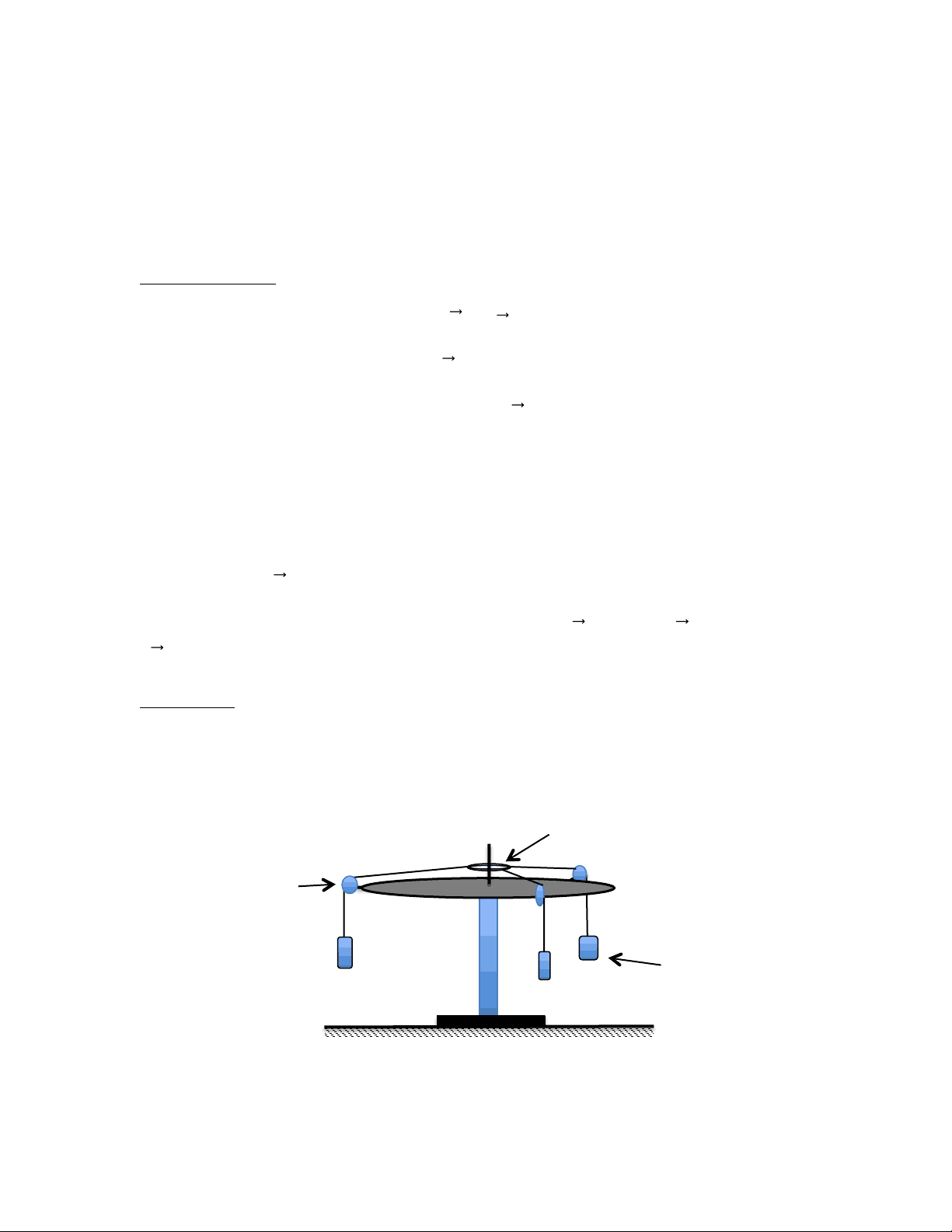
A circular force table will be used in this experiment (Figure 1). The forces act on
a small metal ring in the middle of the table. Strings tied to the ring provide the
forces. The tensions in the strings are provided by masses hanging over the edge
of the force table.
!
Figure 1
Mass!
Pulley!
Ring!
pf3
pf4

Partial preview of the text

Download Lab Report: Equilibrium Forces Determined by Various Methods and more Lecture notes Law in PDF only on Docsity!

Forces in Equilibrium

Goal: To study the conditions of static equilibrium, to graphically analyze forces, and to resolve forces into components, both experimentally and algebraically. Lab Preparation According to Newton’s second law, Σ𝑭 = m 𝒂, if an object stays at rest, the sum of the forces acting on it must add up to zero. Such an object is said to be in equilibrium. The requirement that Σ𝑭 = 0 will be evaluated three ways in this lab:

  1. Experimentally you will find a third force 𝑭 3 that balances two other specified forces by use of a force table.
  2. Graphically you will find a third force by adding two specified forces using the head to tail method (so you might want to review what the head to tail method is).
  3. Resolving forces into components algebraically and experimentally will be the third way that Σ𝑭 = 0 will be evaluated. Thus you might want to review Newton’s 2nd^ law equilibrium problems that use free body diagrams, components, and summing of forces. Recall that if Σ𝑭 = 0, then Σ𝑭 x = 0 and Σ𝑭 y = 0. Equipment A circular force table will be used in this experiment (Figure 1). The forces act on a small metal ring in the middle of the table. Strings tied to the ring provide the forces. The tensions in the strings are provided by masses hanging over the edge of the force table. Figure 1 Mass Pulley Ring

Procedure Units. Since each force involved is directly proportional to the mass hanging on the string, w = mg , you can for convenience in this lab record forces in grams. A card with your apparatus gives the sizes and directions of two forces 𝑭 1 and 𝑭 2. Record these values on your worksheet. For the first 3 parts of the lab you are to find the size and direction of a third force 𝑭 3 so that all three forces produce equilibrium. I. Experimental determination of 𝑭 3. Place the pin through the ring into the hole at the center of the force table. This will keep the ring at the center of the table as you are setting up the forces on the ring. Set one pulley at 180o^ and another at the angle given on your card for 𝑭 2. Put the stings over the pulleys and hang the masses required to produce the forces 𝑭 1 and 𝑭 2 on the ends of the strings. To find the direction of the third force 𝑭 3 required to keep the ring in equilibrium at the center of the table, grip the third string in your hand and by trial and error find the direction of pull (parallel to the table) that will keep the ring at the center of the table. Place a third pulley at the required angle of pull. To determine the magnitude of 𝑭 3 place the third string over the pulley and by trial and error hang masses on the string to bring the ring to equilibrium at the center of the table. When you are near equilibrium remove the pin from the ring. Friction in the pulleys will allow the ring to be in equilibrium over a wide range of positions. To minimize the effects of friction, test for the equilibrium position by lifting the ring about 2 cm and releasing. The ring should return to the center of the table. Test several times and find an average equilibrium position. The three forces must intersect at the center of the table. Use a ruler to check carefully that each string’s direction, when extended, will pass through the hole at the center of the table. You can slide the string on the ring to make this adjustment. Make final adjustments to the pulley and masses if required. Record the magnitude ( F 3 ) and angle ( θ 3 ) for 𝑭 3.

V. Experimentally resolving 𝑭 3 into components. Set up on the force table the force 𝑭 3 you calculated. Set a pulley for a new force 𝑭 4 at 180o, and a pulley for a new force 𝑭 5 at - 90 o^ (= +270o) as shown in Figure 4. Figure 4 Adjust the masses producing 𝑭 4 and 𝑭 5 so that all three forces put the ring in equilibrium. From considering the sum of the components, 𝑭 4 should be equal and opposite to F3x and 𝑭 5 should be equal and opposite to F3y. Compare these values in a table and find the percent difference between the measured and the expected values. *When finished with your lab return all masses to their proper containers and clean up your lab station. Homework The algebraic method used for the lab can be used to solve many different types of problems. Solve the following problem using the method used in the lab. A person sleeps in a hammock tied between a couple of trees. The tension in the two ropes supporting the hammock is 684 N at an angle of 18o^ above the horizontal and 794 N at an angle of 35o^ above the horizontal. What is the mass of the person (ignore the mass of the hammock)?

  • y
  • x

𝑭!!⃗^ 3

𝑭!!⃗^ 5

𝑭!!⃗^ 4

F3x F3y θ 3