Download Leaders by Richard Nixon and more Assignments Leadership and Team Management in PDF only on Docsity!
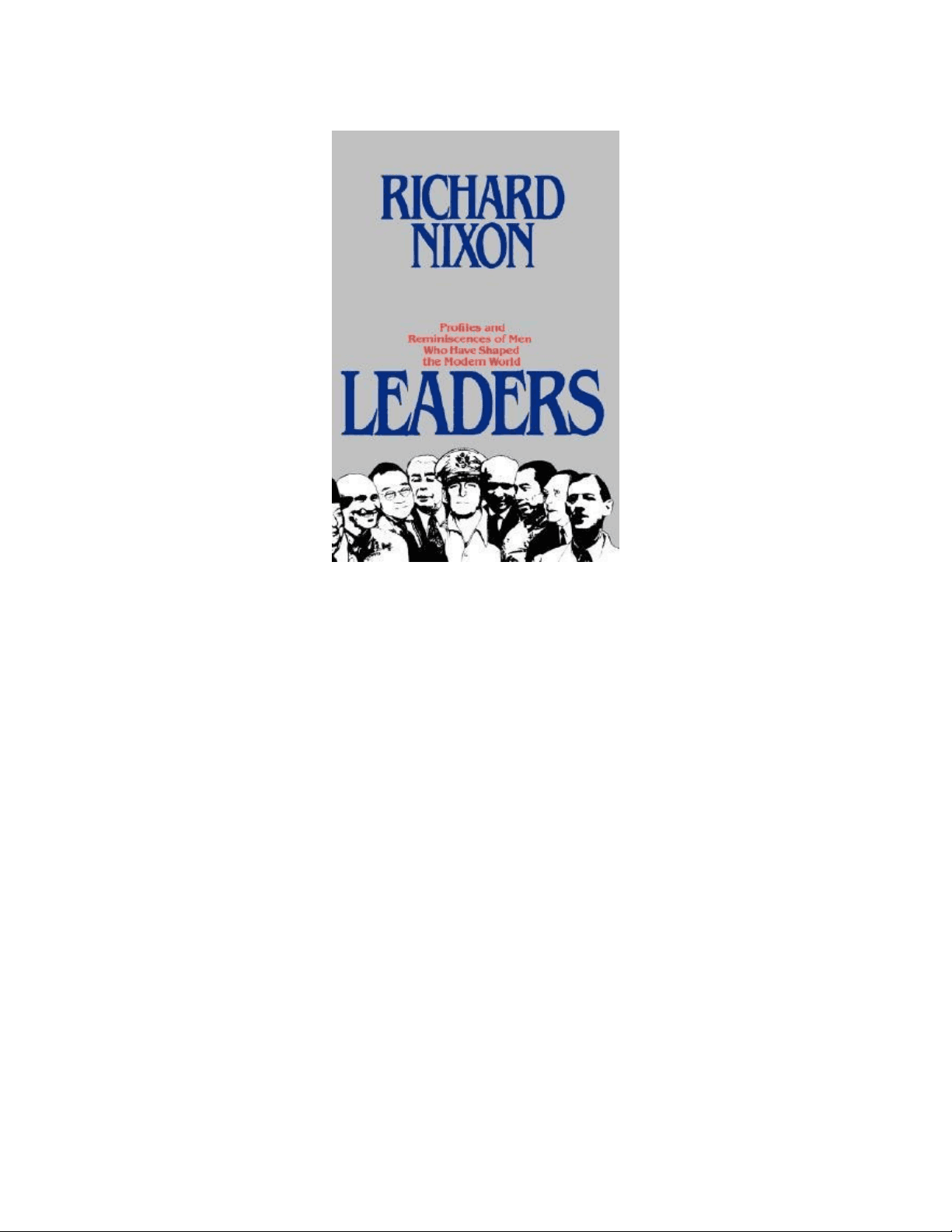
Introduction In 1982, Nixon published Leaders: Profiles and Reminiscences of Men Who Have Shaped the Modern World, a renowned politician and 37th^ president of USA. He has penned down his experiences of meetings with different leaders he had met including Winston Churchill, Charles de Gaulle, Konrad Adenauer, Nikita Khrushchev, Zhou Enlai, Jawaharlal Nehru, Golda Meir, Soekarno, Kwame Nkrumah, and many more Why read this book- Author of this book had not just been a famous figure but also reflecting a potent and credible persona, so words coming from him would surely be having authentic sources with influential and genuine impact. Also, he had met with the majority of leadership figures himself making his words even more
consolidated in terms of liveliness and semantics. Being a person of the same category and experiencing propose as evidence that the author’s life would have been more relatable to the life of leaders he had talked about and his judgment about those personalities will be more unerring and precise than a one who has not been into same situations. Richard had written the aforementioned book in a style incorporating the immediacy for readers to be involved in ongoing discussion rather than just have a writer tell them about his experiences especially when he had talked about his exclusive conversations with other leaders. It has been generally noticed that history books are considered as something dull or boring. But the composition and flow of this book is so artistic and eloquent making it unique among other books with the same genera. How it is relatable to a person-Leadership is a skill that is acquired over time by letting one’s self gain knowledge about those who are already successful; their viewpoints, habits, leadership patterns, etc. So if one wants to be a successful leader he/she must have scrutiny of leaders to acquire best practices to start their journey on the same path. Why Business students read- It is being said that humans are historical animals who base most of their decisions on historical frameworks rather than just incoming data. Historically minded beings are more focused on not only process the data in hand but also analyze what components of data they are missing and why they are missing. Having knowledge of history can help business students prevent analytical error. Also, this approach makes business students think in Longue durée causing them less susceptible to mistaking volatility spikes for the greater trend. Since today generation or youth in future will be in that position where they have to lead people, therefore they should be prepared for it beforehand via learning from those who have already travel through that path.
recollections of world leaders, and in fact, they find it pretty interesting while going through it. Summary “Leader” is a term that is so fascinating and praised not only by those who are entitled to it, but also by those who want to acquire it. As leaders bring forward a perspective for setting a benchmark for evaluating the impact of today’s leadership styles. Richard Nixon describes how leadership is different from management. The leaders are the ones who have a broader vision in term of future whereas managers are those who only focus on short term perspective Additionally, leaders are the individuals whose vision never get affected by external factors such as political risk. Therefore, in this book, he features only those leaders who took a leap of faith and refused to play safe, and delineates to the reader about their early life, personality traits, leadership qualities, personal strengths, and what life events ingrained that strength in them to become leaders. Winston Churchill - The Largest Human Being of Our Time, was a British statesman and political person, who has to face so many difficulties throughout his political career but still he never let these adversities dominate him and this was the quality Richard Nixon really admired about him. Winston Churchill was a man who never followed the trend of traditional media which helped him to outstand among many politicians of that time. He has that visionary and commanding personality that always inspired his acquaintance at the level of admiration. And when Richard Nixon met him in his official visit to the United States in 1954, his thoughts weren’t any different. Richard said that though Winston Churchill’s physical responses were slow even then his political responses were so good and impressive.
Richard Nixon vividly delineates the Charles de Gaulle identity, as he was the one who completely changed the French leader’s strength of character. Nixon said: “He was stubborn, willful, supremely self-confident, a man of enormous ego and yet at the same time enormous selflessness: He was demanding not for himself but for France. He lived simply but dreamed grandly. He acted a part, playing a role he himself created in a way that fit only one actor. Even more, he fashioned himself so that he could play it. He created de Gaulle, the public person, to play the role of de Gaulle, the personification of France.” (Pg: 41). Richard Nixon has appreciated Charles de Gaulle’s performance much on the stage but he also admired the situation that this is how a French leader is aware of the perfect timing for leaving the government gracefully. Then in the book, Richard Nixon mentioned his most dear friend Konrad Adenauer who was also his mentor. Both of them first met in 1947, when Richard Nixon had to visit Germany as part of the delegation for studying the Marshall plan. There he was immediately drawn to Adenauer, who was a basically Rhinelander-ho became West German Chancellor, the architect of a political rapprochement with France, and the driving force behind NATO and the European Common Market. Though he has very diverse accomplishments in his entire political career, in this book, the focus of Richard Nixon was on his personal aspects of life. Nixon said,” Adenauer was a man who was inflexible in adherence to principle but shrewd and subtle in tactics; a man outwardly stiff and austere but who, to those fortunate to be his friends, was cherished as a warm and sensitive human being with a captivating sense of humor; a man who deeply loved his family, his church, and his people, each equally but in different ways; a man one could always count on to stand firm as a rock no matter how great the risks or desperate the odds” (Pg: 167) Nikita Khrushchev and Zhou Enlai have very intriguing personalities. In this book, Richard Nixon thinks back to the Soviet premier as a quarrelsome yet a political