Download Wellesley College CS111: Lists in IntLists with Methods and Examples and more Study notes Computer Science in PDF only on Docsity!
CS111 Computer Programming
Department of Computer Science
Wellesley College
Lists
Checking It Twice
Friday, October 26, 2007
Lists 14-
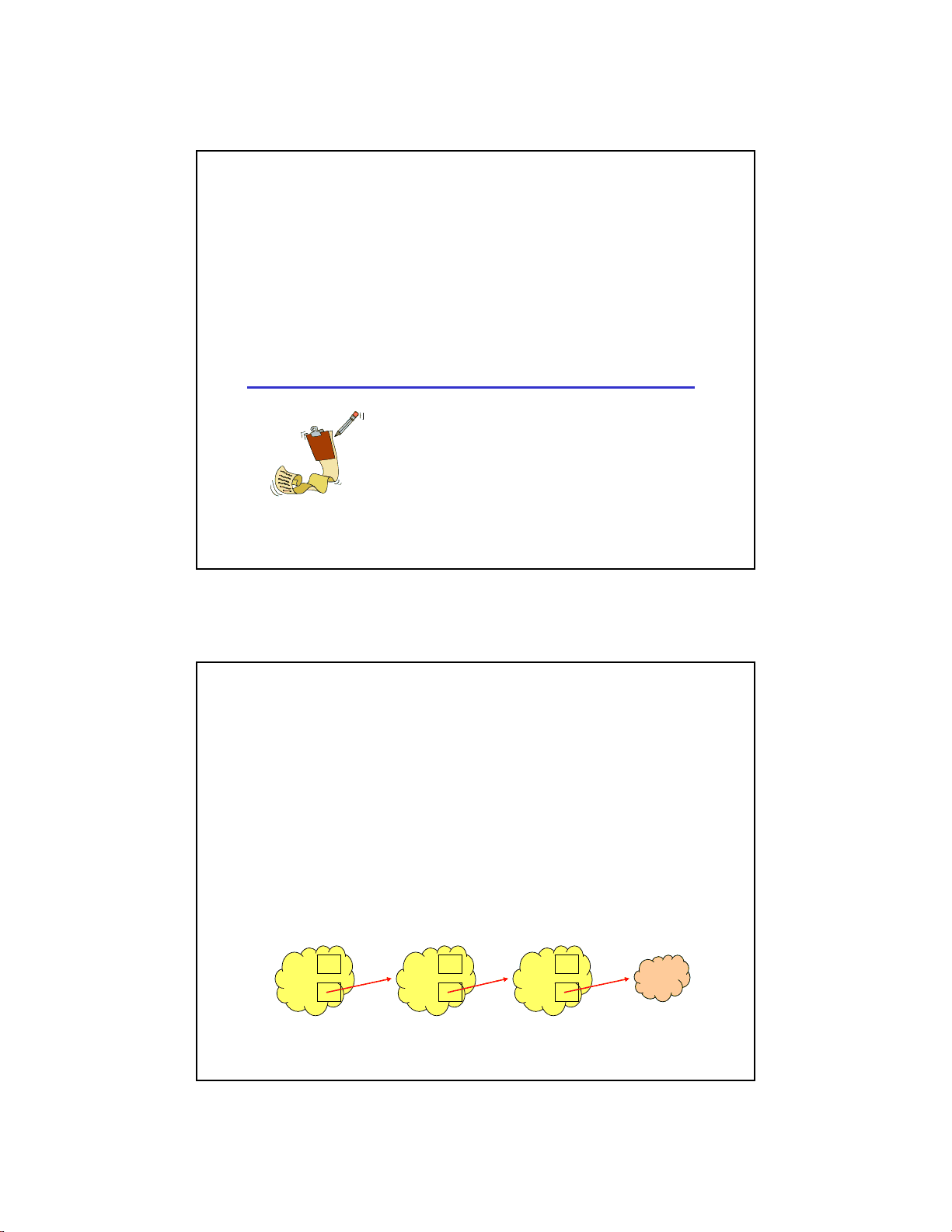
IntLists represent lists of integers
IntLists are defined recursively:
An IntList is either
o the empty list, or
o a (non-empty) list node with two parts:
1. a head which is an integer, and
2. a tail which is another IntList.
head 8 tail
head 11 tail
head- tail
IntList IntList IntList IntList
empty
// list node // list node // list node // empty list
Lists 14-
Box-and-pointer notation
We represent list nodes and empty lists using a shorthand known as box-and-pointer notation.
head 8 tail
head 11 tail
head- tail
IntList IntList IntList IntList
empty
8 11 -2 Ø
// list node // list node // list node // empty list
Lists 14-
Why are lists useful?
Lists are good for storing many numbers (but you don’t know how many in
advance).
91 0 -22 ... (^38) Ø
list
Lists are also very flexible. E.g., here is a new list which starts
with 21, and then the rest are the same as before.
21 91 0 ... (^38) Ø
list
We could create list2 from scratch, or we could use the first list
as the tail of a new list.
21
list
Lists 14-
isEmpty method
IntList.isEmpty(list1)
IntList.isEmpty(list2)
IntList.isEmpty(list3)
public static boolean isEmpty (IntList L) Returns true if L is an empty integer list and false if L is an integer list node.
1 2 3 Ø
5 -5 Ø
Ø
list list list
Lists 14-
head method
IntList.head(list1)
IntList.head(list2)
IntList.head(list3)
public static int head (IntList L) Returns the integer that is the head component of the integer list node L. Signals an exception if L is empty.
1 2 3 Ø
5 -5 Ø
Ø
list list list
Lists 14-
tail method
IntList.tail(list1)
IntList.tail(list2)
IntList.tail(list3)
public static IntList tail (IntList L) Returns the integer list that is the tail component of the integer list node L. Signals an exception if L is empty.
1 2 3 Ø
5 -5 Ø
Ø
list list list
Lists 14-
heads and tails
IntList.head(IntList.tail(list2))
IntList.head(IntList.tail(IntList.tail(list2)))
1 2 3 Ø
5 -5 Ø
Ø
list list list
Lists 14-
Sharing list nodes
list4^4
IntList list4 = IntList.prepend(4, IntList.prepend(3, IntList.prepend(2, IntList.prepend(1, IntList.empty()))));
IntList list5 = IntList.prepend(7, IntList.prepend(4, IntList.tail(IntList.tail(list4))));
1 Ø
list5 7 4 list6 8
IntList list6 = IntList.prepend(8, IntList.tail(list5));
Lists 14-
Recursive list methods
// Returns the integer sum of all elements in L
public static int sumList (IntList L) {
Lists 14-
Recursive list methods
// Returns the number of elements in list L
public static int length (IntList L) {
Lists 14-
Recursive list methods
// Returns the maximum number in list L
public static int maxList (IntList L) {
Lists 14-
Squaring numbers
o Method mapSquares(IntList L) returns a list, such that each element in the list is the “square” of the corresponding element in “L”. o For example, mapSquares(L)
2 Ø
Lists 14-
mapSquares(IntList L);
// Returns a new list whose elements are the sqaures of // the corresponding elements in the given list public static IntList mapSquares(IntList L) {
if ( ) { // base case return } else { // recursive case return
Lists 14-
mapSquares(IntList L);
// Returns a new list whose elements are the sqaures of // the corresponding elements in the given list public static IntList mapSquares(IntList L) {
if ( InList.isEmpty(L) ) { // base case return empty(); } else { // recursive case return IntList.prepend(IntList.head(L)*IntList.head(L), mapSquares(IntList.tail(L))); } }
Lists 14-
Filter methods
Afilter method passes some elements through and holds other elements back.
More formally: Afilter method transforms one list to another by keeping only those elements satisfying a given predicate.
L1 L
filter
Lists 14-
filterEven(IntList L);
// Returns sublist containing elements of L that are even public static IntList filterEven(IntList L) {
if ( IntList.isEmpty(L) ) { // base case return IntList.empty(); } else if ( (IntList.head(L) % 2) == 0 ) { // recursive case return IntList.preprend(IntList.head(L), filterEven(IntList.tail(L))); } else { return filterEven(IntList.tail(L)); } }