Download Maternity Exam 2 Practice Questions with Detailed Rationales(2026/2027) and more Exams Nursing in PDF only on Docsity!
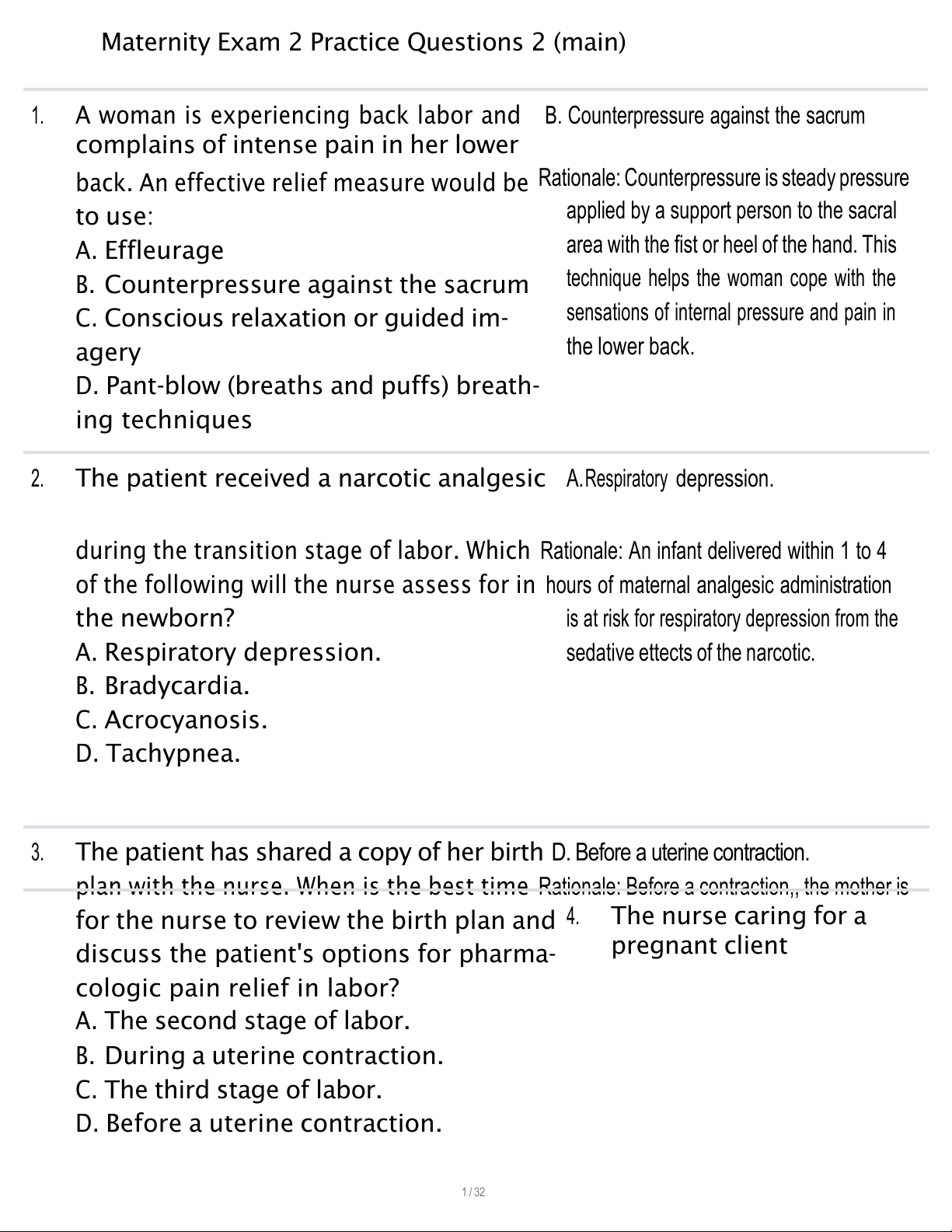
- A woman is experiencing back labor and B. Counterpressure against the sacrum complains of intense pain in her lower back. An effective relief measure would be Rationale: Counterpressure is steady pressure to use: A. Effleurage B. Counterpressure against the sacrum C. Conscious relaxation or guided im- agery D. Pant-blow (breaths and puffs) breath- ing techniques
- The patient received a narcotic analgesic
applied by a support person to the sacral area with the fist or heel of the hand. This technique helps the woman cope with the sensations of internal pressure and pain in the lower back.
A. Respiratory depression.
during the transition stage of labor. Which Rationale: An infant delivered within 1 to 4 of the following will the nurse assess for in hours of maternal analgesic administration the newborn? A. Respiratory depression. B. Bradycardia. C. Acrocyanosis. D. Tachypnea.
is at risk for respiratory depression from the sedative ettects of the narcotic.
- The patient has shared a copy of her birth D. Before a uterine contraction. plan with the nurse. When is the best time Rationale: Before a contraction,, the mother is for the nurse to review the birth plan and discuss the patient's options for pharma- cologic pain relief in labor? A. The second stage of labor. B. During a uterine contraction. C. The third stage of labor. D. Before a uterine contraction. 4. The nurse caring for a pregnant client
able to focus and ask appropriate questions regarding her care.
D. In a side-lying position. knows that her health teaching regarding Rationale: Optimal circulation is achieved
breathing and (^) for the task of giving birth. For those who
have had no preparation, instruction in sim- ple breathing and relaxation can be given in early labor and often is successful.
relaxation instructions C. Assure her that her labor will be over soon D. Administer the prescribed narcotic analgesic
- A major advantage of nonpharmacologic pain management is that: A. A slower labor decreases the risk of complications. B. Elimination of pain is possible. C. The woman remains fully alert at all times. D. There are no side effects or risks to the fetus.
- The nurse is taking an advice call from woman at 40 weeks' gestation. The nurse instructs the patient to go to the hospital to be evaluated when the patient states which of the following? A. "The baby has been moving." B. "I passed the mucous plug." C. "I have had irregular contractions for the last hour." D. "I have a trickle of fluid leaking from my vagina."
- Immediately following administration of epidural anesthesia of the patient, the
D. There are no side ettects or risks to the fetus. Rationale: Because nonpharmacologic pain management does not include analgesics, adjunct drugs, or anesthesia, it is harmless to the mother and the fetus.
D. "I have a trickle of fluid leaking from my vagina."
B. Decrease in her blood pressure
nurse must monitor the mother for which Rationale:^ After^ epidural^ administration,^ the of the following? mother will show signs of hypotension if
A. Paresthesia in her feet and leg B. Decrease in her blood pressure C. Increase in her central venous pres- sure D. Fetal heart rate accelerations
- A primigravida is pushing with contrac- tions. The nurse notes that the woman's perineum is beginning to bulge and that
formed. This decrease in blood pressure is due to the dilation of the vessels in the pelvis and the increased compression of the vena cava.
B. Report the findings to the woman's health care provider.
there is an increase in bloody show. Which Rationale:^ The^ provider^ will^ need^ to^ be^ no- of the following actions by the nurse is appropriate at this time? A. Monitor the fetal heart rate every 60 minutes. B. Report the findings to the woman's health care provider C. Immediately assess the woman's pulse and blood pressure. D. Place the client on her side with oxygen via face mask.
- When managing the care of a woman in the second stage of labor, the nurse uses various measures to enhance the
tified the patient is pushing ettectively with descent of the fetal head.
A. Encouraging the woman to try various upright positions, including squatting and standing
progress of fetal descent. These measures Rationale: include when possible: A. Encouraging the woman to try various upright positions, including squatting and standing B. Telling the woman to start pushing as
soon as her cervix is fully dilated C. Starting an epidural so that pain is re-
Upright positions and squatting both may en- hance the progress of fetal descent.
ed 16 hours B. Gravida 2, para 1 who lives 10 minutes away
The woman described is multiparous with a history of rapid labors, increasing the likeli-
C. Gravida 1, para 0 who lives 40 minutes away D. Gravida 3, para 2 whose longest previ- ous labor was 4 hours
- The nurse is teaching a 25 year old preg- nant woman about nutrition and weight gain. Which of the following statements demonstrates the woman understands the teaching?
hood that her infant might be born in uncon- trolled circumstances.
C. "The normal weight gain for pregnancy is 25-35 (11.5-16 kg) pounds for a woman with a normal BMI." Rationale: Total weight gain throughout preg- nancy should be about 11.5 to 16kg (25-35lb)
A. "I should maintain a weight gain of one for women with a normal BMI. pound per month so that by gestation week 40, I would have gained 40 pounds (18 kg), which is the minimum healthy weight gain I need for my baby." B. "Even though I'm obese, I should not be concerned because obesity is not associ- ated with pregnancy loss." C. "The normal weight gain for pregnancy is 25-35 (11.5-16 kg) pounds for a woman with a normal BMI." D. "A weight gain of 2.2 pounds (1 kg) per month is a healthy weight gain for the baby and for me."
- A G1P0 patient, 40 weeks pregnant, is la- boring in bed, flat on her back, in the supine position. She becomes pale, her
B. Turn the patient to her side. Rationale: The patient is experiencing supine hypotensive syndrome. She is experiencing
skin becomes clammy, and she states she low blood pressure due to the pressure of the feels dizzy. What is the first action by the nurse?
fluid bolus. B. Turn the patient to her side. C. Notify her medical provider. D. Apply oxygen 10 liters by simple face mask.
- A client is admitted to the birthing suite in early active labor. Which nursing ac- tion takes priority during the admission process? A. Determining when the last meal was eaten B. Ascertaining whether the membranes have ruptured C. Auscultating the fetal heart D. Obtaining an obstetric history
- The client has just received and epidural and is concerned about having a bowel movement while pushing and delivering her baby. Which of the following state- ments by the nurse is appropriate? A. "Don't worry, we can get you to the bathroom and you can have a bowel movement before delivery." B. "You are at risk for falling if you try to get out of bed. I will assist you in keeping clean while you are pushing." C. "This happens with most deliveries. You shouldn't worry about having a bowel movement."
C. Auscultating the fetal heart
Rationale: Determining fetal well-being takes priority over all other measures. If the fetal heart rate is absent or persistently deceler- ating, immediate intervention is required. Al- though obtaining an obstetric history, deter- mining when the client had her last meal, and ascertaining whether the membranes have ruptured are all important, the determination of fetal well-being takes priority.
B. "You are at risk for falling if you try to get out of bed. I will assist you in keeping clean while you are pushing." Rationale: Because the patient has regional anesthesia, she is a fall risk, and should not ambulate until after the anesthesia has worn ott. The nurse can assist with perineal care during the second stage of labor.
D. "When you visited the bathroom before your epidural was placed, that was your opportunity to have a bowel movement."
- A woman has come to the clinic for preconception counseling because she wants to start trying to get pregnant at 3 months. She asks the nurse: "One of my friends told me I need to take folic acid. Why do I have to do that?" The nurse's best response is: A. "Folic acid is not needed in pregnancy. You do not need to take it." B. "Folic acid is in enriched breads and cereals. You do not need any extra in preg- nancy." C. "Folic acid is used to treat certain types of anemia." D. "Folic acid prevents neural tube defects like spina bifida."
- A woman is 3 months pregnant. At her prenatal visit, she tells the nurse that she doesn't know what is happening; one minute she's happy that she is pregnant, and the next minute she cries for no rea-
D. "Folic acid prevents neural tube defects like spina bifida." Rationale: Folic acid is to be taken before and during the first trimester of pregnancy to pre- vent neural tube defects. She will need to use the folic acid supplement to achieve enough amounts to prevent the defects.
C. "Hormonal changes during pregnancy commonly result in mood swings." Rationale: "Hormonal changes during preg- nancy commonly result in mood swings" is an accurate statement and the most appropriate
son. Which response by the nurse is most response by the nurse. appropriate? A. "Perhaps you really don't want to be pregnant." B. "Don't worry about it; you'll feel better in a month or so." C. "Hormonal changes during pregnancy
C. Tub bathing is permitted even in late pregnancy unless membranes have rup- tured. D. Bubble bath and bath oils are permis- sible because they add an extra soothing and cleansing action to the bath.
- Which statement made by a pregnant woman would lead the nurse to believe that the woman might have lactose intol- erance? A. "Sometimes I notice that I have bad breath after I drink a cup of milk." B. "If I drink more than a cup of milk, I usually have abdominal cramps and bloat- ing." C. "Drinking milk usually makes me break out in hives." D. "I always have heartburn after I drink milk."
- A nurse is conducting the admission as- sessment of a client who is positive for Group B Streptococcus (GBS). Which find- ing is of most concern to the nurse? A. Spontaneous rupture of membranes 3 hours ago B. Cervical dilation of 4 cm C. Contractions every 4 minutes D. Continued bloody show
B. "If I drink more than a cup of milk, I usually have abdominal cramps and bloating."
Rationale: These symptoms are consistent with lactose intolerance.
A. Spontaneous rupture of membranes 3 hours ago Rationale: Rupture of the membranes before intrapartum treatment of GBS increases the chances that infection will ascend into the uterus. GBS infection is a leading cause of neonatal morbidity and mortality. Continued bloody show, cervical dilation of 4 cm, and contractions every 4 minutes are all normal findings for a client in labor.
- A client in her 10th week of pregnancy exhibits presumptive signs of pregnan- cy that the nurse may detect, including which of the following?Select all that ap- ply. A. Amenorrhea B. Positive urine pregnancy test C. Abdominal enlargement D. Breast changes E. Urinary frequency
- A woman is in the second stage of labor with a strong urge to push. Which of the
A. Amenorrhea C. Abdominal enlargement D. Breast changes E. Urinary frequency
B. Notify the provider that the woman is hav- ing the urge to push
following actions by the nurse is appropri- D. Instruct the mother to push with contrac- ate at this time? A. Assess maternal vital signs every 5 min- utes B. Notify the provider that the woman is having the urge to push C. Assess the fetal heart rate (FHR) every 5 to 15 minutes D. Instruct the mother to push with con- tractions and rest in between E. Perform a sterile vaginal examination (SVE)
tions and rest in between
- When planning care for a laboring woman A. Intrauterine infection Rationale: When the whose membranes have ruptured, the nurse recognizes that the woman's risk for has increased A. Intrauterine infection
B. Precipitous labor
C. Hemorrhage D. pine hypotensio
- When assessing a woman in the first stage D. Dilation of the cervix of labor, the nurse recognizes that the Rationale: The vaginal examination reveals most conclusive sign that uterine contrac- whether the woman is in true labor. Cervical tions are effective would be: A. Descent of the fetus B. Increase in bloody show C. Rupture of the amniotic membranes D. Dilation of the cervix
change, especially dilation, in the presence of adequate labor indicates that the woman is in true labor.
- The nurse expects to administer an oxyto- D. Stimulate uterine contraction Oxytocics cic (e.g., Pitocin, Methergine) to a woman after expulsion of her placenta to: A. Prevent infection B. Relieve pain C. Facilitate rest and relaxation D. Stimulate uterine contraction
- After an emergency birth, the nurse en- courages the woman to breastfeed her newborn. The primary purpose of this ac- tivity is to: A. Facilitate maternal-newborn interac- tion B. Stimulate the uterus to contract C. Initiate the lactation cycle D. Prevent neonatal hypoglycemia
- With regard to primary and secondary
stimulate uterine contractions, which reduce blood loss after the third stage of labor.
B. Stimulate the uterus to contract Rationale: Stimulation of the nipples through breastfeeding or manual stimulation causes the release of oxytocin and prevents maternal hemorrhage.
C. Primary powers are responsible for ettace-
powers, the maternity nurse should know ment and dilation of the cervix that: