Download Mendelian Genetics - Evolution, Ecology and Biodiversity - Lecture Slides and more Slides Ecology and Environment in PDF only on Docsity!
Mendelian Genetics
Reading: Chap. 13, pp. 265-276, 282- I. Intro A. Motivating question B. Mendel II. Mendel’s findings A. Mendel’s experiments B. Law of segregation of alleles C. Law of independent assortment of traits III. Complications
Terms and Concepts
- character, trait, alleles, locus
- homozygous/heterozygous
- phenotype/genotype
- P, F1, F
- dominant/recessive
- law of segregation
- law of independent assortment
- Testcross
- Rules of probability
- Incomplete dominance
- codominance
- Quantitative characteristics
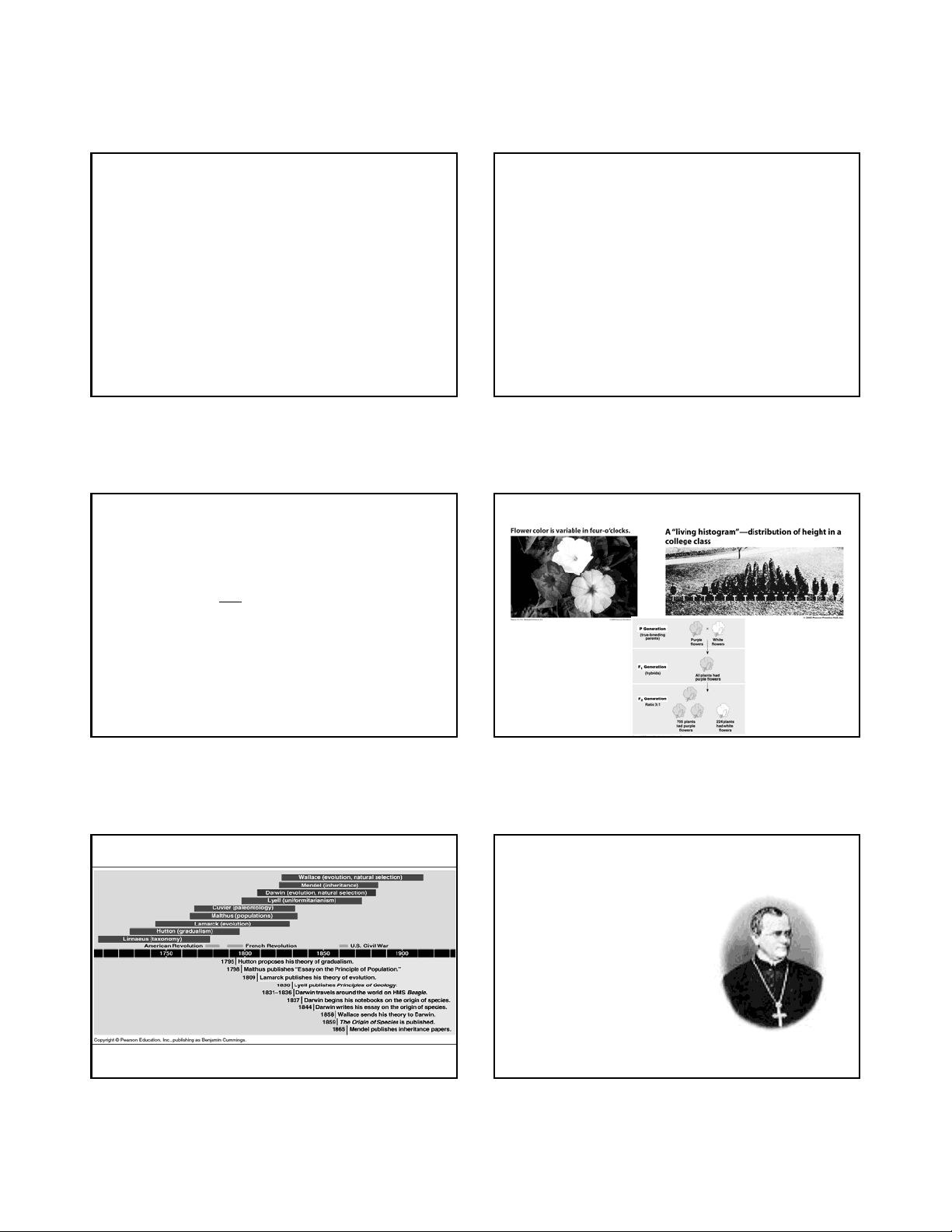
What Darwin didn’t know:
How did heritability work? What exactly was passed down from parents to offspring? No idea about: Genes, chromosomes, DNA, mitosis and meiosis
Blending vs. particulate inheritance?
Fig 22.
Gregor Mendel
Austrian contemporary of Darwin Published shortly after Darwin - but work was “buried”
Who was Mendel?
- Austrian monk
- Background in agriculture (grew up on a farm)
- Failed his teacher’s exam
- University of Vienna: math, causes of variation in plants
- Teaching at the Brünn Modern School
What did he do?
Pea breeding Testing mechanisms of inheritance: blending vs. acquired characteristics (e.g., Lamarck) Used many different characters Published results in 1865
Mendel didn’t know about chromosomes either!
- Results were buried for ~40 years – not broadly accepted until ~16 years after his death.
•Early in the 20th century, Sutton and Boveri (working independently) formulated the chromosome theory of inheritance, which proposes that meiosis causes the patterns of inheritance that Mendel observed.
Why did his experiments succeed?
- Control over fertilization 2. “Either/or”characters 3. True breeding parents
- Multiple generations: P, F1, F
II. What did Mendel find?
A. Mendel’s experiments
B. Law of segregation (of alleles)
C. Law of independent assortment (of traits)
A. Mendel’s experiments: Simple cross
P - true breeding parents with different traits for same character.
F 1 - Cross two of same generation
F 2 - evaluate resulting traits: 3 to 1
3 to 1!!!
Mendel tested many traits
How does the law of segregation relate to meiosis?
Chromosomes, genes, and alleles
Alleles segregate on the homologous chromosomes
Homologous chromosomes separate after doubling
Sister chromatids separate
C. Law of independent assortment
What about two or more characters? Are they inherited together or independently?
1. Two traits: an example
Together
13.6b
Independent
13.6a
556 total
Which hypothesis does this support?
Rules of probability
Yellow round: YYRR YYRr YyRR YyRr (1/41/4) + (21/41/4)+(21/41/4)+(41/4*1/4) = 9/
From YyRr x YyRr
Green round: yyRR yyRr (1/41/4) + (21/41/4) = 3/ Yellow wrinkled: YYrr Yyrr (1/41/4) + (21/41/4) = 3/ Green wrinkled: yyrr (1/4*1/4) = 1/
Law of independent assortment
(of characters)
“Independent segregation of each pair of alleles (i.e., genes coding for each character) during gamete formation.”
2. What we know now:
Mendel’s independent assortment referred to characters. How does this relate to independent assortment of chromosomes in meiosis?
13.9b
What if genes for two traits are
on the same chromosome?
Independent or linked? Linked, except for…? Crossing over Depends how close they are: genes further apart are more likely to behave as independent.
Did Mendel get lucky?
(not that way - he was a monk!)
- Genes for traits he studied were either on separate chromosomes, or
- Far enough apart on the same chromosome that they assorted independently
III. Complications
A. Incomplete dominance
Is this the same as blending?
B. Multiple alleles – co-dominance
Red hair?
C. Complications: Quantitative Characters
-One trait determined by multiple genes -Could lead to perception of “blending” but that’s not what it is.
fig. 13.