Download Midterm Exam for Spacecraft Guidance I | MAE 180A and more Exams Mechanical Engineering in PDF only on Docsity!
MAE 180A: Spacecraft Guidance I, Summer 2009
Midterm Exam Thursday, July 16. Part I: Questions. (40pt)
Guidelines: Please turn in a neat and clean exam solution. Answers should be written in the blank spaces provided in these exam sheets. Vector quantities are denoted in bold letters in what follows. This part of the exam is closed book, closed notes, no use of calculator allowed.
Student’s Name:.......................................................... Student’s ID:.............................
Question 1 (20 pts).
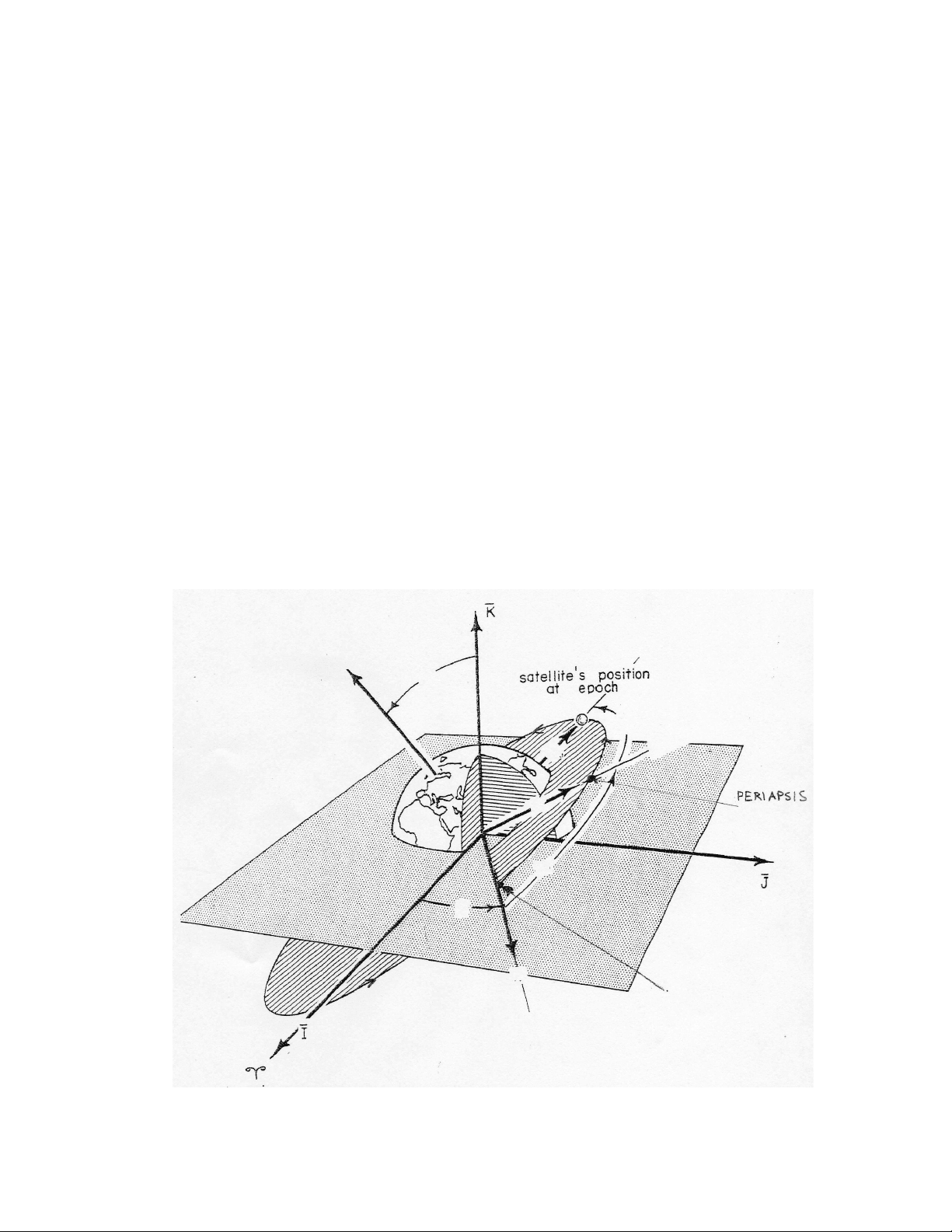
a) Indicate on the following figure the six main orbital parameters and the fundamental vectors that define those parameters. Also indicate on the figure where is the ascending node and locate the line of nodes.
b) Provide a separate list with the names of the orbital parameters and vectors that you indicated on part a) and the geometrical meaning for each of them.
c) What is the name of the direction pointing on the Aries constellation (Υ) direction?
d) What is the name of the system of coordinates shown in the picture? Is this coordinate system inertial or non-inertial?.
e) What is the name of the fundamental (dotted) plane on this picture?
3.6 The fundamental plane in the perifocal system of coordinates is a) the ecliptic. b) the galactic equator. c) the orbit plane. d) the celestial equator.
3.7 If the launch site is very close to the equator then a) the spacecraft can be generally inserted into an equatorial orbit very easily. b) it is impossible to insert a spacecraft into an equatorial orbit. c) the orbit is always polar. d) the orbit is always retrograde.
3.8 The specific mechanical energy of a satellite orbiting around the Earth a) is not constant and varies sinusoidally with time. b) is constant but only for US-manufactured satellites. c) is constant if the satellite is not subject to any dissipative forces or external forces other than gravitational interactions. d) is always constant.
3.9 The orbital period of a planet in a circular orbit of radius r 1 around the Sun is P 1. The orbital period of another planet in a circular heliocentric orbit of radius r 1 /3 is a) longer. b) shorter. c) equal. d) undefined.
3.10 The angular momentum in an orbital motion is a) constant and parallel to the orbit plane. b) constant and normal to the orbit plane. c) not constant, and it is parallel to the orbit plane. d) not constant, and it is normal to the orbit plane.
MAE 180A: Spacecraft Guidance I, Summer 2009
Midterm Exam Thursday, July 16. Part II: Problem. (60pt)
Guidelines: Please turn in a neat and clean exam solution. Answers should be written in the blank spaces provided in these exam sheets. Show all work. Vector quantities are denoted in bold letters in what follows. This part of the exam is open book, open notes, use of calculator allowed.
Student’s Name:.......................................................... Student’s ID:.............................
Problem (60 pts)
The PAVE-PAWS (Phased Array Warning System) is a United States’ Space Command radar system capable of detecting intercontinental ballistic missiles (ICBMs). An unidentified object is detected by this system orbiting at a position r = 1. 5 K DU⊕ with velocity v = 0. 4 I− 0. 2 K DU⊕/TU⊕, both referred to the geocentric-equatorial system of coordinates. Give all your results in both canonical units and dimensional units.
Figure 1: The PAVE-PAWS radar at Clear AFS (Alaska).
a) Calculate the specific mechanical energy of the object.
b) Calculate the specific angular momentum of the orbit.
h) What minimum set of parameters, of those calculated above, would you choose to determine the orbit orientation, orbit geometry and object location?.
i) Calculate the latitude of impact.