Download Network Topologies: Quiz and Definitions and more Exams Advanced Education in PDF only on Docsity!
NETWORK TOPOLOGIES TEST
LATEST
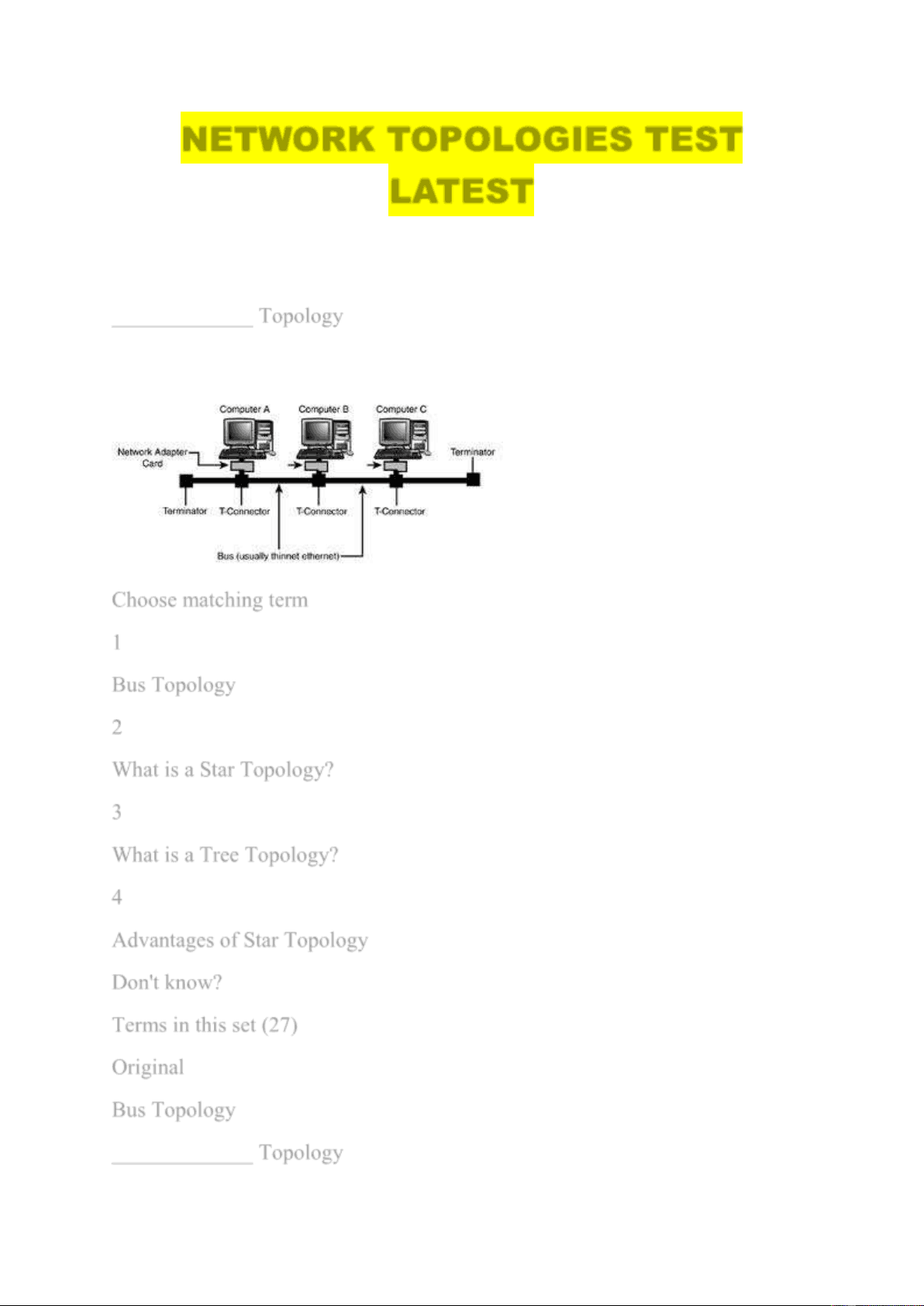
_____________ Topology Choose matching term 1 Bus Topology 2 What is a Star Topology? 3 What is a Tree Topology? 4 Advantages of Star Topology Don't know? Terms in this set (27) Original Bus Topology _____________ Topology
Backbone A bus topology network has a cable as a ______________ to network the nodes. Mesh Topology ________ Topology Star Topology _______ Topology Ring Topology _________ Topology Tree Topology ________ Topology
In a mesh topology, every device has a dedicated point-to-point link to every other device. The term dedicated means that the link carries traffic only between the two devices it connects. What is a Star Topology? In local area networks where the star topology is used, each machine is connected to a central hub. The star topology allows each machine on the network to have a point to point connection to the central hub. All of the traffic which transverses the network passes through the central hub. Advantages of Star Topology *Easy to install and reconfigure. *No disruptions to the network when connecting or removing devices. *Easy to detect faults and to remove parts. *Less expensive. *Includes robustness, that is, if one link fails, only that link is affected, other links remain active. Disadvantages of Star Topology *If the hub fails, the whole system is dead. *If the hub, switch, or concentrator fails, nodes attached are disabled. *Requires more cable length than a bus topology. *More expensive than bus topologies because of the cost of the hubs, etc. What is a Ring Topology? In local area networks where the ring topology is used, each computer is connected to the network in a closed loop or ring. The signal passes through each machine or computer connected to the ring in one direction, from device to device, until it reaches its destination. Each machines or computers connected to the ring act as signal boosters or repeaters. Advantages of a Ring Topology *It is relatively easy to install and reconfigure. &Easy to identify the problem if the entire network shuts down. Disadvantages of a Ring Topology
*Only one machine can transmit on the network at a time. · *The failure of one machine will cause the entire network to fail. What is a Tree Topology? The type of network topology in which a central 'root' node (the top level of the hierarchy) is connected to one or more other nodes that are one level lower in the hierarchy (i.e., the second level) with a point-to-point link between each of the second level nodes and the top level central 'root' node, while each of the second level nodes that are connected to the top level central 'root' node will also have one or more other nodes that are one level lower in the hierarchy Advantages of a Tree Topology *Point-to-point wiring for individual segments. *Supported by several hardware and software vendors. Disadvantages of a Tree Topology *Overall length of each segment is limited by the type of cabling used. *If the backbone line breaks, the entire segment goes down. *More difficult to configure and wire than other topologies. What is a Bus Topology? In local area networks where bus technology is used, each machine is connected to a long, single cable. The cable acts as a backbone to link all the devices in a network. Each computer or server is connected to the single bus cable through drop lines and some kind of connector. A terminator is required at each end of the bus cable to prevent the signal from bouncing back and forth on the bus cable. Advantages of a Bus Topology *Easy to connect a computer or peripheral to a linear bus. *Requires less cable length than mesh or star topologies. *It is cheaper than any other topologies. Disadvantages of a Bus Topology *If the network cable breaks, the entire network will be down. *Terminators are required at both ends of the backbone cable.