Download Noneuclidean Geometries: Poincaré Plane and Hyperbolic Plane and more Assignments Geometry in PDF only on Docsity!
4.3 Noneuclidean geometries
Up to now, we have looked at surfaces that can be placed in 3-space with the standard inner
product defined on R^3. The usual inner product is the dot product, but there are many
other inner products available to us! Recall that any nonsingular symmetric n × n matrix
defines an inner product on Rn^ by
< x, y >= x
t Ay.
The dot product is simply the inner product where A = I, the identity matrix.
To see geometries and surfaces beyond what we normally encounter, we will have to
extend our interest beyond the usual dot product. We will have to modify the way that
we have been doing our calculations. Since most of our work has been done in the tangent
plane (R^2 ), we will look there for our dependence.
Let x = (x 1 , x 2 ), y = (y 1 , y 2 ) and define
x · y = [x 1 x 2 ]
[
] [
y 1
y 2
]
= x 1 y 1 + x 2 y 2.
Now, change the matrix to
A =
[
1 /a 0 0 1 /a
]
Then,
x ◦ y =
[
x 1 x 2
]
[
1 /a 0
0 1 /a
] [
y 1
y 2
]
x 1 y 1 + x 2 y 2
a
x · y
a
We have modified our usual dot product to get a new inner product. All of the usual
properties of the dot product will hold for the modified inner product. For an inner product
on the tangent planes of a surface M the number a may change at each point p ∈ M. Then
we may take the value a to be a = f (p)^2 , for f : M → R and p ∈ M. The reason we take
the square of the functional value f (p) is to insure that a is positive at each point. Then
for two tangent vectors v, w ∈ TpM we have,
v ◦ w =
v · w
f (p)^2
These inner products on the tangent space are called metrics on M because they allow us
to calculate E, F , and G, the basic components of distance along M. The dot product is
usually called the Euclidean metric. A metric such as ◦ is called conformal (to the Euclidean
metric) with a scaling factor f.
If a surface is not going to use the usual metric, then it must not sit in R^3 in the usual
way! This means that we cannot use the unit surface normal to define curvature. How do
we retrieve this information? We will revert to a result that is independent of the metric!
For a surface with orthogonal metric (i.e., F = 0), the Gaussian curvature K is
defined to be
K = −
EG
∂v
Ev √ EG
∂u
Gu √ EG
Since this was a result in R^3 we know that it will agree with the usual definition of
Gaussian curvature.
Let’s look at some interesting examples.
4.3. NONEUCLIDEAN GEOMETRIES 49
Example 4.5 The Poincar´e Plane P.
Define P to be the upper half-plane P = {(x, y) ∈ R^2 | y > 0 }. Define the patch x(u, v) =
(u, v) and define the metric to be:
w 1 ◦ w 2 =
w 1 · w 2
v^2
where w 1 , w 2 ∈ TpP and p = (u, v).
In this definition, the usual dot product is scaled down by the height of the point above the
x-axis. Let’s do the usual computations.
xu = (1, 0) and xv = (0, 1)
This makes
E = xu ◦ xu =
v^2
F = xu ◦ xv = 0 G = xv ◦ xv =
v^2
Now, note that Gu = 0 and Ev = − 2 /v^3. Thus,
K = −
1 /v^4
∂v
− 2 /v^3 √ 1 /v^4
v^2
2
∂v
v
v^2
2
v^2
= − 1
Thus, P has constant curvature equal to −1 at each point.
Example 4.6 The Hyperbolic Plane H.
Define H to be the disk of radius 2 in the plane minus the bounding circle: H = {(x, y) ∈
R^2 | x^2 + y^2 < 4 }. We can put a patch on H by
x(u, v) = (u cos v, u sin v), 0 ≤ u < 2 , 0 ≤ v < 2 π.
Define a conformal metric on H by
w 1 ◦ w 2 =
w 1 · w 2
(1 − u^2 /4)^2
where w 1 , w 2 ∈ TpH and p = (u cos v, u sin v). It can be shown that K = −1 for H. (You
are going to do it for homework!)
Beyond be able to compute the Gaussian curvature, we would like to understand the
geodesics on these surfaces. Again, we have to remove all traces of the unit surface normal,
U , from our previous discussions of geodesics. When we computed the Christoffel symbols
for xuu, xuv, and xvv, we never used U. Hence the same formulas hold for surfaces not in
R^3. Thus, our calculation for σ′′^ is the same, just without the final term involving U. Thus,
σ
′′ = xu
[
u
′′
Eu
2 E
u
′^2
Ev
E
u
′ v
′ −
Gu
2 e
v
′^2
]
[
v
′′ −
Ev
2 G
u
′^2
Gu
G
u
′ v
′
Gv
2 G
v
′^2
]
4.3. NONEUCLIDEAN GEOMETRIES 51
This is fine, but we might want to think of this in a different way, and write it down
differently in order to gain a little more understanding.
Let θ denote the angle between α′^ and xu. Since α is unit speed, we have
α
′ = u
′ xu + v
′ xv
= cos θ
xu √ E
xv √ G
Therefore, u′
E = cos θ and b′
G = sin θ. If we differentiate the first expression and
substitute it into the second, we have
u
′′
E + u
′ Euu
′ + E
vv
′
E
d
dt
cos θ (4.1)
u
′′
E +
Euu′
2
E
Evu′v′
2
E
= − sin θ
dθ
dt
u
′′
E +
Euu′
2
E
Evu′v′
2
E
Gv
′ dθ dt
u′′
v′
E
G
Euu′
2
2 v′
EG
Evu′
2
EG
dθ
dt
Comparing this with our previous expression for κg gives the following.
Theorem 4.3 Let α(t) be a unit speed curve in a surface M with patch x(u, v) and let θ
denote the angle between α′^ and xu. Then the geodesic curvature of α is given by
κg =
dθ
dt
EG
[
Guv
′ − Evu
′]^
This theorem is valid both for those surfaces in R^3 and those not in R^3.
Example 4.7 The Poincar´e Plane P.
Here we have the patch x(u, v) = (u, v) and the conformal metric,
w 1 ◦ w 2 =
w 1 · w 2
v^2
We computed that E = 1/v^2 , F = 0, and G = 1/v^2. Thus, the patch is v-Clairaut, so for
α(t) = x(u(t), v(t)), the geodesic equations give
u′′^ −
v
u′v′^ = 0 v′′^ +
v
u′
2 −
v
v′
2 = 0.
Separate the first equation:
u′′
u′^
v
v
′
ln(u
′ ) = 2 ln(v) + C
u′^ = cv^2
Plugging this into the unit speed relation 1 = u′
2 (1/v^2 ) + v′
2 (1/v^2 ) gives v′^ = v
1 − c^2 v^2.
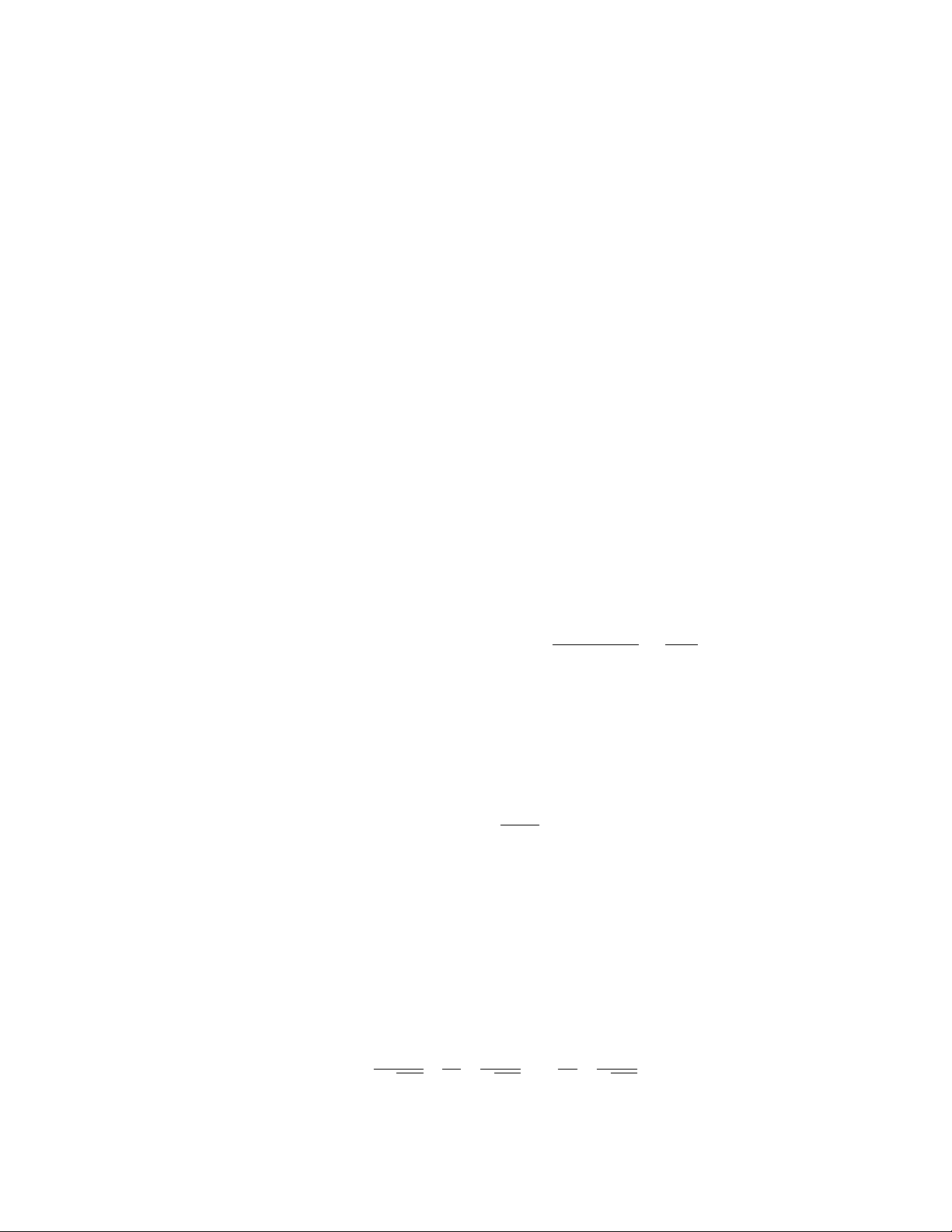
Then dividing v′^ by u′^ and integrating gives
∫
du =
cv √ 1 − c^2 v^2
dv
u − d =
c
sin wdw where v =
c
sin w
c
cos w
c
1 − c^2 v^2
(u − d)
2
2
c^2
This is the equation of a circle centered on teh u-axis. Also, since the patch is v-Clairaut,
vertical lines (i.e., v-parameter curves) are geodesics as well. Thus, the Poincar´e plane has
geodesics that are arcs of circles centered on the u-axis and vertical lines.
Example 4.8 The Hyperbolic Plane H
Doing the same as the previous example, since x is u-Clairaut, u-parameter curves are
geodesics. Hence, radial lines through (0, 0) are geodesics. For non-u-parameter geodesics,
apply the Clairaut integral formula and you get
v =
c(1 − u^2 /4)
u^2
c(1−u^2 /4) u
du.
Substituting w = c u
√ 1+c^2
(1 + u^2 /4) we get
∫
dv =
dw √ 1 − w^2
v − v 0 = cos
− 1 w
cos(v − v 0 ) = w =
c
u
1 + c^2
(1 + u
2 /4)
4 u
1 + c^2
c
cos(v − v 0 ) = 4 + u
2
u^2 + 4 −
4 u
1 + c^2
c
cos(v − v 0 ) = 0
Let x = u cos v and y = c sin v and expand cos(v − v 0 ) and we get
u^2 + 4 −
1 + c^2
c
cos v 0 u cos v −
1 + c^2
c
sin v 0 u sin v = 0
x^2 + y^2 + 4 −
1 + c^2
c
cos v 0 x −
1 + c^2
c
sin v 0 y = 0
(x −
1 + c^2
c
cos v 0 )^2 + (y −
1 + c^2
c
sin v 0 )^2 −
4(1 + c^2 )
c^2
(x −
1 + c^2
c
cos v 0 )^2 + (y −
1 + c^2
c
sin v 0 )^2 =
c^2