Download PHYS 1402 General Physics II The Geometric Wave ... and more Schemes and Mind Maps Physics in PDF only on Docsity!
Name______________________ Date_____________
PHYS 1402 General Physics II
The Geometric Wave Properties of Light
Equipment Optics Bench Ray Table & Base Cylindrical Lens Light Source
White paper/cardboard Graphical Analysis Flashlight
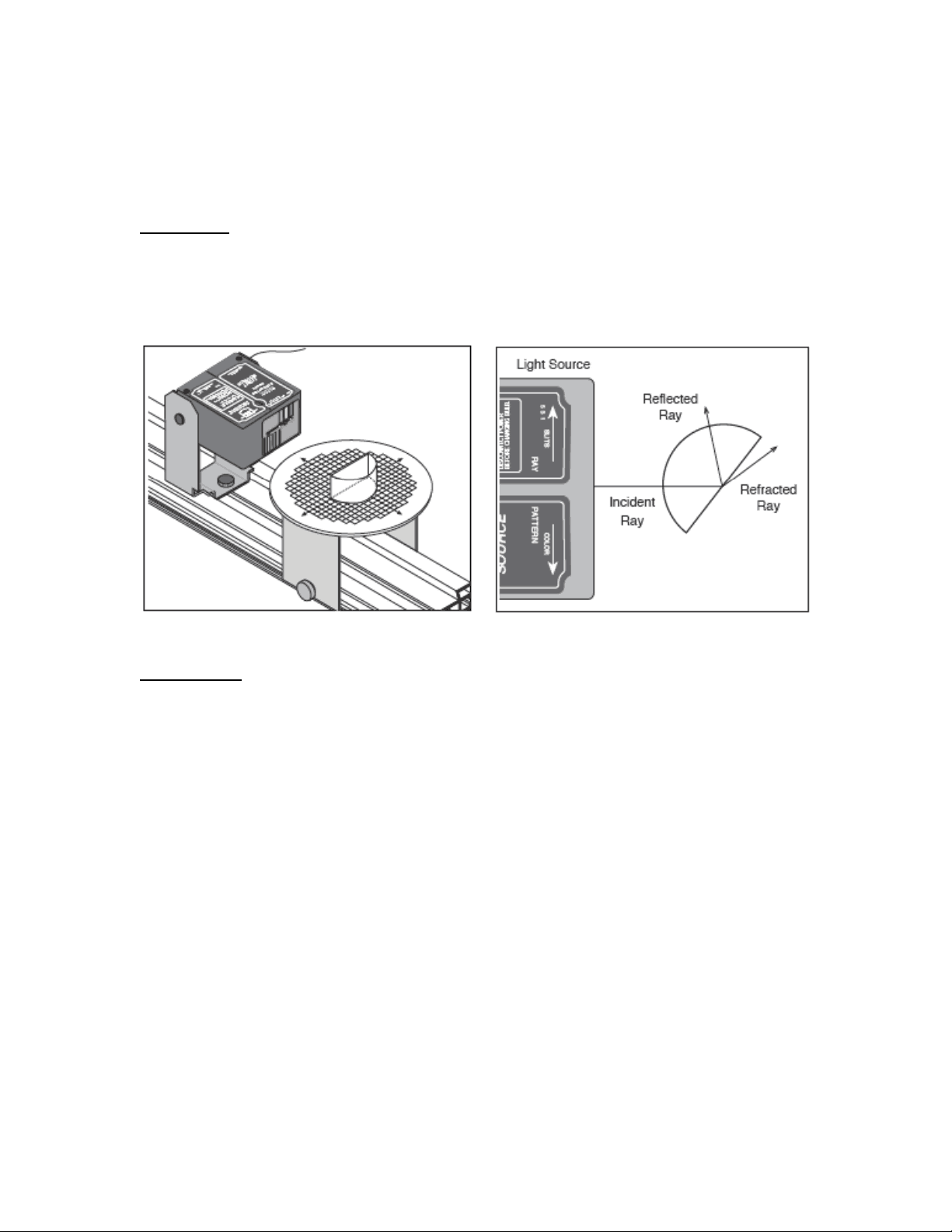
Figure 1 Figure 2
Introduction
As determined by Thomas Young, light has wave properties and specifically is an electromagnetic wave, as determined by James Clerk Maxwell. All waves exhibit reflection, refraction, dispersion, diffraction, and interference. Using the ray model of light, we can analyze reflection, refraction, and dispersion. From our everyday experience we are familiar with both the reflection and refraction, or bending, of light as it strikes the interface between two different media, such as between either air and water, air and glass, or even glass and water. Clear images are seen from specular reflections off of smooth surfaces, such as a mirror, whereas rough surfaces produce diffuse reflections. Refraction is the bending of the light due to a change in the speed of light as it goes from one medium into the next, such as when a straw in a glass of water appears to be bent. Dispersion is the separation of light into its component frequencies due to the frequency dependence of the speed of light in the medium, as illustrated by a rainbow that is produced when white light is refracted through a prism. In this lab we will investigate all of these wave properties of light. Some terminology that will be used in this lab is as follows. Light rays traveling from a source, before they are reflected or refracted are called incident rays. If a ray undergoes reflection, it is called a reflected ray while a ray that undergoes refraction is called a refracted ray. The line perpendicular to the surface at the point where the incident ray strikes is called the normal. The angle between the normal and the reflected
ray is called the angle of reflection. The angle between the normal and the refracted ray is called the angle of refraction. The critical angle is the angle of incidence for which there is no refracted ray, or in other words the light ray is totally reflected.
Theory
The law of reflection states that the angle of incidence is equal to the angle of reflection. (^) incident reflected
Snell’s law governs the refracted ray by:
nincident sin incident nrefracted sin refracted
Where n is the index of refraction , which is the ratio of the speed of light in a vacuum to the speed of light in the material:
material
material v
c n
The critical angle is obtained from Snell’s law with refracted = 90o^ and solved as:
incident
refracted critical n
1 n
sin
Procedure
- Mount both the light source and the ray table base to the optics bench. Then attach the ray table to the ray table base with the Cartesian grid (mm SCALE) facing up. Turn the ray table so that the zero degree line points toward the light source.
- Plug in the light source and orient it so that the multiple slits are facing the ray table. Position the ray table so that it is about two centimeters from the edge of the light source. Adjust the slit mask on the front of the light source so the light source projects one ray of light across the middle of the top surface of the ray table.
- Place the cylindrical lens on the ray table so the flat surface of the lens faces the light source. See Figure 1. You will need to make sure that the edge of the lens is EXACTLY on the ninety degree line and that it is PRECISELY centered on the zero degree line.
- Without disturbing the alignment of the cylindrical lens, rotate the ray table and set the angle of incidence equal to the values listed in Data Table 1. Measure both the angle of reflection and the angle of refraction and list them in the appropriate columns in Data Table 1.
Analysis Calculate the percent difference between the angle of incidence and the angle of reflection for your nine measurements as follows:
% Difference
incident reflected
incident reflected
Then take the average of these nine values and report that as an overall percent difference for this part of the lab.
Data Run: Percent Difference: 1 2 3 4 5 6 7 8 9
Average
Question # Does your data support the conclusion that you have verified the law of reflection within a reasonable expectation of experimental uncertainty?
Now take your angle of incidence and angle of refraction data and calculate the sine of each of these angles and enter them into the appropriate columns in Data Table 1. Make a graph of sin(incident) – vs.- sin(refracted). According to Snell’s law what should the slope of this graph be equal to?
Find the slope of this graph as well as the uncertainty in the slope and report it here.
Appropriately compare your slope to the accepted value for the index of refraction for Lucite which is nlucite = 1.49. You should do this by calculating a percent error by the following formula:
% Error
n exp erimental nlucite nlucite
Finally, with the data from the critical angle also calculate the index of refraction of the Lucite for each color via the following formula:
critical
nLucite sin
nlucite-red =
nlucite-blue =
Comment on how your values compare both to the accepted value for the index of refraction of Lucite and to your experimentally obtained value.
Question # Does your data support the conclusion that you have verified the law of refraction or Snell’s law within a reasonable expectation of experimental uncertainty?
Looking at the data collected in Data Table 2. What is the overall effect when the light is incident upon the curved surface? Think about the normal to the curved surface of the lens and what the angle of incidence and the angle of refraction are at this surface. Subsequently, how does this affect the light when it strikes the flat surface?