
Astronomy: Planets and Comets Orbits, Study notes of Astronomy

An explanation of the orbits of planets and comets around the sun, focusing on the concepts of perihelion, aphelion, major axis, and semi-major axis. It also discusses the more elliptical orbit of comets and the impact of shoemaker-levy 9 on jupiter. Vocabulary and exercises are included.

Typology: Study notes

Pre 2010

Uploaded on 02/13/2009

koofers-user-scl
koofers-user-scl 🇺🇸

9 documents

1 / 5

Toggle sidebar

This page cannot be seen from the preview

Don't miss anything!

bg1
Note:
- Lab is in the Computer Lab this week – turn right after you come in the main
doors, turn left at the end of the hall. It’s room 1220.
----------------------------------------------------------------------------------------------
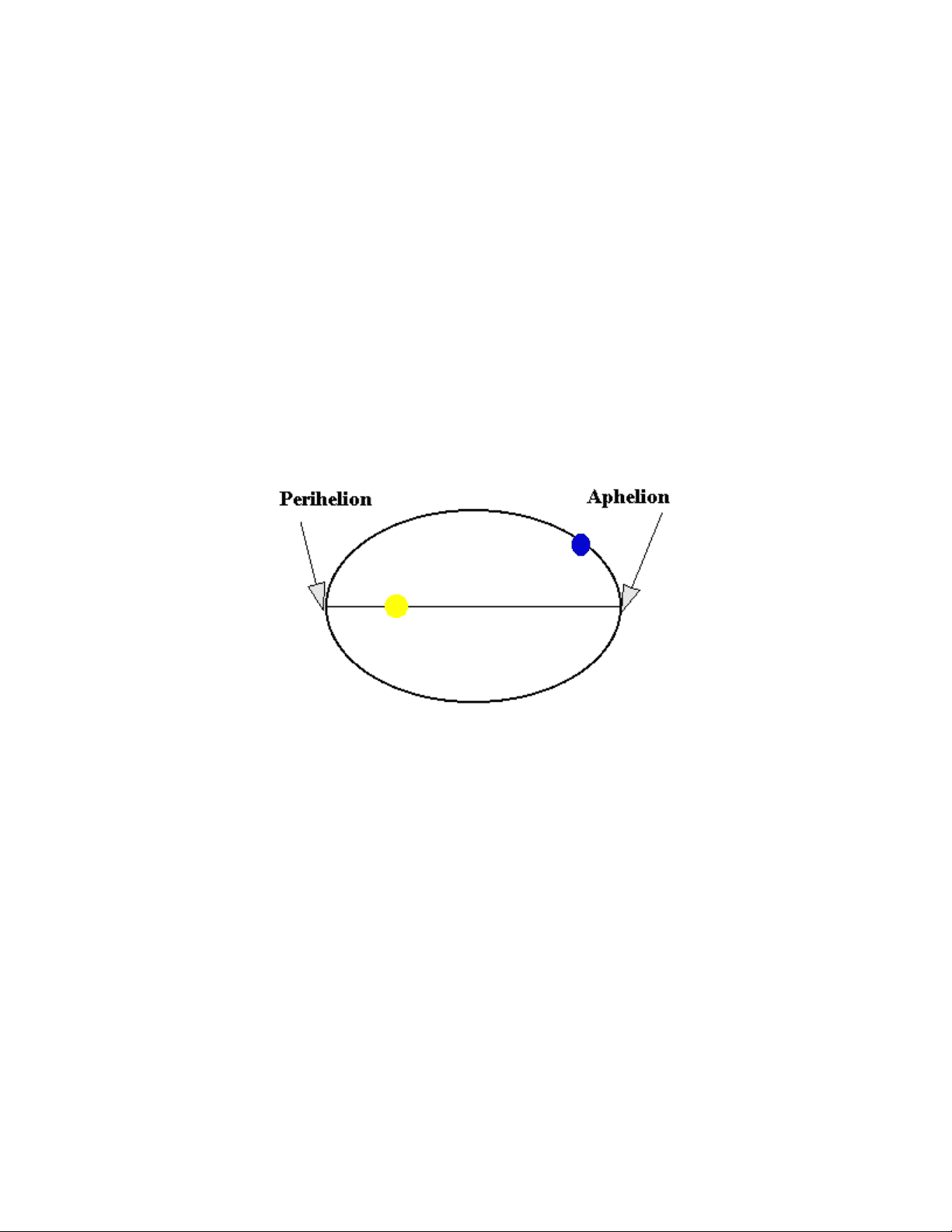
A Planet’s Orbit:
Perihelion – closest point to the sun
Aphelion – furthest point from the sun
-Distance from perihelion to aphelion = major axis = 2a
- Semi-major axis = half of the major axis (a)
- Remember Kepler’s 3rd law:
32
aP
- P is the period in years, a is the semi-major axis in astronomical units (A.U.)
- Label the major axis, the semi major axis on the drawing above.
- Note that the sun is actually a lot closer to the center of the ellipse than shown,
and that the Earth’s orbit is not that elliptical.
pf3
pf4
pf5

Partial preview of the text

Download Astronomy: Planets and Comets Orbits and more Study notes Astronomy in PDF only on Docsity!

Note:

  • Lab is in the Computer Lab this week – turn right after you come in the main doors, turn left at the end of the hall. It’s room 1220.

A Planet’s Orbit: Peri helion – closest point to the sun Ap helion – furthest point from the sun

  • Distance from perihelion to aphelion = major axis = 2a
  • Semi-major axis = half of the major axis (a)
  • Remember Kepler’s 3rd^ law: P^2  a^3
  • P is the period in years, a is the semi-major axis in astronomical units (A.U.)
  • Label the major axis, the semi major axis on the drawing above.
  • Note that the sun is actually a lot closer to the center of the ellipse than shown, and that the Earth’s orbit is not that elliptical.

A Comet’s Orbit – Shoemaker-Levy 9 Peri jove – point closest to Jupiter Apo jove – point furthest from Jupiter

  • A comet’s orbit is much more elliptical than that of a planet’s. Note that they revolve around the sun and not Jupiter! This one got trapped around Jupiter because it came too close to the giant planet, which has a lot of gravitational pull.
  • Shoemaker-Levy 9 was a comet that was torn apart by Jupiter’s gravity as a result of a very close approach in 1992. It was broken into at least 21 separate fragments which were dispersed several million kilometers along its orbit.
  • Between 16 July 1994 and 22 July 1994 the fragments impacted the upper atmosphere of Jupiter.
  • Fragment A struck Jupiter with its kinetic energy equivalent to about 225, megatons of TNT creating plume which rose about 1000 km above the Jovian cloudtops. (2nd^ movie)

Midterm # Midterm 1 Distribution 0 2 4 6 8 10 12 14 90s 80s 70s 60s 50s 40s Grade Number Overall class average: Section average: 75. Re-grade procedures:

  1. Read the question – did you really answer the question that was asked?
  2. Read the solutions posted in the glass case near the lab room.
  3. On a separate piece of paper, write the question number and state why you think you deserve more credit.
  4. Attach paper to exam and give to Mrs. Deming in lecture Thursday, Mar 9 , no late re-grades will be accepted. Most Common Multiple Choice Mistakes : Some of these questions will show up on the final!! Question Answer White Blue Green Yellow Didn’t see new or full crescent is large b/c Venus is closer B 7 4 7 5 Use pointers (C+D) in big dipper to find polaris at end of handle of little dipper B 8 25 20 6 Video – winter solstice sun shines through hallway as rising A 9 7 3 7 All planets formed in flat disk, but those near forming sun were hearted, no ices condensed B 11 23 18 9 Skywatches mentioned Saturn, Mars, Saturn again, Jupiter, Venus, and Mercury – all 5 D 17 2 22 19 Effect of synchronous rotation – same side of moon always faces earth, so if you see “earth” it’s always in the sky at the same place C 19 8 10 21 If only gravity – it would fall, but it is in motion while it is falling. For every 1 km it goes forward A 21 6 9 23

it falls 0.14 cm The Greenhouse Effect: (this might be on the next test)

  1. Visible Sunlight goes through atmosphere to surface.
  2. Ground absorbs light, re-emits the light as Infrared Radiation (IR).
  3. IR is absorbed + re-emitted by the greenhouse gases, does a random walk , which keeps it in our atmosphere and close to the surface.
  • Primary Greenhouse gas: o Earth: H20 – water vapor o Venus: CO2 – carbon dioxide