
Conceptual Questions: Geometric Optics - Physics 2B, Exams of Physics

A set of conceptual questions related to geometric optics from a physics 2b course. The questions cover topics such as refraction, reflection, dispersion, and total internal reflection. Students are required to identify the correct answer or response for each question based on diagrams and given information.

Typology: Exams

Pre 2010

Uploaded on 07/30/2009

koofers-user-v3r-1
koofers-user-v3r-1 🇺🇸

9 documents

1 / 4

Toggle sidebar

This page cannot be seen from the preview

Don't miss anything!

bg1
Physics 2B 12/6/2020
Name______________
Conceptual Questions: Geometric Optics
Circle the best answer or write the appropriate response
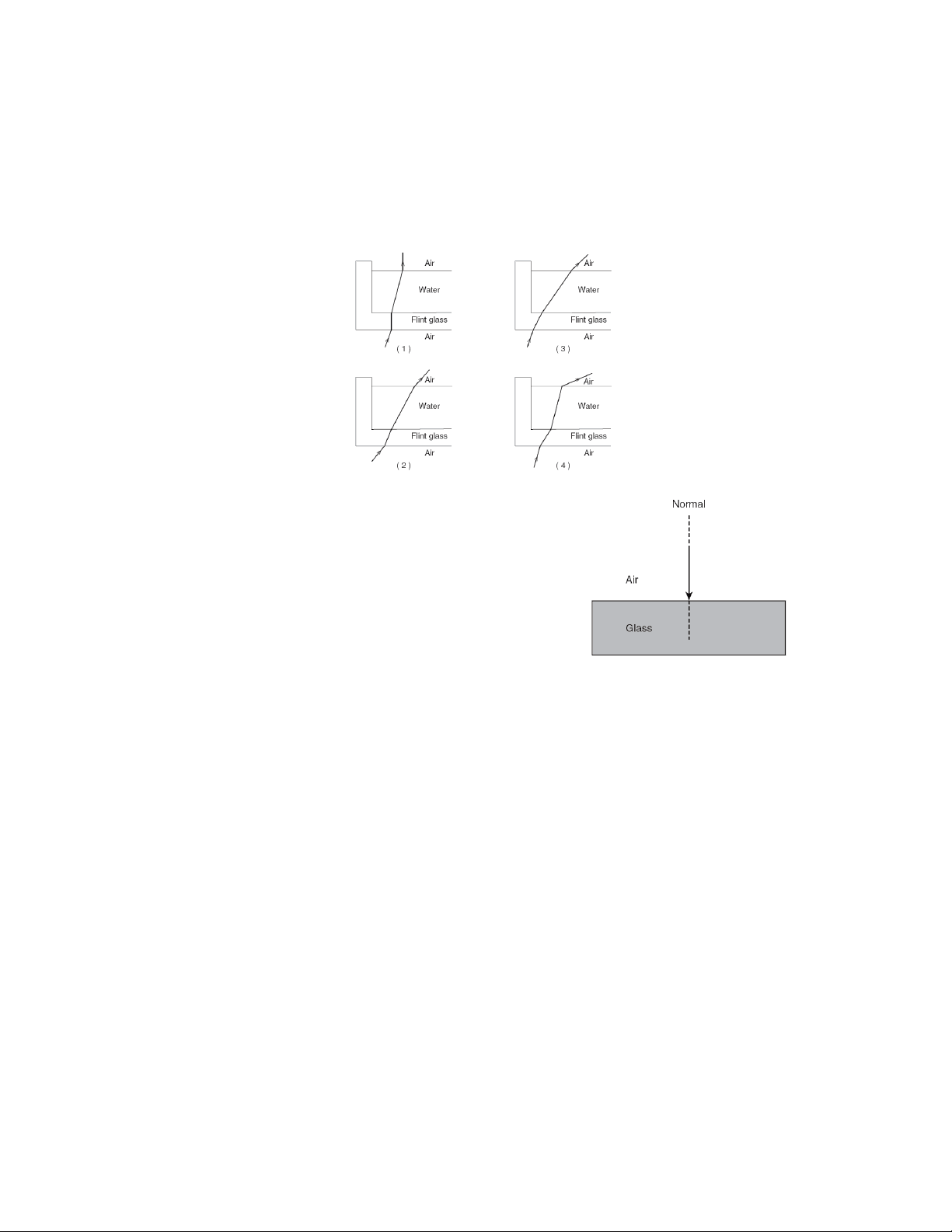
1. Which diagram best represents the path taken by a ray of monochromatic light as it passes from air
through the materials shown?
2. The diagram below shows a ray of light passing from air into
glass at an angle of incidence of 0°.
A. Only the speed changes.
B. Only the direction changes.
C. Both the speed and the direction change.
D. Neither the speed nor direction change.
3. A diverging lens of focal length f is placed is placed in water. The magnitude of the focal length of the lens
in water is ____________ the focal length in air.
A. less than
B. greater than
C. same as
D. infinite compared to
4. When light of one wavelength from air hits a smooth piece of glass at an angle, which of the following will
not occur?
a. reflection b. refraction c. dispersion d. All of the above will occur.
5. When an astronomer uses a telescope to view events on a star that is 1000 light years away, this means
that
A. the astronomer is viewing events that are 1000 years into the future.
B. the astronomer is viewing events that are 2000 years into the future.
C. the astronomer is viewing events that are 1000 years into the past.
D. the astronomer is viewing events that are 2000 years into the past.
6. A handful of white sand-like material is poured into a beaker of clear oil and vanishes from sight as it
passes into the liquid. We can conclude that
A. the material dissolved.
B. This phenomenon is impossible and could not have happened.
C. The oil and material have mutually decomposed.
D. The oil has the same index of refraction as the material.
E. None of the above.
1
pf3
pf4

Partial preview of the text

Download Conceptual Questions: Geometric Optics - Physics 2B and more Exams Physics in PDF only on Docsity!

Name______________

Conceptual Questions: Geometric Optics

Circle the best answer or write the appropriate response

  1. Which diagram best represents the path taken by a ray of monochromatic light as it passes from air through the materials shown?
  2. The diagram below shows a ray of light passing from air into glass at an angle of incidence of 0°. A. Only the speed changes. B. Only the direction changes. C. Both the speed and the direction change. D. Neither the speed nor direction change.
  3. A diverging lens of focal length f is placed is placed in water. The magnitude of the focal length of the lens in water is ____________ the focal length in air. A. less than B. greater than C. same as D. infinite compared to
  4. When light of one wavelength from air hits a smooth piece of glass at an angle, which of the following will not occur? a. reflection b. refraction c. dispersion d. All of the above will occur.
  5. When an astronomer uses a telescope to view events on a star that is 1000 light years away, this means that A. the astronomer is viewing events that are 1000 years into the future. B. the astronomer is viewing events that are 2000 years into the future. C. the astronomer is viewing events that are 1000 years into the past. D. the astronomer is viewing events that are 2000 years into the past.
  6. A handful of white sand-like material is poured into a beaker of clear oil and vanishes from sight as it passes into the liquid. We can conclude that A. the material dissolved. B. This phenomenon is impossible and could not have happened. C. The oil and material have mutually decomposed. D. The oil has the same index of refraction as the material. E. None of the above.
  1. Two plane mirrors are separated by 120o^ as shown below. If a ray strikes M 1 at 65o, at what angle, q, does the light leave M 2? A. 25 o B. 55 o C. 65 o D. 130 o
  2. A ray of light strikes a mirror at 45o^ with respect to the normal to the mirror. The mirror is then rotated by 15 o^ while the angle of the incident ray is kept fixed. Through what angle does the reflected ray rotate? Hint-Draw a picture and ray diagram. A. 15 o B. 30 o C. 45 o D. 90 o
  3. A boundary separates two media of absolute refractive indices n 1 and n 2 , where n 1 > n 2. Check the two boxes that indicate the two conditions required for total internal reflection to take place.
  4. You are given two lenses, a converging lens with focal length + 10 cm and a diverging lens with focal length 20 cm. Which of the following would produce a virtual image that is larger than the object? A. Placing the object 5 cm from the converging lens. B. Placing the object 15 cm from the converging lens. C. Placing the object 25 cm from the converging lens. D. Placing the object 15 cm from the diverging lens. E. Placing the object 25 cm from the diverging lens.
  5. True or False : Light and radio waves travel at the same speed through a vacuum.
  6. True or False : The index of refraction of water is the same for all wavelengths in the visible spectrum.
  7. A ray of light passes from glass into air, striking the surface at a 20o^ angle of incidence. Of the following quantities, choose all that change as the light enters the air. If none change, write \none". A. Wavelength B. Frequency C. Propagation speed D. Propagation direction Incident light must be in material of refractive index n 1 Incident light must be in material of refractive index n 2 Incident light must strike the boundary at an angle greater than the critical angle c Incident light must strike the boundary at an angle less than the critical angle c 65 o

M 1

M 2

n 1 n 2

  1. Myopic (nearsighted) persons sometimes claim to see better underwater without corrective lenses. Why? A. The accommodation of the eye lens is better under water. B. Refraction at the water cornea interface is less than that of the air-cornea interface. C. Refraction at the water cornea interface is greater than that of the air-cornea interface. D. No reason; this effect is only an illusion and not really true.
  2. A nearsighted person wears a corrective lens and would like to examine an object at close distance. Which statement is correct? A. The corrective lenses give an enlarged image and should be worn while examining the object. B. The corrective lenses give a reduced image and should be removed. C. The corrective lenses result in a magnification of unity; it does not matter whether they are worn or removed.
  3. A scientific supply catalog advertises a material having an index of refraction of 0.85. Is this a good product to buy? A. Yes B. No C. Not enough information provided.
  4. Chromatic aberrations is a common defect of A. concave and convex lenses. B. concave lenses only. C. convex and concave mirrors. D. All lenses and mirrors.
  5. We wish to set up an eye test in a rather modest sized office and so must use a plane mirror to get the full distance required to charge C. If the observer is a distance d=14.0ft from the mirror M (of height H), the distance, s, is 6.0ft and the chart is h=2.0ft wide what is the minimum required width of the mirror? Hint- use similar triangles. A. 0.60ft B. 0.80ft C. 1.0ft D. 1.20ft E. 1.4ft

Chart, C

Chart Image, C’

M

Eye d

s

h