Download Pulse-Chase Primer and more Lecture notes Cellular and Molecular Biology in PDF only on Docsity!
Pulse-Chase Primer
What is a pulse-chase experiment?
A pulse-chase experiment is a two-phase technique used to examine cellular processes that take place over a period of time.
During the pulse phase of the experiment, cells are exposed to a labeled compound. The labeled compound is incorporated into the molecule or pathway being studied.
In the chase phase, an unlabeled form replaces the labeled compound. The reaction is monitored to see how long it takes the labeled form of the compound to be replaced by the unlabeled form.
There are many ways to label a compound for use in a pulse-chase experiment. Radioisotopes or fluorescent labeling using compounds such as green fluorescent protein (GFP) are both popular. _________________________________________________________________________________
Classic Pulse-Chase Experiment
In the 1950s, James Watson and Francis Crick suggested a mechanism for the replication of DNA. During replication, each of the two strands of DNA would act as a template for the synthesis of a new strand. The two new DNA molecules would consist of one strand from the original molecule and a newly synthesized strand. This was called the “Semiconservative Model of Replication.”
At the time, there were three replication models being considered. The models were:
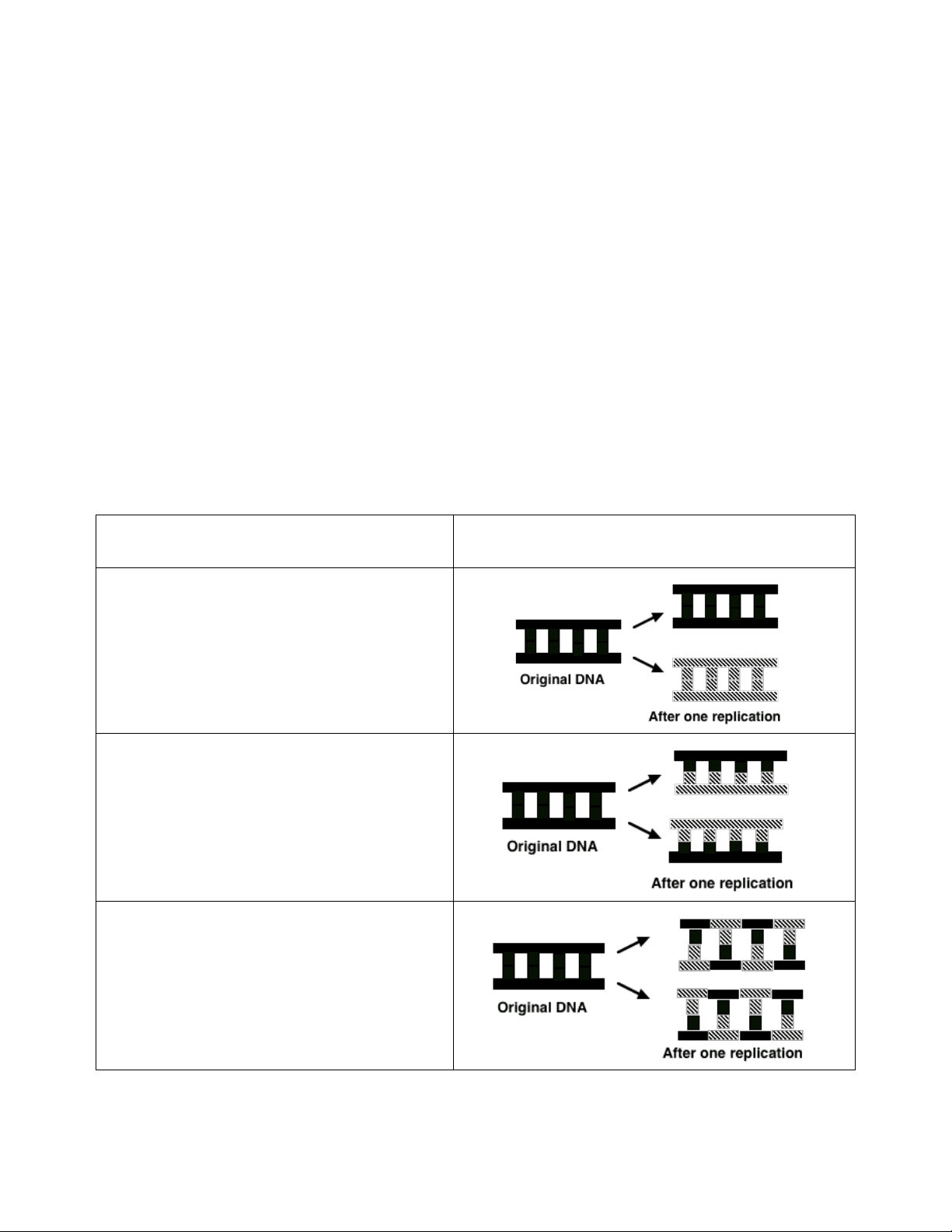
Type of Replication Composition of DNA Molecules Before and After Replication
(a) Conservative Replication – the original DNA molecule remains intact and a new DNA molecule is synthesized that contains no part of the original. It is a completely new molecule.
(b) Semiconservative Replication – each of the two DNA molecules is composed of one strand from the original molecule and one newly synthesized strand.
(c) Dispersive Replication – each of the two DNA molecules is composed of sections of the original DNA and newly synthesized DNA randomly interspersed along each strand.
In 1958 Matthew Meselson and Franklin Stahl conducted their now famous pulse-chase experiment to determine which of these three models was correct.
The key to their experiment was the use of the non-radioactive isotopes nitrogen ( 14 N and 15 N) in the media for growing E. coli bacteria. As E. coli reproduced, new DNA molecules were synthesized incorporating these isotopes. Those E. coli grown in the presence of 15 N created “heavy” DNA. After many generations, all of the DNA in the culture was heavy. Those grown in the presence of 14 N produced “light” DNA and after many generations, all of the DNA in the culture was light.
Meselson and Stahl took samples from each culture, extracted the
DNA, mixed equal amounts together, and centrifuged the mixture. The light and heavy DNA separated. Molecules of different weight accumulated at different depths. The heavy DNA formed a band lower in the mixture than the light DNA. The difference in density of the DNA was enough to allow it to separate. (See Figure 1: Result of centrifugation of light and heavy DNA)
Using this technique, Meselson and Stahl grew E. coli on a medium containing 15 N for many generations. This ensured that all of the DNA would be labeled with 15 N. As the bacteria grew and reproduced, they incorporated the 15 N isotope. This was the pulse phase of the experiment. Meselson and Stahl next took some of these bacteria, prepared the DNA as before, and centrifuged it. Because all of the DNA was labeled with 15 N, a single band was formed. This is “Generation Zero.”
- Using Figure 1 as a reference, indicate the location of the band for heavy DNA in Generation Zero in the centrifuge tube represented below.
Next, the bacteria with heavy DNA were moved to a culture medium containing 14 N. This step marks the beginning of the chase phase of the experiment.
After 20 minutes (the time it takes for E. coli to grow and produce the next generation), a sample was prepared for centrifugation. This was identified as “Generation One.” Another sample was taken after the next 20 minutes had passed. This was “Generation Two”, and so on.
- Using the tube on the left as the standard, sketch where the bands of DNA would collect in the tubes for Generations Zero, One, and Two if DNA replication is semiconservative.
- Using the key provided in question 2 illustrate the location of light and heavy isotopes of nitrogen in the stands of DNA in Generations Zero, One, and Two if DNA replication is conservative.
- In the tubes below, illustrate the banding patterns Meselson and Stahl would have observed if the results of their experiment supported the conservative model of DNA replication.
- Using the key provided in question 2, illustrate the location of light and heavy isotopes of nitrogen in the stands of DNA in Generations Zero, One, and Two if DNA replication is dispersive.
Modern Pulse-Chase Experiment
Researcher Dr. Douglas Melton of Harvard University and his colleagues performed an experiment to determine the source of new pancreatic beta (β) cells in adult mammals. β cells produce insulin, a hormone that is necessary to maintain the appropriate level of glucose in the blood. During an individual’s lifetime, β cells die and are replaced with new β cells. A minimal number of β cells is necessary to maintain homeostasis. If β cells are damaged or do not function properly, too much glucose accumulates in the blood and does not enter the cells where it is needed for metabolic processes. Homeostasis is disrupted. In general, a person unable to maintain appropriate blood glucose levels is identified as a diabetic.
Dr. Melton wanted to know if β cells in the pancreas are replaced through:
(1) the mitotic cell division of existing β cells
(2) the differentiation of adult stem cells located either in the pancreas or the bone marrow
(3) a combination of stem cell differentiation and the mitotic division of existing β cells.
Like Meselson and Stahl, Dr. Melton was looking for one of three distinctly different outcomes. He also designed a pulse-chase experiment. He used mice as a model system because they have pancreatic β cells like us. Before starting the experiment, however, there were other components of a pulse-chase experiment Dr. Melton and his colleagues had to consider.
- In addition to a model organism, what else did Dr. Melton’s team need to have in place so that they would be able to determine how β cells are replaced? Support your answer.