Download Introduction to Quantum Mechanics: Why Quantum Mechanics? and more Lecture notes Physics in PDF only on Docsity!
Quantum Mechanics: Introduction
Why Quantum Mechanics?
The first question a student of quantum mechanics might ask is "why do I need quantum
mechanics?" Let us first address this question. For this we have to see whether the
Newton’s Laws of Motion are sufficient to describe everything. If we want to describe the
motion of objects, we use Newton’s equations. A better word to describe the formalism of
Newton’s laws is classical mechanics - we will use this term to follow convention.
Now if one wants to describe the motion of planets around the sun, one knows that one
has to write the Newton’s equation taking into account the garvitational force between the
sun and a planet. Given the initial postion and velocity (or momentum) of the planet, one
can calculate its position and velocity at any future time. What about something smaller
than that? Well, classical mechanics can also be used to describe the motion of a football,
a cricket ball, a table-tennis ball. It can also be used to describe the motion of tiny bullets
fired from an air-gun. The question arises, can classical mechanics describes paticles of
any size? What about dust particles, molecules, atoms, electrons?
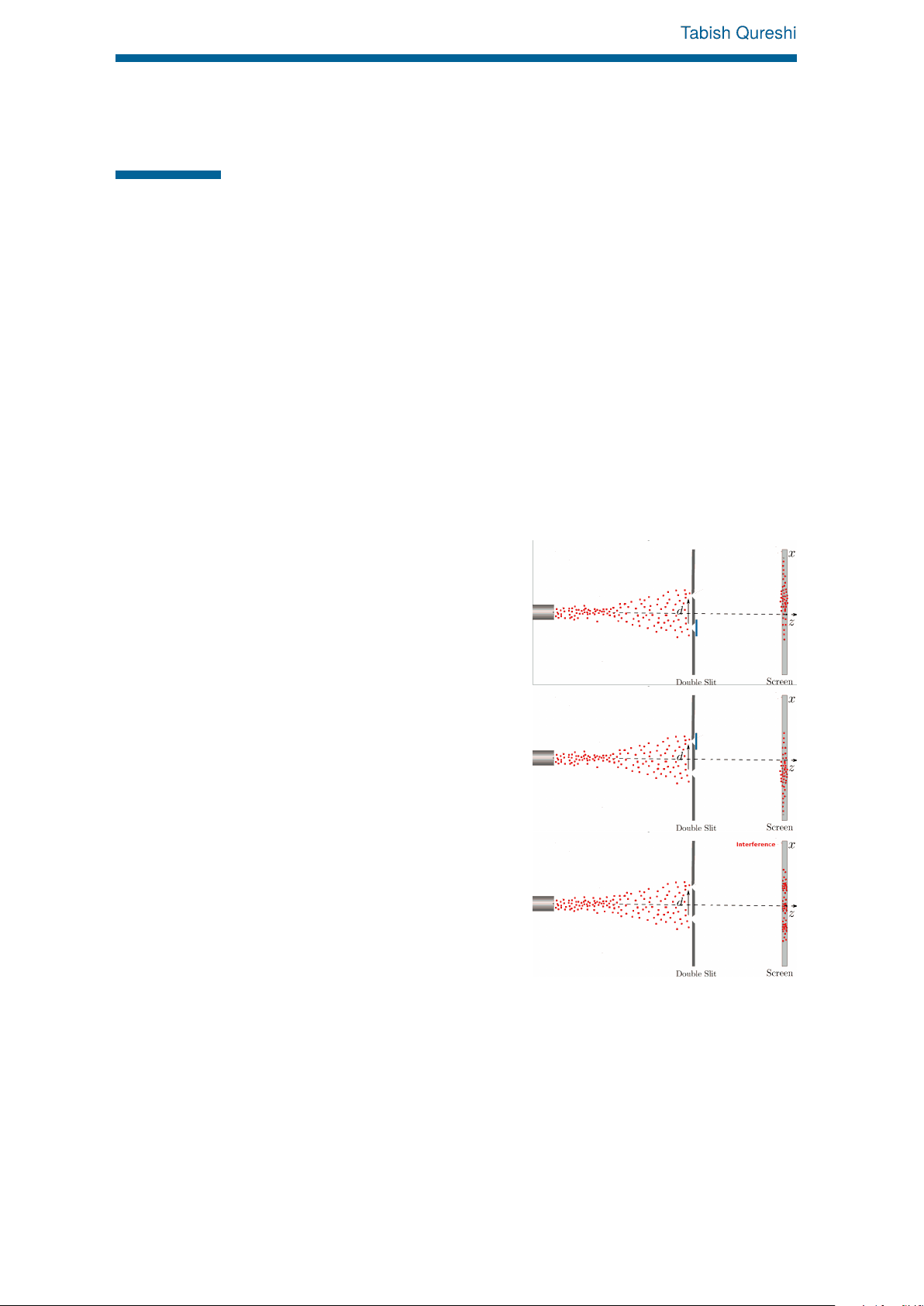
A two-slit experiment with electrons.
To answer this question we consider a gedanken ex-
periment (thought experiment) with tiny bullets. Sup-
pose that we have an air-gun which can fire tiny bullets
onto a screen kept a large distance away. The air-gun,
like all other guns, is not hundred percent accurate.
One bullet fired in the same direction may go slightly
away from another one fired in exactly the same direc-
tion. If one fires, say, a hundred bullets on the screen
- all of them will not hit the screen at the same spot.
One would rather see a spread out blob on the screen.
Now suppose one keeps an screen-like obstacle in
between the gun and the screen, which has two holes.
If one of the holes is blocked, the only bullets which
are able to pass through the open hole, and one would
see a blob on the screen at a point in line with the gun
and the open hole. If one opens the second hole and
closes the first one, one gets a blob on the screen at
a spot in line with the second hole and the gun.
If now one opens both the holes and again fires lots
of bullets, one would see a double blob which will just
be the sum of the two blobs obtained in the previous
cases. You might say that this is expected because
if the bullet goes through one hole, it will land some-
where in the first blob, and if it goes through the second hole, it will land up in the second
blob. There is nothing new happening here. Quite true - this is all trivial stuff.
Electron diffraction
Two clever scientists, Davisson and Germer tried to repeat this experiment, not with bullets,
but with electrons. And they found a weird phenomenon. They found that if either of the
two holes is closed, one gets a blob as in the case of bullets, but when both the holes are
open one gets a pattern which looks like a long array of blobs. This pattern is not just the
sum of the patterns obtaines with only one holes open. This is the most amazing thing
one would have ever seen in nature. Trying to visualize what must be happening, one
imagines that an electron fired from the electron gun passes through one of the two holes,
and should behave as if only that hole was open. So, the net pattern should be a sum of
the two patterns with only one hole open. But this does not happen, which can only mean
one of the two things. One, that the electron passes through only one hole, but somehow
knows that the other hole is open. Second, the electron somehow passes through both the
holes simultaneously.
Both these possibilities sound very strange, but that is exactly how nature is seen to work.
So, one observes that laws of classical mechanics fail when dealing with electrons. Infact,
they mostly fail when applied to particles as tiny as atoms, molecules and subatomic
particles.. So there must be new laws of motion which govern the behaviour of electrons. It
turns out that these new laws governing the dynamics of atomic scale particles constitute
quantum mechanics.
The reader might have noticed a similarity between this experiments with electrons and the
Young’s double-slit experiment that one does with light. There one gets exactly the same
pattern as with electrons through the two holes. Light shows this behaviour because of its
wave nature. So, the electrons seem to behave like waves.
Photoelectric effect
Let us look at another phenomenon which was observed. Here one looks at a vacuum
tube in which one of the electrodes is coated with a metal which can emit electrons if light
falls on it.
V
A
B
S
P
R
Lamp
Filter
Reverse-biased arrangement for studying
photo-electric effect.
One observes that if one shines light of low
frequency, say infra-red, no electrons are
emitted and hence no current flows. One
can try to increase the intensity of light to any
extent, but still no electrons are ejected. But
for light of higher frequency, say blue color,
the electrons are emitted and a current flows,
even if the intensity is low.
Now the energy of a wave is basically its
intensity. The experiment here shows that
light is not behaving like a wave, because higher intensity is not able to kick out electrons.
On the other hand if we imagine that light is made up of particles, which we can call photons ,
whose energy is ℎ휈, where 푣푢 is the frequency of light, one can easily understand the
results of this experiment. Higher frequency lights is made up of particles which have
higher energy, and so are able to kick out electrons. And if the energy of these photons
is less than the energy needed to kick out an electron, no electron will be emitted, no
matter how many photons one throws at the metal surface. What does this mean? This
means that in this experiment, light which is considered normally to be a wave, behaves
like particles.
where 푘 is the wave vector, 휔 is the frequency and 휓(푥) represents the displacement of
whatever is oscillating. For a wave on a stretched string, 휓(푥) denotes the amount by
which the string is pulled up, at the position 푥. For a wave generated in a water puddle,
휓(푥) denotes the height of the surface of water at the point 푥. In our theory we do not
know what is it that is oscillating, but we know that there is some kind of a wave. So, let us
start with that.
Now, de Broglie told us that for a particle with momentum 푝, there is a wave associated
which has a wavelength 휆 = ℎ/푝. We know that the wave vector is related to the wavelength
by the relation 푘 = 2 휋/휆. Using this we can write write 푘 =
2 휋푝
ℎ
. Here we introduce another
constant \ = ℎ/ 2 휋, and use it to write 푘 = 푝/. Now we have momentum in the expression,
which is what we like because a particle is expected to have quantities like momentum and
position. Now the expression for the wave (1), takes the form
휓(푥) = exp
\
(2)
So, what do we do with this expression? Let us differentiate it with respect to 푥, which
gives us
\
푝 exp
\
\
Equation (3) indicates that −푖\
휕
휕푥
plays the role of 푝. To put it more precisely,
푝 → −푖\
which indicates that in our new theory, 푝 is like an operator which acts on the function
휓(푥). We will see later that this observation is of great importance in quantum mechanics.
Let us now differentiate (2) with respect to 푡, because it is also a function of time. This
yields
=−푖휔 exp
\
What do we do with 휔? We remember that photons, particles of light have energy 퐸 =
ℎ휈 = \휔. So, we can write 휔 = 퐸/. Now that we are dealing with particles, the energy
has to be a sum of potential energy and kinetic energy. This leads us to write
\
2
(6)
where 푝
2 / 2 푚 denotes the kinetic energy and 푉(푥) represents the potential energy. Using
(6), equation (5) takes the form
\
2
or,
푖\
2
Let us use equation (4) which says that 푝 = −푖\
휕
휕푥
, so that (8) becomes
푖\
\
2
2
2
Equation (9) is known as Schrödinger equation, and is the basic equation of quantum
mechanics. This was first constructed by Erwin Schrödinger. It describes how the wave
function 휓(푥) changes with time, for a particle of mass 푚 in a potential 푉(푥).
What does 휓 represent?
From the preceding analysis we conclude that quantum objects act like waves, and the
entity which appears to oscillate is the wave function 휓(푥). But what does 휓 represent, one
might ask? In different kinds of waves that we know of, there are different entities which
oscillate. In a wave on a stretched string, what oscillates is the displacement of the string
in the transverse direction. In the waves on the surface of water, we know that if a leaf falls
on the surface, it oscillates. So what oscillates is the surface displacement of the water
surface from its mean position. In sound waves, it is the density of air which oscillates,
leading to compression and rarifaction. In electromagnetic waves, it is the electric and
magnetic field which oscillates. So, what oscillates in our quantum wave? This question
confounded people when quantum theory was being formulated. The Schrödinger equation
(9) is complex, and in general it admits complex solutions. So, 휓(푥, 푡) is in general complex,
and hence cannot represent a measurable quantity which should be real.
Max Born came up with a solution to this problem. He proposed that 휓(푥, 푡) itself has
no meaning, but |휓(푥, 푡)|
2 푥 = 휓
∗ (푥, 푡)휓(푥, 푡)푑푥 represents the probability of finding the
particle at position 푥, at a time 푡. This interpretation of the wave-function is known as the
Born interpretation , and is known to hold good till now.