Recursion - Data Structures - Lab, Exercises of Data Structures and Algorithms

Some concept of Data Structures are Data Structures, Dynamic Programming, First-In-First-Out, Implementation, Python Code. Main points of this lecture are: Recursion, Binary Heap, Non-Intuitive, Complete Binary Tree, Heap-Order, Node, General Idea, Swapping, Violates, Parent

Typology: Exercises

2012/2013

Uploaded on 04/30/2013

naji
naji 🇮🇳

4.3

(6)

87 documents

1 / 1

Toggle sidebar

This page cannot be seen from the preview

Don't miss anything!

bg1
Objective: To understand recursion by writing simple recursive solutions.
To start the lab: Download and unzip the file at:
Part A: Complete the recursive searchHelper function in the search method of our OrderedList class
in ordered_linked_list.py. Test it with the listTester.py program.
Raise your hand when done. Demonstrate and explain your code to an instructor or TA.
Part B: Recall that Lecture 7 and Section 6.6 discussed a very “non-intuitive”, but powerful list/array-based
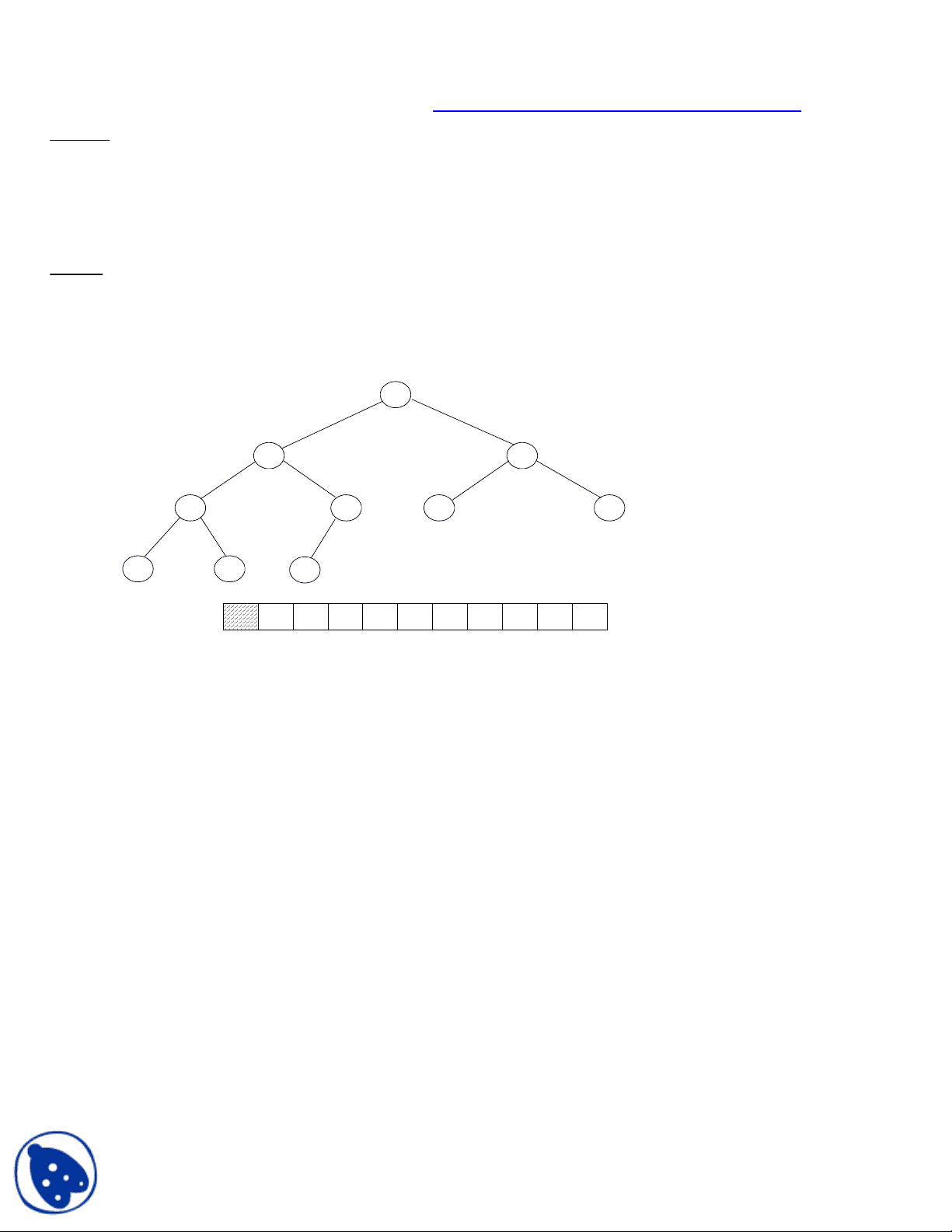
approach to implement a priority queue, call a binary heap. The list/array is used to store a complete binary tree
(a full tree with any additional leaves as far left as possible) with the items being arranges by heap-order
property, i.e., each node is either of its children. An example of a min heap “viewed” an a complete binary tree
would be:
6
15 10
114 20 50
20
300 125 117
[1]
[2] [3]
[4] [5] [6] [7]
[8] [9] [10]
1 2 3 4 5 6 7 8 9 100
not
used 6 15 10 114 20 20 50 300 125 117
Python List actually used
to store heap items
Recall the General Idea of insert(newItem):
append newItem to the end of the list (easy to do, but violates heap-order property)
restore the heap-order property by repeatedly swapping the newItem with its parent until it percolates up to the
correct spot
Recall the General Idea of delMin():
remember the minimum value so it can be returned later (easy to find - at index 1)
copy the last item in the list to the root, delete it from the right end, decrement size
restore the heap-order property by repeatedly swapping this item with its smallest child until it percolates
down to the correct spot
return the minimum value
Originally, we used iteration (i.e., a loop) to percolate up (see percUp) and percolate down (see percDown) the
tree. Now I want you to complete the recursive percUpRec and recursive percDownRec methods in
binHeap.py. Run this file to test your code.
Raise your hand when done. Demonstrate and explain your code to an instructor or TA.
If you have extra time, work on homework #3!
Data Structures (CS 1520) Lab 5 Name:_________________
Lab
5 -
1
Docsity.com

Partial preview of the text

Download Recursion - Data Structures - Lab and more Exercises Data Structures and Algorithms in PDF only on Docsity!

Objective: To understand recursion by writing simple recursive solutions.

To start the lab: Download and unzip the file at:

Part A: Complete the recursive searchHelper function in the search method of our OrderedList class in ordered_linked_list.py. Test it with the listTester.py program.

Raise your hand when done. Demonstrate and explain your code to an instructor or TA.

Part B: Recall that Lecture 7 and Section 6.6 discussed a very “non-intuitive”, but powerful list/array-based approach to implement a priority queue, call a binary heap. The list/array is used to store a complete binary tree (a full tree with any additional leaves as far left as possible) with the items being arranges by heap-order property , i.e., each node is ≤ either of its children. An example of a min heap “viewed” an a complete binary tree would be:

6

15 10

(^114 20 )

300 125 117

[1]

[2] [3]

[4] [5] [6] [7]

[8] [9] (^) [10]

0 1 2 3 4 5 6 7 8 9 10 Python List actually used usednot 6 15 10 114 20 20 50 300 125 117 to store heap items

Recall the General Idea of insert(newItem):

 append newItem to the end of the list (easy to do, but violates heap-order property)  restore the heap-order property by repeatedly swapping the newItem with its parent until it percolates up to the correct spot

Recall the General Idea of delMin():

 remember the minimum value so it can be returned later (easy to find - at index 1)  copy the last item in the list to the root, delete it from the right end, decrement size  restore the heap-order property by repeatedly swapping this item with its smallest child until it percolates down to the correct spot  return the minimum value

Originally, we used iteration (i.e., a loop) to percolate up (see percUp) and percolate down (see percDown) the tree. Now I want you to complete the recursive percUpRec and recursive percDownRec methods in binHeap.py. Run this file to test your code.

Raise your hand when done. Demonstrate and explain your code to an instructor or TA.

If you have extra time, work on homework #3!

Data Structures (CS 1520) Lab 5 Name:_________________

Docsity.com^ Lab^ 5 -^1